

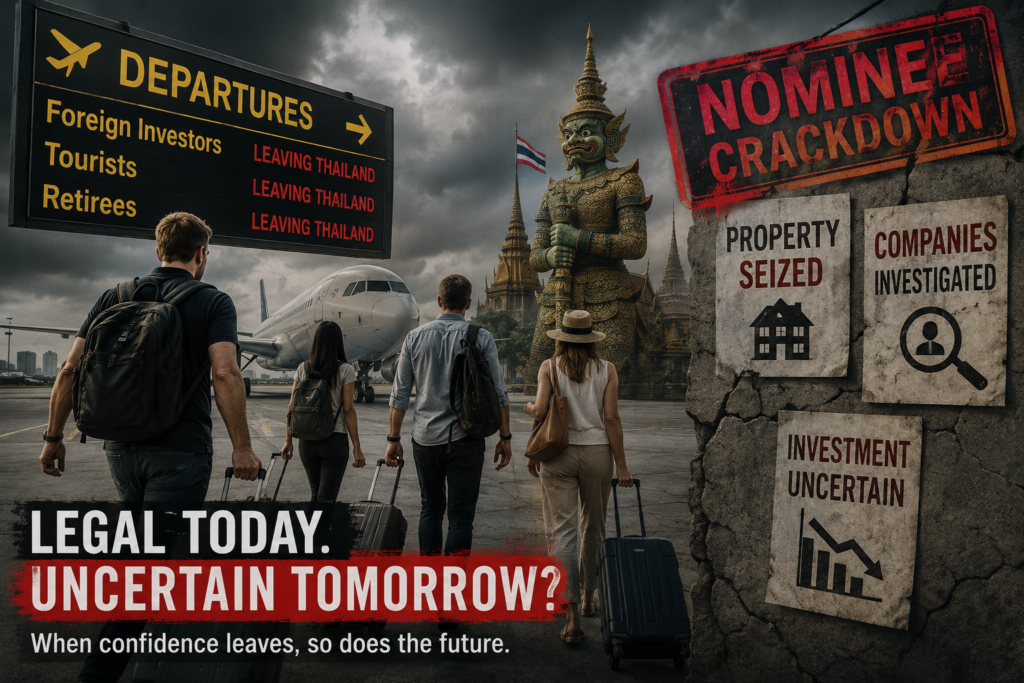
 Thailand’s Nominee Crackdown a Clear Legal Case with Economic Consequences. Thailand is fully entitled to enforce its laws on foreign ownership and nominee shareholding.
Thailand Has the Right to Enforce Its Laws
That is not the issue.
The real question is whether a crackdown carried out after decades of inconsistent enforcement could create economic, reputational and tourism damage far beyond the companies and properties directly investigated.
How the Market Developed
Although nominee structures have been prohibited since the Foreign Business Act entered into force in 1999, the intensity of enforcement varied considerably over the following twenty-five years. During that period, a widespread market practice emerged in which foreign purchasers acquired luxury villas through Thai companies using structures arranged by lawyers, accountants, developers and corporate-service providers. Companies were incorporated by the authorities, land transfers were registered, taxes and official fees were paid, properties were financed, occupied, rented and resold. As a result, many foreign investors came to believe that these structures, while technically unlawful, represented an accepted commercial practice rather than a serious enforcement risk.
Market Perception Became Economic Reality
Whether that perception was legally correct is ultimately beside the point. The perception itself became part of the market. Buyers made investment decisions, developers built projects, banks financed transactions and professional advisers structured acquisitions on the assumption that, provided the arrangements remained discreet, the likelihood of regulatory intervention was relatively low. It is this long-established expectation that makes the current enforcement campaign economically significant.
A Legally Correct Commercial Disaster
That distinction matters.
A government can be legally correct and still create a commercial disaster if enforcement is introduced without considering the expectations that its own administrative system allowed to develop.
The First Damage is Already Visible
Foreign buyers are reportedly postponing luxury villa purchases in Phuket and Koh Samui because of the crackdown. At the same time, the Department of Business Development has identified thousands of companies with foreign participation in Phuket, Koh Samui and Koh Phangan for closer examination.
The economic impact therefore begins long before any court orders, confiscations or criminal convictions.
Investment decisions are based on confidence. Once confidence begins to disappear, capital simply waits—or goes elsewhere.
Thailand is fighting several battles at the same time
The nominee crackdown is taking place at a difficult moment.
Thailand is already facing increasing competition from Vietnam, Malaysia, Indonesia and other regional destinations for tourists, retirees, digital entrepreneurs and long-term foreign residents.
Thailand welcomed approximately 33 million international visitors in 2025, but this represented a decline from the previous year, while Vietnam recorded more than 21 million visitors, the highest figure in its history and an increase of over 20%.
Vietnam has also become increasingly attractive through easier visa policies, major infrastructure investments, competitive pricing and rapidly developing coastal destinations.
The issue therefore is not simply nominee companies.
The issue is cumulative.
A wealthy investor looking at Southeast Asia today does not evaluate each regulation separately. He looks at the overall investment environment.
He sees:
- changing visa policies;
- increasing immigration uncertainty;
- restrictions on business ownership;
- inability to own land directly;
- investigations into ownership structures previously marketed as common practice;
- uncertainty regarding long-term property rights.
At the same time, neighbouring countries are actively trying to make themselves easier—not harder—to invest in.
The international headlines will not explain Thai company law
Imagine the following headline:
“Chinese investor loses USD 3 million Phuket villa in nominee company investigation.”
Or:
“American retiree forced to surrender Samui home after ownership investigation.”
The legal explanation may be entirely correct.
The property may indeed have been held through an unlawful nominee arrangement.
But that will not be the story that travels around the world.
The story that international investors may hear is much simpler:
Thailand can take back your house.
Whether that conclusion is legally accurate is almost irrelevant.
Markets react to perception.
And perception spreads much faster than legal analysis.
Property owners are much more than property buyers
A wealthy foreign villa owner does not simply purchase a house.
He contributes continuously to the local economy through:
- construction;
- renovations;
- property management;
- restaurants;
- hotels;
- domestic employees;
- healthcare;
- international schools;
- vehicle purchases;
- marina services;
- legal and accounting work;
- tourism spending.
A USD 2 million villa owner may generate several million dollars of additional economic activity during the lifetime of that investment.
If that investor decides to buy in Da Nang, Bali, Kuala Lumpur or Dubai instead, Thailand loses far more than one real estate transaction.
The reputational risk extends far beyond nominee structures
Perhaps the greatest danger is that international buyers will not distinguish between:
- an unlawful nominee company;
- a lawful leasehold structure;
- a condominium held under the Condominium Act;
- a BOI-promoted investment;
- another legally compliant ownership structure.
Many will simply conclude: Property investment in Thailand is legally uncertain.
Once that perception develops, legitimate projects may suffer alongside unlawful ones.
Developers may postpone projects.
Banks may become more cautious.
Existing owners may struggle to sell.
Future buyers may demand substantial discounts to compensate for perceived legal risk.
Chinese and USA confidence matters
Chinese and USA buyers have historically been among the most important purchasers of luxury property in Phuket and other resort destinations.
If stories begin circulating through Chinese social media describing families losing villas worth millions of dollars, the legal nuances of the Foreign Business Act will not be discussed.
The message will simply become:
Do not buy property in Thailand.
Once that perception becomes established, reversing it may take many years.
The professional-services question
Many foreign purchasers did not invent these ownership structures.
They relied upon advice received from lawyers, accountants, developers, brokers and corporate-service providers.
That creates an uncomfortable question.
If these structures were always unlawful:
- Why were the companies incorporated?
- Why were land transfers registered?
- Why were taxes and official fees accepted?
- Why were these structures openly marketed for decades?
These questions are likely to become increasingly important as investigations continue.
Thailand risks losing more than property investment
Thailand is not simply competing for tourists.
It is competing for:
- retirees;
- entrepreneurs;
- digital professionals;
- second-home owners;
- family offices;
- international investors.
Those people bring recurring spending over many years.
Thailand about to lose the Valuable Rich Tourists it Wants to Target
If they begin choosing Vietnam, Malaysia, Indonesia or other competing destinations, Thailand loses:
- tourism revenue;
- construction activity;
- employment;
- local business income;
- foreign capital;
- tax revenue;
- international confidence.
This is not a theoretical risk.
It is exactly how investment capital reallocates itself when confidence declines.
The biggest risk is cumulative
One policy alone rarely changes investment behaviour.
But several policies together often do.
If an investor believes that Thailand now offers:
- more complicated visas;
- greater immigration uncertainty;
- uncertain long-term property rights;
- increasing regulatory investigations;
- higher legal risk;
while competing countries appear to be simplifying entry, encouraging investment and providing clearer legal pathways, the decision becomes increasingly straightforward.
Investors do not need to leave because Thailand is bad.
They only need to conclude that another country offers a better balance of opportunity and legal certainty.
The policy dilemma
The Thai Government has entirely legitimate objectives.
It seeks to:
- protect Thai ownership of land;
- prevent unlawful nominee arrangements;
- improve transparency;
- ensure fair competition;
- enforce existing legislation.
Those objectives are understandable.
However, there is also a broader economic question.
How should a government address structures that existed openly for decades without creating unnecessary damage to investment confidence?
A distinction may ultimately need to be drawn between organised nominee networks established to circumvent the law on a commercial scale, and individual foreign purchasers who acquired a single family home in good faith after relying on established local advisers.
That distinction may become critical if Thailand wishes to preserve both the rule of law and its attractiveness as an international investment destination.
A turning point for Thailand
The current crackdown is about far more than nominee shareholding.
It is becoming a test of how Thailand balances the enforcement of long-standing legislation with the need to remain competitive in an increasingly dynamic Southeast Asian region.
Thailand may successfully eliminate unlawful nominee structures.
But if the process creates the perception that long-term foreign investment is legally unpredictable, the country risks discouraging exactly the high-value residents, tourists and investors it has spent decades trying to attract.
The challenge is therefore not whether the law should be enforced.
The challenge is ensuring that enforcement strengthens Thailand’s legal system without unintentionally weakening the tourism, property and investment ecosystem that supports a significant part of the country’s economy
In our next post we will examine A Practical Solution That Protects Both Thailand and Investors