
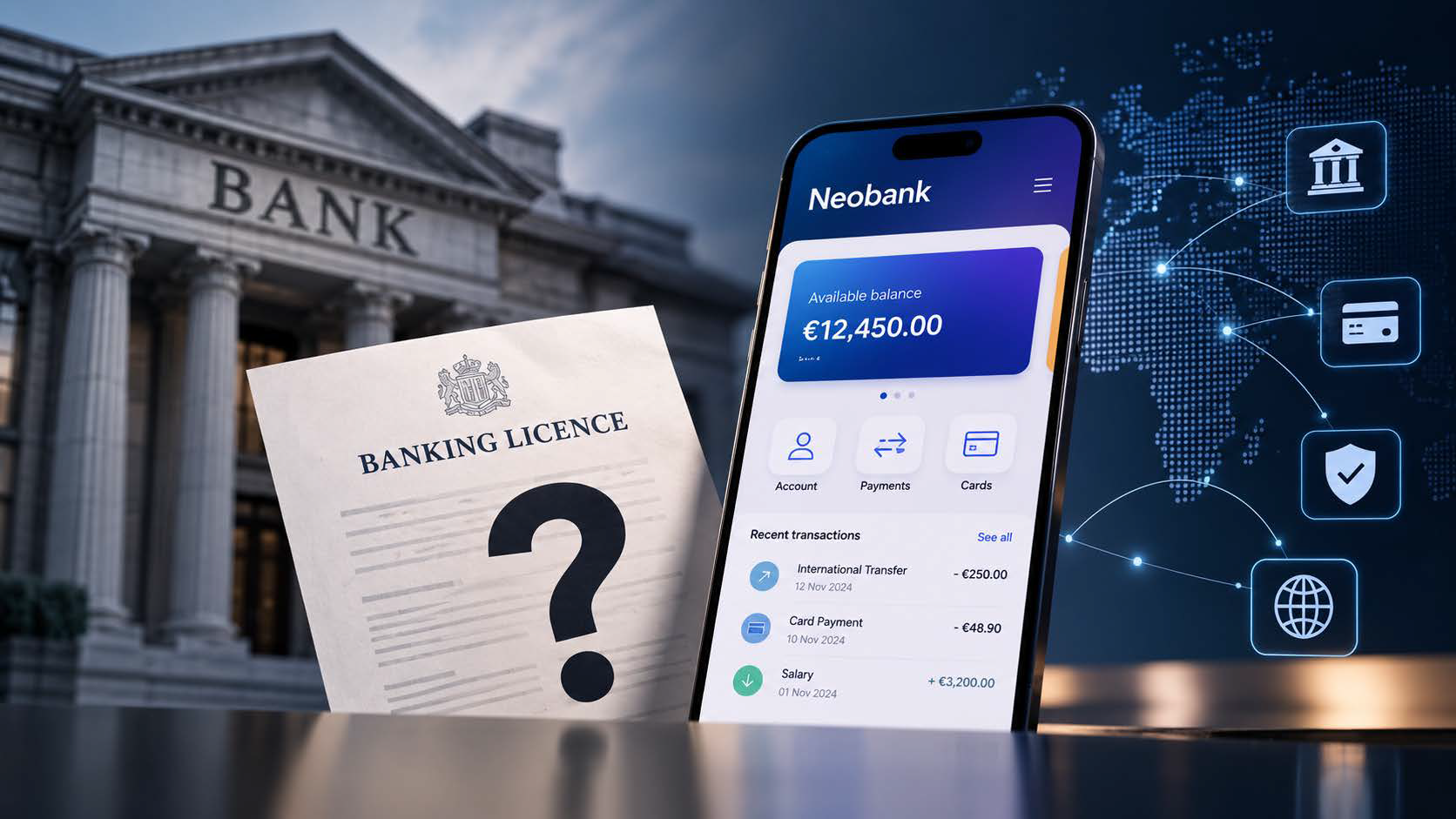
Which banking licence do I need? Possibly none.
That answer sounds surprising because the word “neobank” seems to imply a bank. In practice, a neobank is not necessarily a bank. It is a digital financial business model and customer proposition: an app-led way to provide accounts, cards, payments, foreign exchange, lending, investments or other financial services.
Some neobanks are licensed banks. Others operate through a licensed bank, electronic money institution (EMI), payment institution, card issuer, banking-as-a-service (BaaS) platform or another regulated white-label provider. The brand may look like a bank to the customer while the regulated infrastructure sits with a different legal entity.
The important question is therefore not what you call the product. It is: who performs each regulated activity, in which jurisdiction, and under which authorisation?
A neobank is a customer experience, not a regulatory category
“Neobank” is a commercial description. It normally refers to a mobile-first interface, rapid onboarding, modern payments and a single digital experience. It does not automatically tell a regulator whether the business is taking deposits, issuing e-money, providing payment services, arranging credit, holding client assets, offering investments or dealing in crypto-assets.
Those activities can fall under different legal regimes. A bank licence may be relevant where an institution accepts deposits and operates as a bank. An EMI licence may be relevant where the business issues e-money or provides certain payment services. A payment institution may cover payment services without issuing e-money. A separate regime may apply to lending, consumer credit, investment services, insurance, foreign exchange or crypto-assets.
This is why founders should map the actual money and data flows before choosing a licence. The customer-facing brand, app developer, programme manager and regulated provider may all be different parties.
Possibly none: how a regulated white-label model works
If the regulated activities are performed by a properly licensed white-label provider, the customer-facing company may not need its own banking licence. Depending on the exact activities, contract structure, customer journey and jurisdiction, it may not need a separate financial licence at all.
In that arrangement, the provider may perform customer onboarding, know-your-customer checks, safeguarding, account or wallet operation, payment execution, card issuance, transaction monitoring and regulatory reporting. The neobank company may own the brand, user interface, marketing, customer relationship and product design while clearly presenting the regulated provider in the contractual and regulatory role.
That is not a shortcut around regulation. It is a division of responsibilities. The provider must be authorised for the services it actually performs, and the parties must operate exactly as the legal and operational documents describe. A company cannot avoid authorisation simply by calling itself a technology business if, in reality, it receives client money, provides payment services, makes regulated financial promotions or exercises control over a regulated product.
Registration or authorisation obligations can still arise for agents, distributors, introducers, lenders, brokers, crypto businesses, payment intermediaries and firms marketing financial products. Consumer protection, data protection, outsourcing, safeguarding, AML and financial-promotion rules can also apply even when there is no own bank licence. Local advice is essential.
Three practical neobank structures
1. No own licence: full white-label
In a full white-label structure, a regulated bank, EMI, payment institution or BaaS provider performs the regulated functions. The founder supplies the commercial proposition: brand, app, front-end experience, acquisition strategy and customer support model.
This can be the fastest route to market. It can reduce initial capital needs, avoid building a full compliance department and provide ready access to accounts, cards, payment rails and operational tools. The trade-offs are dependence on the provider, less control over risk decisions and pricing, contractual limits on geography or customers, and the possibility that the provider changes its risk appetite or ends the relationship.
2. Own regulated entity plus outsourced infrastructure
Here, the group obtains its own authorisation and remains the regulated service provider, but outsources technology and selected operations. It may use a third-party ledger, card processor, KYC vendor, payments engine, cloud infrastructure or banking connectivity while retaining responsibility for governance, compliance, safeguarding and regulatory reporting.
This structure gives the founder more control over the product, customer base and economics. It can also improve long-term strategic value. However, obtaining a licence takes time and requires an appropriate management team, policies, capital, systems, risk controls and ongoing supervision. Outsourcing does not outsource accountability.
3. Hybrid structure
A hybrid model combines own authorisation with regulated partners. For example, a business may hold an authorisation for one core activity while using a partner for cards, accounts, local payment rails, custody or a second jurisdiction. Another company in the group may provide technology or distribution without performing the regulated function itself.
Hybrid structures can be useful when founders want control over a strategic activity but do not want to build every part of the stack. They require careful perimeter analysis. The group must know which entity contracts with the customer, holds funds, makes decisions, bears risk and communicates with the regulator.
Which licence might be relevant?
There is no universal “neobank licence”. The relevant authorisation depends on the services and jurisdictions involved.
- Bank licence: potentially relevant to deposit-taking and operating a bank on your own balance sheet.
- EMI licence: potentially relevant to issuing e-money, payment accounts and related payment services.
- Payment institution licence: potentially relevant to payment services where the model does not issue e-money.
- Credit or lending authorisation: potentially relevant where the business lends, arranges consumer credit or makes credit decisions.
- Investment, brokerage or asset-management authorisation: relevant where the product offers investment services or manages assets.
- Crypto or virtual-asset authorisation: potentially relevant to exchange, custody, transfers or other regulated crypto activities.
The same feature can be regulated differently depending on where customers are located, where the provider is established, how funds are held and how the product is marketed. A licence in one country does not automatically authorise every activity everywhere.
Questions founders should answer first
Before selecting a structure, founders should document the answers to these questions:
- What exactly will customers be able to do: hold funds, pay, receive salary, exchange currencies, borrow, invest or trade crypto?
- Who will hold or safeguard customer money and who will be the legal issuer of the account, card or e-money?
- Who signs the customer agreement and whose name appears in the terms, app and financial promotions?
- Will the business lend its own money, or will a licensed partner make and service the loans?
- Which countries will the business target on day one, and where will customers, management, technology and providers be located?
- How much control is required over onboarding, transaction monitoring, pricing, risk appetite, customer data and product changes?
- What capital, governance, compliance staffing and reporting obligations can the founders support for the next three years?
- What happens if the main provider exits, loses a permission, changes its risk policy or becomes unavailable?
These answers usually make the licensing question much clearer than the word “neobank” ever can. They also reveal whether the priority is speed, control, margin, geographic reach, investor confidence or long-term licensing value.
Conclusion
Which banking licence do you need to launch a neobank? Possibly none. A neobank is a digital proposition, not a specific legal category. The correct structure may be full white-label, an own-authorisation model with outsourced infrastructure, or a hybrid.
What matters is who performs the regulated activity, who holds customer money, who contracts with the customer and which rules apply in each target market. Founders should map those responsibilities before choosing a provider or submitting a licence application.
For a structured overview of launch paths, see our Neobank Launch & Licensing service. If a partner-led route is appropriate, review our White-Label Banking and Neobank Solutions.