
 By Rene Philippe Raymond Dubout · · Updated
A banking licence is not a bank.
That distinction is where many international banking projects go wrong. An investor sees a banking licence advertised for sale and focuses on the headline price. The assumption is that once regulatory approval has been obtained, the bank is ready for business. Then comes the first practical question: how will the money move?
A functioning bank needs capital, competent people, working technology and banking relationships that support its customers. The licence matters. So does everything that has to work on the morning the first customer arrives. At FintechLex, we bring those elements together around a Dominica banking structure, with an optional Swiss SRO company where a Swiss service presence makes commercial sense.
Three ways to own the bank
| Your starting point | Indicative CHF budget | What you are buying |
|---|---|---|
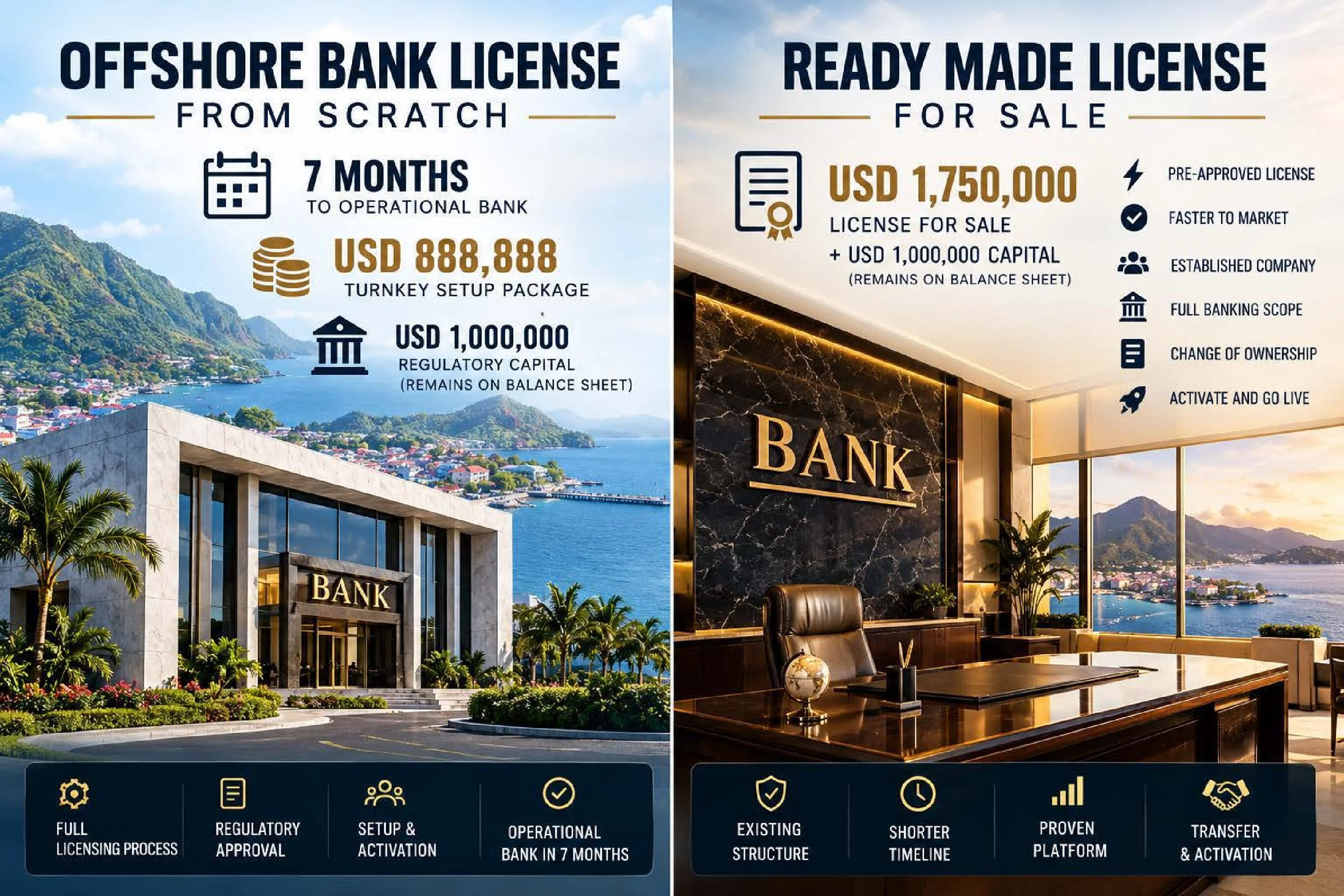
| Build a new Dominica bank | 779,000 for the licence, plus activation and capital | Obtaining the banking licence, built around your proposed business. Activation (office, software, correspondent accounts, SWIFT) comes on top. |
| Acquire an existing licensed entity | 1,440,000 plus applicable capital | An existing licensed legal entity; the remaining operational work depends on the target. |
| Acquire an operating bank | 5–7 million | An operating institution, assessed through its financial position, customers, systems and banking relationships. |
For the new-bank route, we budget CHF 825,000 for initial regulatory capital. That brings the licence and the initial-capital allowance to CHF 1,604,000, before the activation, the optional services and the operating budget set out below.
An operating-bank acquisition at CHF 5–7 million buys a different starting point. The transaction determines which cash, capital, technology and other assets are included. We examine those items before adding anything to the purchase budget.
Our Dominica commitment. For projects accepted under our Dominica engagement, FintechLex guarantees delivery of the banking licence, subject to the agreed eligibility requirements and the client completing its obligations. Allow approximately seven to eight months for a new licence. The engagement records the guarantee; the formal licensing decision remains with the competent authority. Correspondent banks make their own onboarding decisions.
Why we use Swiss francs
We quote in Swiss francs because we want a stable currency as our reference. Switzerland’s long record of low inflation, political and economic stability, and the franc’s established safe-haven role make it a sensible basis for international project budgets. Using one currency also makes the figures easier to compare: you should be able to read the budget without doing three currency conversions in your head.
The franc still fluctuates against other currencies. Our CHF budgets are rounded planning figures; statutory obligations remain payable in their legally prescribed currency. The final quotation states its validity and any exchange-rate treatment.
Build the budget in three layers
The useful way to read the numbers is straightforward: what it costs to establish the bank, what capital stays in the bank, and what it costs to operate it.
Establishment and selected services
| Component | CHF budget | Budget treatment |
|---|---|---|
| Dominica banking licence | 779,000 | Everything needed to obtain the licence. |
| Office lease deposit (six months) | 18,000 | Activation. |
| Office furniture and fit-out | 25,000 | Activation. |
| Staff search and onboarding | 6,000 | Activation. |
| Banking software and mobile platform | 60,000 | Activation: core banking software and mobile banking. |
| Correspondent-account assistance (IBAN accounts) | 80,000–130,000 each | Activation: budget per correspondent account. |
| SWIFT application assistance | 100,000 | Activation. |
| Optional Swiss SRO setup | 105,000 | Separate Swiss company and agreed setup scope. |
| Administrative and corporate documentation | 1,000 | Included once where applicable, outside the core scope. |
| Initial regulatory-capital allowance | 825,000 | Capital funding, separate from the service fees above. |
We agree the detailed scope before engagement. Software, staffing, annual compliance, taxes, disbursements and third-party charges must be allocated clearly. An existing system or account already included in an acquisition should not be charged again without a reason. A private bank serving a limited number of wealthy clients does not need the same technology as a digital bank handling thousands of accounts, cards and daily transactions. That is why the software budget depends on the actual business.
What a complete configuration looks like
The following includes the licence, the full activation (office, software and mobile platform, SWIFT), the Swiss SRO setup and the documentation item. The range varies with the cost of the correspondent accounts.
| Configuration | Setup and selected services | Including initial capital |
|---|---|---|
| One correspondent account | CHF 1,174,000–1,224,000 | CHF 1,999,000–2,049,000 |
| Two correspondent accounts | CHF 1,254,000–1,354,000 | CHF 2,079,000–2,179,000 |
Additional capital, virtual-asset implementation, client-asset escrow, provider collateral, taxes and expenses outside the agreed scope must be budgeted separately where applicable.
Keep money to run the bank
The running costs start once the bank is operational and are not part of the set-up budget. The fixed costs in Dominica alone look like this:
| Fixed running cost in Dominica | CHF per month | CHF per year |
|---|---|---|
| Annual contribution to the Government fund | – | 25,000 |
| Local director | – | 50,000 |
| Local authorised agent | – | 50,000 |
| Two local employees | 6,000 | 72,000 |
| Office rent | 2,000–3,000 | 24,000–36,000 |
| Internet, telephone and other expenses | 1,000 | 12,000 |
| Total fixed running costs | about 19,400–20,400 | 233,000–245,000 |
Add compliance, audit, software maintenance and the rest of the team you need, and a small offshore operation typically runs at CHF 25,000–50,000 a month, or CHF 300,000–600,000 a year. In other words, the two-correspondent configuration, the initial capital and twelve months of operations come to approximately CHF 2.38–2.78 million.
The operating estimate is a planning assumption, to be replaced by a budget for the actual team and business. The Swiss company’s running costs are additional. The CHF 5–7 million operating-bank range is a purchase budget, not a running cost: a buyer still needs to plan post-acquisition funding, capital top-ups and the cost of any changes to the business.
Why Dominica remains a practical option
The Commonwealth of Dominica combines an established offshore banking framework, in place since the Offshore Banking Act of 1996, with a comparatively accessible capital requirement and operating base. Its Financial Services Unit supervises offshore banks within the Ministry of Finance framework, and the licensing decision belongs to the Minister.
The law requires USD 1 million of paid-up initial capital; we budget CHF 825,000, rounded upward. Capital stays on the bank’s balance sheet and supports its obligations; establishment fees and running costs are funded separately. Capital requirements continue after launch, and the regulator may ask for more. The bank also needs a representative office in Dominica, two approved authorised agents, appropriate management and compliance resources, reporting and annual audits.
One requirement many promoters discover too late: the Act looks at the people, not only the company. Each director and associate of the applicant must show a personal net worth above USD 1 million, independently confirmed. Check this before anything else.
Whether Dominica works for you depends on the customers, markets and services you intend to serve.
Correspondent banking deserves serious attention
An offshore bank without the right banking relationships may hold a valid licence and still be unable to offer the international payments its clients need. Securing those relationships has become considerably more difficult. Our current budget is CHF 80,000–130,000 per correspondent account, with CHF 80,000 as the minimum. The range reflects the work involved and the possible need for outside specialists.
The question is not simply whether an account can be opened. We need to establish what that account permits: the bank’s own payments, its customers’ transactions, particular countries, virtual IBANs, cash-related flows or digital-asset activity. A correspondent reviews the institution, its owners and management, its controls and its proposed customers. Serving trading companies is one proposition. Providing access to payment companies or crypto businesses is another, and nested arrangements need express approval.
Our proposed service scope may extend to approximately 25 currencies, including EUR, USD, CHF, GBP, CAD, SGD, JPY, HKD and AUD. The final coverage comes from the approved contracts and completed integrations.
What the SWIFT budget covers
SWIFT application assistance is CHF 100,000, a separate service from correspondent-account assistance. SWIFT provides financial messaging. Payments also need accounts, settlement arrangements and counterparties that accept them. In other words, a BIC and the ability to send a message do not, by themselves, make a working international payment service. The same goes for letters of credit, standby letters of credit and bank guarantees: they need credit policies, capital, collateral, expertise and counterparties willing to accept the issuing bank’s word.
Read the IBAN and SEPA arrangements properly
The customer documentation must identify the account-holding institution and the legal owner of the account. A virtual IBAN can route funds into an underlying account without creating a separate bank account in each customer’s name. SEPA is a euro-payment framework with its own eligibility rules; an offshore transfer does not become eligible merely because a European intermediary is involved, and the European Payments Council has warned specifically against that kind of misuse.
Add a Swiss service presence where it helps
The optional CHF 105,000 Swiss SRO setup adds a Swiss company affiliated with a FINMA-recognised self-regulatory organisation. It can provide its own permitted financial-intermediary services and a practical Swiss point of contact. The offshore bank holds the banking licence and owes its deposits; the Swiss company carries out its own activities under the rules that apply to it. The ownership can be structured with the Swiss company holding a majority of the bank or through a parallel arrangement, after the necessary regulatory and tax review.
Depending on the model, the Swiss services may include remittance, payments, currency exchange, certain crypto exchange and segregated-custody arrangements, precious-metal services, merchant payments, credit funded from the company’s own resources, and corporate or onboarding support.
Be clear about the limits. A Swiss SRO affiliation is anti-money-laundering supervision, nothing more. Taking deposits from the public, portfolio management and securities business have their own rules. If people in Switzerland represent the foreign bank, forward orders or manage accounts for it, a FINMA representative-office or branch authorisation may be required, and a Swiss office or CH IBAN does not give customers Swiss deposit insurance. Switzerland is also preparing a payment and crypto reform that could bring some SRO activities under new licensing regimes, so we design the Swiss company with that change in mind.
Banking and crypto need the right permissions
A Dominica bank can be designed around corporate accounts, international payments, FX, lending, custody, private banking and trade finance, subject to its licence conditions and approved business plan. Securities, brokerage and asset management need their own regulatory assessment.
Digital assets are a separate workstream. The Virtual Asset Business Act 2022 covers exchange, transfer, safekeeping, administration and issuer-related services, and a banking licence does not automatically include those activities. The 2024 Regulations add requirements on capital and liquidity, client-asset protection, governance, transfer information, cybersecurity and insurance, and the Act requires client funds to be partly held in escrow. These obligations belong in the design and the budget from day one.
Allow seven to eight months for a new licence
The licence and the operating launch are separate milestones. Technology, premises, recruitment and banking-provider onboarding can proceed alongside the application where practical. The sequence starts with the owners, management, source of funds, target customers and products; from there we prepare the application and business plan, set up the operating resources, complete provider arrangements and test the service before launch.
For an acquisition, the timetable depends on the target’s condition, the ownership approvals and the work needed after closing. We check whether the existing correspondents will accept the new ownership and business model.
What matters before you buy
- Verify the authority and the licence. A company certificate is not a banking licence. The Central Bank of the Comoros has warned against purported offshore regulators on Anjouan and Mohéli, and the Central Bank of The Gambia confirmed to us in writing in 2017 that it had not licensed any offshore bank. See Comoros fake regulators, Gambia fake offshore licences.
- Read the financial position. The price, existing capital, unrestricted cash, losses, debts and contingent liabilities are separate questions. An acquisition should be supported by audited accounts, current management figures, regulatory correspondence and evidence of the capital actually available.
- Inspect the operating reality. Staff, customer records, AML controls, technology rights and bank contracts need examination. An account in onboarding, a signed price schedule and a live payment service are three very different stages of readiness.
- Check that the licence is in good standing. On paper, the Offshore Banking Act allows revocation if business does not start within six months of the licence being issued. In practice, licensed banks that are not yet operating can stay in good standing for years; there is a difference between the law and practice. Either way, confirm the entity’s standing and the regulator’s position before you sign, as we do for every bank we sell.
- Keep capital and customer money under control. Capital, liquidity, exposure and related-party rules continue to apply, and the licence is not a passport into every country where a customer might be approached.
Dominica’s supervisory and tax position has also improved. The CFATF follow-up report of May 2026 rates 36 of the 40 FATF Recommendations Compliant or Largely Compliant, and Dominica is on neither annex of the EU list of non-cooperative tax jurisdictions. Useful context, but correspondent banks still apply their own risk assessment.
A bank can support a wider investment business
For a fintech group, investment platform or venture builder, an owned banking layer can do more than provide accounts. The investment vehicle supplies long-term equity to portfolio companies; a separately capitalised bank can provide credit, liquidity and banking infrastructure within its permissions: working-capital and bridge facilities, venture debt, operating accounts, escrow, treasury, FX and trade finance. The separation is fundamental. Bank deposits carry liquidity and depositor obligations, and connected lending needs proper credit approval, arm’s-length terms and respect for concentration limits.
Owning the bank gives the group control over the institution and its economics. It also brings the responsibility to run it properly. A partner-bank or EMI arrangement remains an alternative where the business does not justify owning the institution: see our EMI licence guide. And if you were looking at Puerto Rico, read what the 2024 reform changed first.
Start with the business you intend to build
FintechLex brings the Dominica licensing process together with Swiss legal and regulatory work, bank structuring, acquisition analysis and the operational relationships needed for launch. If you would rather start from an existing institution, we currently have an international bank in Dominica for sale.
The useful first conversation is about your customers, their countries, the services they need, your ownership structure and the capital available. Those answers determine which route makes sense and what the bank will actually cost. After preliminary KYC and a project outline, we arrange a focused 30-minute discussion, then set out the proposed structure, CHF budget, agreed deliverables and implementation plan. Acquisition information is shared under confidentiality.
To discuss building or acquiring an offshore bank, write to us at insight@fintechlex.com.
If you are planning to buy or set up a bank, see our banking licence acquisition and formation service.
Budget basis: FintechLex indications as updated on 24 October 2026; the signed engagement defines the scope and guarantee. CHF conversions use Swiss National Bank rates of 23 October 2026 (USD/CHF 0.8231, EUR/CHF 0.9212) before commercial rounding. Sources: Dominica Offshore Banking Act 1996 and FSU licensing materials; Virtual Asset Business Act 2022 and Regulations 2024; CFATF follow-up report, May 2026; Council of the EU list of non-cooperative jurisdictions; European Payments Council; Swiss Banking Ordinance and FINMA guidance; Swiss National Bank.
This article is for general information only and does not constitute legal, tax or investment advice.