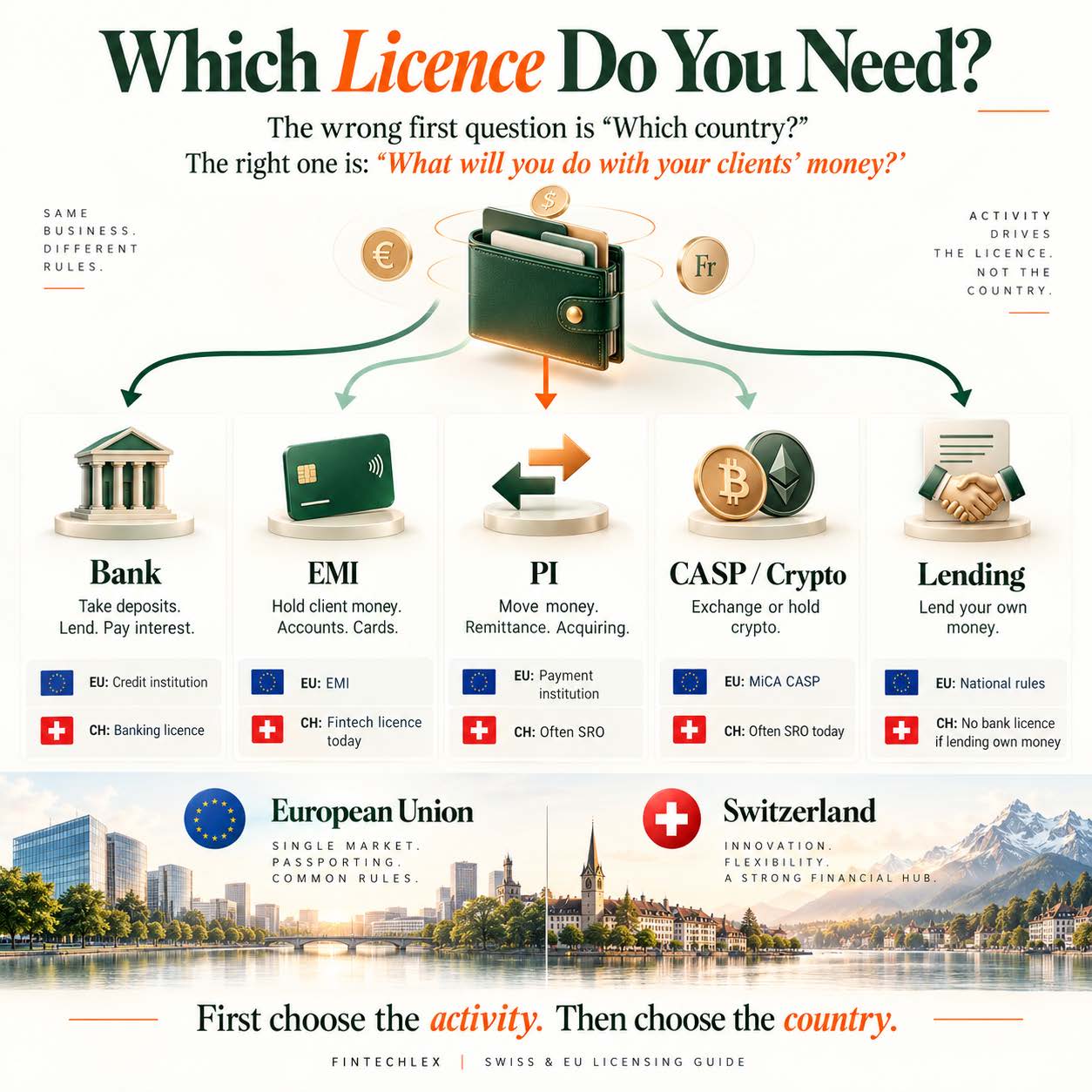
Founders usually ask us “which country?” first. It is the wrong first question. The right one is: what will you do with your clients’ money? Hold it, move it, lend it, or exchange it into crypto? The answer decides the licence. The country comes second.
This guide walks through the five answers, with the Swiss and the EU licence for each.
Step 1: what do you do with the money?
| If you… | In the EU you need | In Switzerland you need |
|---|---|---|
| Take deposits and lend them out, or pay interest | Credit institution (bank) | Banking licence (FINMA) |
| Hold client money in accounts, issue IBANs or cards | Electronic money institution (EMI) | Fintech licence today; payment instrument institution after the reform |
| Only move money (transfers, acquiring, remittance) | Payment institution (PI) | Often SRO membership, if funds pass through quickly |
| Exchange or hold crypto for clients | MiCA crypto-asset service provider (CASP) | SRO membership today; crypto institution after the reform |
| Lend your own money | National licence, depending on the country | No bank licence, but AML rules and, for consumers, a cantonal authorisation |
Step 2: the five licences, in plain words
1. The bank
A bank is the only institution allowed to take deposits from the public and use them: lend them, invest them, pay interest on them. That is why it costs the most. In the EU, a credit institution needs at least EUR 5 million of initial capital. In Switzerland, FINMA requires at least CHF 10 million, and in practice much more, plus a serious board, risk management and an audit firm.
You need a bank only if your business model is the balance sheet: lending, interest margin, deposit products. Most fintechs do not. If you do, building is slow and buying an existing bank is often the faster route.
2. The electronic money institution (EMI)
An EMI may hold client money, issue e-money, open IBAN accounts and, with a card scheme membership, issue cards. It may not lend that money or pay interest on it. Client funds are safeguarded, kept separate from the EMI’s own money, but they are not deposits and are not covered by a deposit guarantee.
Initial capital: EUR 350,000. With an EU licence, you can passport across the EEA. This is the licence behind most neobanks. See our EMI licence guide for Lithuania, Latvia, Ireland and when to buy one.
3. The payment institution (PI)
A payment institution moves money but does not store it: transfers, card acquiring, money remittance, payment initiation. Capital depends on the service: EUR 20,000 for money remittance only, EUR 50,000 for payment initiation, EUR 125,000 for the other services.
Under PSD3, expected to apply around 2028, EMIs and payment institutions merge into one family: the EMI becomes a type of payment institution. Plan for it now if you are applying or buying.
4. The crypto licence
In the EU, MiCA created one licence for crypto-asset service providers. Minimum capital is EUR 50,000, EUR 125,000 or EUR 150,000 depending on the services. One rulebook, but 27 national regulators applying it, as we explained in MiCA: Europe’s Trojan Horse.
Switzerland has no single “crypto licence”. Most crypto businesses operate today under membership of a self-regulatory organisation (SRO) for anti-money-laundering purposes. See our Swiss Crypto Licence 2026 guide and Swiss SRO guide.
5. Lending
Lending your own money, or money from professional investors, is not banking. In Switzerland it needs no banking licence, but the lender is a financial intermediary under the Anti-Money Laundering Act, and consumer lending requires an authorisation from the canton. In the EU, non-bank lending is regulated country by country.
The trap: as soon as you finance your loans with money from the public, you are taking deposits, and you need a bank.
Switzerland: a special case
Switzerland has no EMI and no payment institution licence today. Founders have three options:
- SRO membership. Enough for many payment and crypto models, as long as client money is not held as a deposit. Money held only to settle a transaction, without interest, for no more than 60 days, is not a deposit.
- The sandbox. Up to CHF 1 million of public deposits without a licence, under strict conditions. Good for testing, not for scaling.
- The fintech licence. Public deposits up to CHF 100 million, no lending and no interest, capital of 3% of deposits and at least CHF 300,000. Few have used it, as we explained in Switzerland’s Fintech Licence Failed.
The Federal Council has proposed two new licences, a payment instrument institution and a crypto institution, expected around 2027 or 2028. Until then, a Swiss licence gives no access to the EU market. If your clients are in Europe, compare both sides first: European EMI vs Swiss fintech licence.
Do you need a licence at all?
Often not at the start. If you only need accounts and cards for your clients, you can run on a licensed partner’s infrastructure: a white-label or banking-as-a-service set-up. The partner holds the licence and the client money; you hold the brand and the client relationship.
It is the fastest and cheapest way to launch. The price is dependence: if the partner changes its risk appetite, your business stops with it. Many of our clients start this way and apply for their own licence once the volumes justify it. See white-label banking and neobank solutions and Which Banking Licence Do I Need to Launch a Neobank?.
Five questions before you choose
- Do you hold client money, or only move it? Holding means EMI; moving means payment institution.
- Do you need to lend it or pay interest? Then you need a bank, nothing less.
- Where are your clients? An EU licence passports across the EEA; a Swiss licence does not.
- How fast do you need to be live? Partner first, own licence later, or buy an existing institution.
- What will the regulator think of your model in three years? PSD3 and the Swiss reform are coming. Choose a structure that survives them.
The licence is the foundation of your business. Choosing the wrong one costs a year and several hundred thousand euros. Tell us what you do with the money, and we will tell you which licence fits.
This article is for general information only and does not constitute legal advice.