
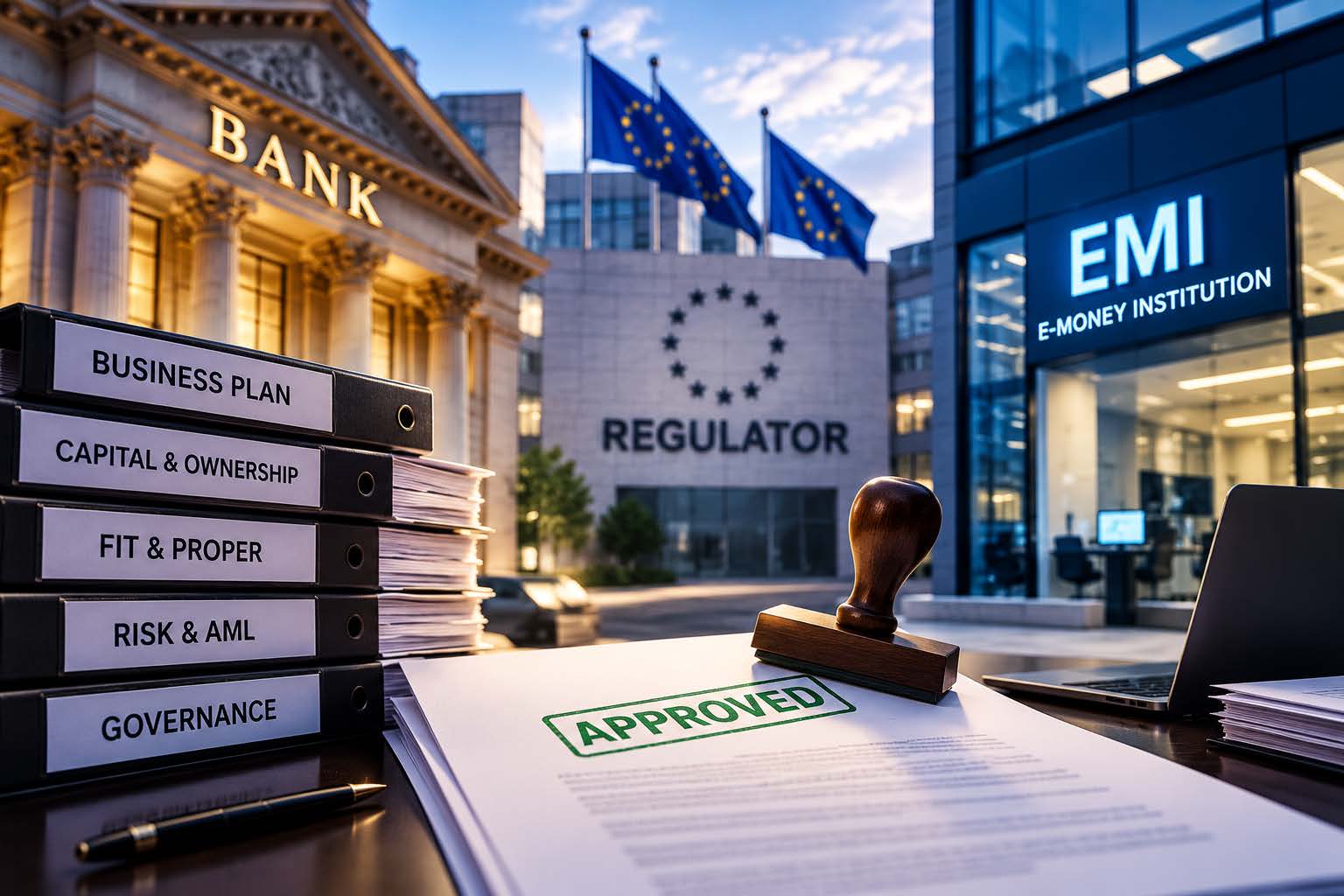
Buying a regulated company is not like buying any other company. You can agree the price, sign the contract and transfer the money into escrow, but you cannot take control until the regulator has approved you as the new owner. That approval, the change of control, is where most acquisitions lose time, and some lose the deal.
Why the regulator has a say
A bank or an e-money institution holds other people’s money. The regulator licensed it on the basis of who owned and ran it. If the owner changes, the licence is only as good as the new owner. So the law turns the question around: it is not the company that must be fit and proper any more, it is you.
When you need approval
Approval is triggered by a qualifying holding: a stake of 10% or more of the capital or voting rights, or any stake that gives significant influence. In the EU, every further step at 20%, 30% and 50%, and the move to control, needs approval again. In Switzerland, anyone who plans to acquire a qualifying participation in a bank must inform FINMA in advance, and again when crossing 20%, 33% or 50%.
Indirect holdings count. If you buy the parent company, you are buying the bank.
Who decides, and how long it takes
| Who decides | Legal clock | In practice | |
|---|---|---|---|
| Bank in the euro area | The ECB, on a proposal from the national supervisor | 60 working days from a complete file, suspendable once | 6–12 months from first contact |
| EMI or payment institution (EU) | The national regulator | Similar assessment under national law | Several months |
| Swiss bank | FINMA | Prior notification; FINMA reviews the new owner | Depends on the file and the buyer’s origin |
The legal clock only starts when the regulator considers the file complete. The real delay is usually the time it takes to get there.
In Switzerland, a buyer from abroad faces one more step: a bank that becomes foreign-controlled needs an additional licence.
What the regulator looks at
In the EU, the assessment rests on five questions:
- Reputation of the buyer: integrity, professional track record, any past proceedings.
- Reputation and experience of the new management the buyer will appoint.
- Financial soundness of the buyer: can it support the institution, now and in a crisis?
- Continued compliance: will the institution still meet its prudential requirements, and can it be supervised effectively inside the buyer’s group?
- Money laundering and terrorist financing: is there any reason to suspect the acquisition is connected to them?
In practice, it comes down to three things: who you really are, where your money really comes from, and what you really plan to do with the institution.
What goes into the file
- the complete ownership chain, up to the individuals who ultimately own and control the buyer;
- the source of funds for this purchase, and the source of wealth of the people behind it;
- audited financial statements of the buyer and its group;
- a business plan for the institution after the acquisition;
- the proposed board members and managers, with their CVs and fit-and-proper documents;
- how the purchase is financed, and whether any of it is borrowed.
What slows a file down
- Complex ownership chains, especially through trusts, foundations or several jurisdictions, without a clear explanation of who is behind them.
- Source of wealth that cannot be documented: “we have always been successful” is not evidence.
- Borrowed money. A regulator does not like an institution whose owner must service acquisition debt.
- A business plan that changes everything. If you want to turn a quiet EMI into a crypto or gambling platform, say so, and expect a much closer look.
- A management team chosen late. The people matter as much as the money.
How to structure the deal
Sign the purchase agreement first, with closing conditional on the regulator’s approval, and a long-stop date after which either side can walk away. Agree what the seller may and may not do in the meantime. And do not take control before approval: no instructions to management, no access to client data, no new directors. Regulators treat that very seriously.
Prepare the regulatory file in parallel with the due diligence, not after it. On the buyer’s side, a good change-of-control file is the fastest way to close. On the seller’s side, it is worth checking the buyer’s file before signing: a buyer who cannot be approved is no buyer at all.
For the other side of the coin, see Before You Buy a Bank, EMI or Swiss SRO: What Due Diligence Really Matters, our EMI licence guide and Offshore Bank: Buy a Banking Licence or Apply From Scratch.
Ask us to prepare your change-of-control file, or write to insight@fintechlex.com.
This article is for general information only and does not constitute legal advice.