
Before you choose a licence, you need to know who will be looking at you, and how often. In Switzerland the answer is not always FINMA, and that surprises many newcomers.
Three layers, not one
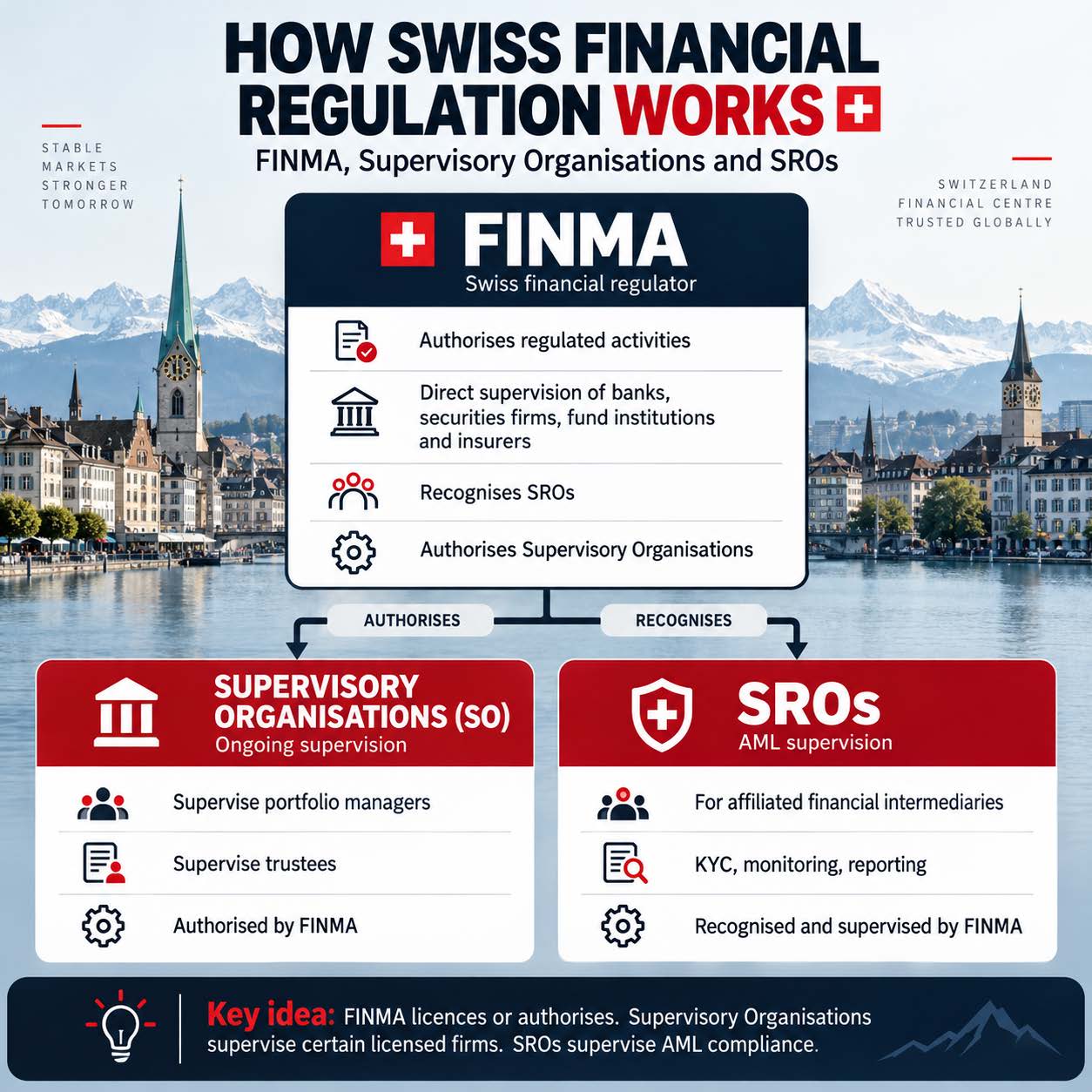
Swiss financial supervision works in three layers.
- FINMA, the Swiss Financial Market Supervisory Authority, licenses and directly supervises banks, securities firms, fund management companies, insurers and financial market infrastructures.
- Supervisory organisations are private bodies authorised by FINMA. Since the 2020 reform, they carry out the day-to-day supervision of portfolio managers and trustees. FINMA grants the licence; the supervisory organisation supervises you afterwards.
- Self-regulatory organisations (SROs) supervise financial intermediaries that are only subject to the Anti-Money Laundering Act: payment services, money transfer, currency exchange, certain lending and many crypto businesses.
On top of that, audit firms carry out the regulatory audits that FINMA and the supervisory organisations rely on. In practice, the auditor is often the person you will see most.
Principles, not checklists
Swiss regulation is principle-based. The law and FINMA set the objectives: proper organisation, adequate capital, fit and proper people, effective risk management. They leave you room to show how you meet them. That is an advantage for a well-prepared applicant. It is a trap for one who expected a form to fill in.
The activity decides
The single most important rule: what you actually do decides which regime applies. Not the name of your company, not the wording of your website, and not what you would like to be. Two companies with the same business plan on paper can need different licences because of how they handle clients’ money in practice.
The two laws that changed everything
Since 1 January 2020, the Financial Services Act (FinSA) sets the rules of conduct towards clients, and the Financial Institutions Act (FinIA) sets who needs a licence. Before 2020, an independent asset manager could operate with little more than an SRO membership. That world is gone.
What nobody tells you
The regulator is rarely the first to ask questions. Your bank is. Before you ever meet FINMA, your Swiss bank will want to know exactly what you do, under which regime and supervised by whom. If you cannot answer that clearly, the account will not open, licence or no licence.
For the full list of Swiss licences and what each one allows, see our Swiss Financial Licences: The Complete Map.
Not sure which regime applies to your business? Contact FintechLex · insight@fintechlex.com
Last updated: October 2026. This article is general information, not legal advice.