
Switzerland remains one of the best places in the world to run a financial business. It is also one of the easiest places to choose the wrong licence.
Most people start with the wrong question: “Which licence should I get?” The right question is: “What exactly will I do, for whom, and with whose money?” In Switzerland, the activity decides the licence. Your company name, your website and your business plan do not.
This section explains the Swiss landscape as it really works: who supervises what, what each licence allows, what it costs in time and money, and what nobody tells you before you apply.
The Swiss landscape in one table
| What you do | What you need | Who supervises you |
|---|---|---|
| Payments, money transfer, currency exchange, lending, trading precious metals or commodities for clients | Membership of a self-regulatory organisation (SRO) for anti-money laundering | The SRO, recognised by FINMA |
| Advise clients on investments without a licence of your own (including foreign advisers serving Swiss clients) | Registration in the client adviser register | A registration body approved by FINMA |
| Crypto exchange, broker or custody of crypto assets for clients | SRO membership today; a banking or securities firm licence for some activities | The SRO, or FINMA |
| Trading platform for tokenised securities (DLT securities), with custody and settlement | DLT trading facility licence | FINMA |
| Stock exchange, multilateral trading facility, central securities depository, clearing | Financial market infrastructure licence | FINMA |
| Manage clients’ assets | Portfolio manager licence | FINMA grants it; a supervisory organisation supervises you |
| Act as trustee | Trustee licence | FINMA grants it; a supervisory organisation supervises you |
| Manage funds or pension money | Manager of collective assets or fund management company licence | FINMA |
| Trade securities for clients | Securities firm licence | FINMA |
| Accept public deposits without lending them | Fintech licence (to be replaced) | FINMA |
| Accept deposits and lend | Banking licence | FINMA |
| Insurance | Insurance licence (direct insurance or reinsurance) | FINMA |
| Insurance broker | Registration in the FINMA register of insurance intermediaries | FINMA |
Three levels of supervision
- Full FINMA licence and direct supervision: banks, securities firms, fund management companies, insurers and market infrastructures.
- FINMA licence with delegated supervision: portfolio managers and trustees, licensed by FINMA but supervised day to day by a supervisory organisation.
- Membership or registration only: financial intermediaries through an SRO, client advisers through the client adviser register, and insurance intermediaries through the FINMA register.
Two new licences on the way
In October 2025, the Federal Council proposed two new licence categories:
- Payment instrument institution: it would replace today’s fintech licence, remove the CHF 100 million cap on client funds, protect client funds if the institution fails, and allow the issue of certain stablecoins.
- Crypto-institution: for businesses providing crypto services, with requirements modelled on those of securities firms, but lighter.
The consultation closed in February 2026. These licences are not yet in force; we will update this page as the legislation progresses.
Browse our practical guides to doing financial business in Switzerland, by topic.
How Swiss Regulation Works
-

Swiss Trust: The Swiss Trust Company That Does Not Exist
Looking for a Swiss trust or a Swiss trust company? Swiss law has no trust. Here is what exists instead: SRO companies, FINMA licences, foreign…
-
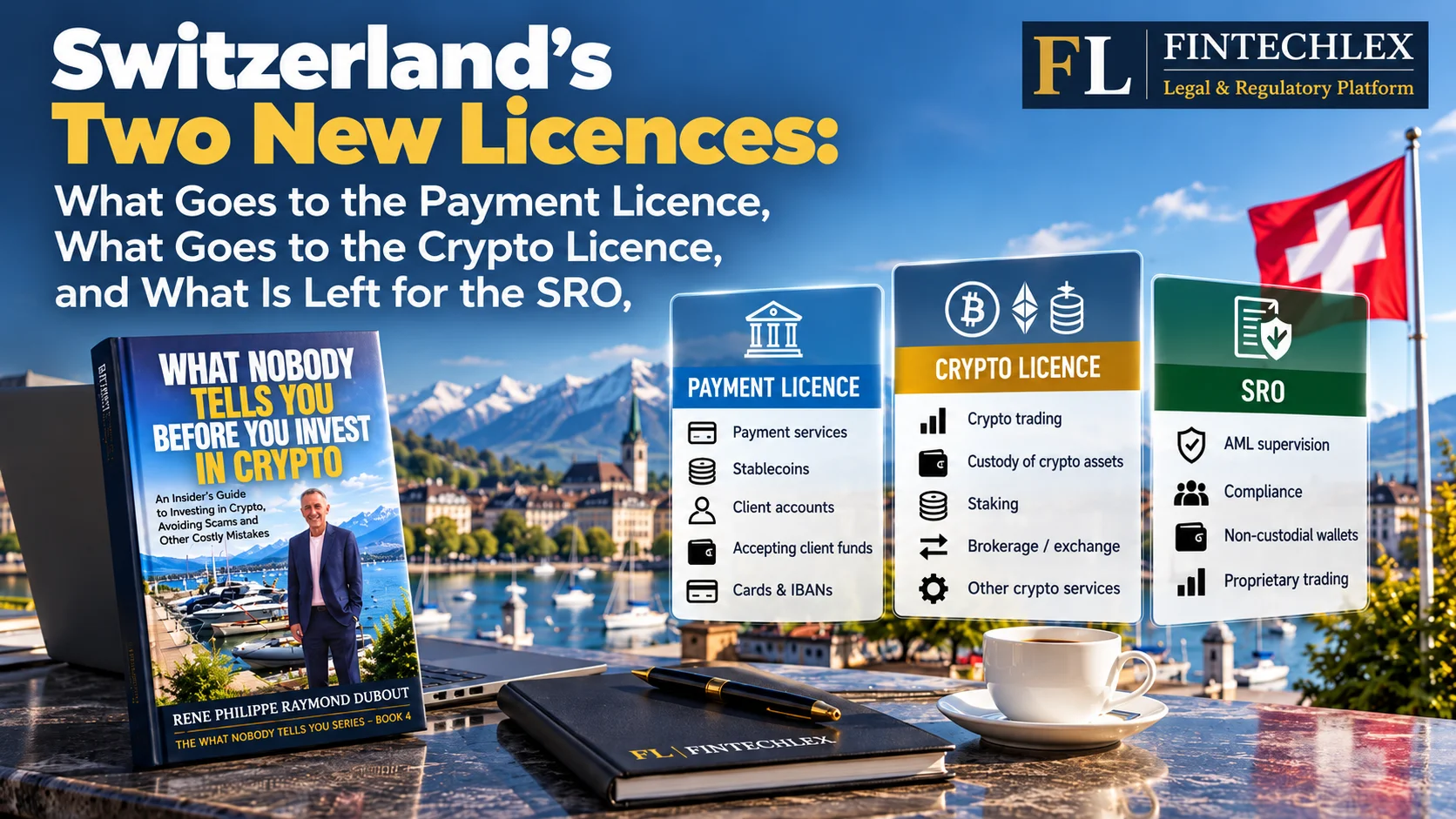
Switzerland’s Two New Licences: What Goes to the Payment Licence, What Goes to the Crypto Licence, and What Is Left for the SRO
Two new Swiss licences are coming. What belongs to the payment instrument institution, what belongs to the crypto institution, and what a crypto business can…
-

Stablecoins: When Even a Bank Needs a Separately Licensed Subsidiary
Under Switzerland’s draft stablecoin law, a bank could not issue a regulated stablecoin itself. It would need a separately licensed subsidiary. Is that justified?
SRO, Financial Intermediaries and Crypto
-

No Swiss Bank Will Open Your SRO Company an Account? There Is Now an Alternative
Crypto, FX and payment companies affiliated to a Swiss SRO often struggle to open a bank account. FinTech-licensed providers now offer a real alternative, with…
-

The Swiss SRO Annual Audit: What the AML Auditor Checks, and How to Pass It
Joining a Swiss SRO is the start, not the end. What the yearly AML audit checks, the findings we see most often, and how to…
-
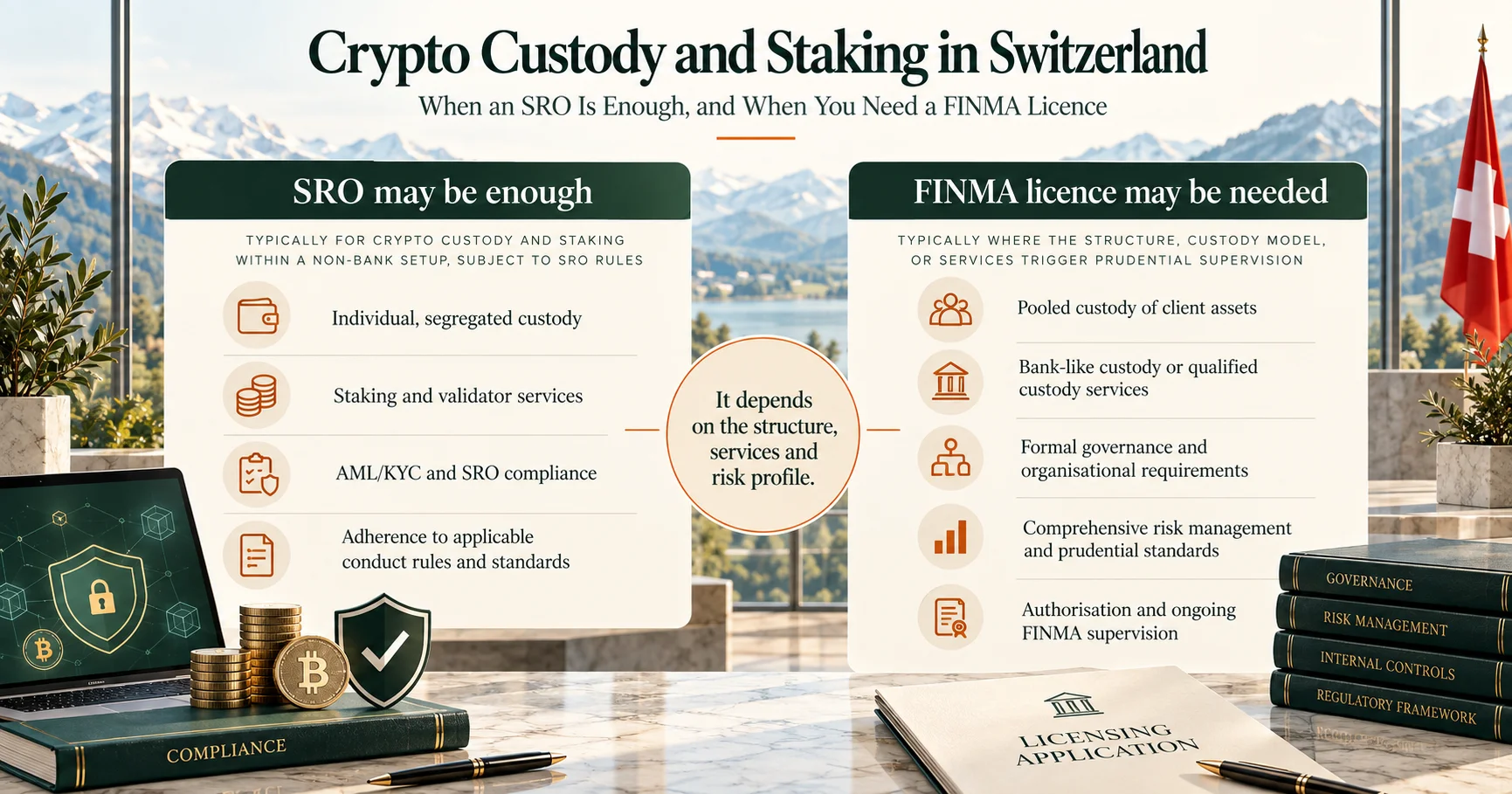
Crypto Custody and Staking in Switzerland: Is SRO Enough, and When You Need a FINMA Licence
Holding or staking crypto for clients in Switzerland? Individual custody, omnibus wallets, staking and lending each fall under different rules. Where an SRO is enough,…
Swiss FINMA Licences: Financial Institutions
-

Buying a Swiss Regulated Company: What to Check Before You Sign
A licence is not sold in a box. It comes inside a company, with that company’s files, clients and history.
-

Who Counts as a Qualified Investor in Switzerland? The Gate to the L-QIF
The L-QIF is easy to launch. The hard part is making sure every investor in it is allowed to be there.
-

Buy and Upgrade, or Start Fresh? The Fastest Route to a Swiss Fund Manager Licence, and When It Backfires
Buying a Swiss portfolio manager and upgrading it can cut the road to a fund manager licence by half. Unless the company’s past gets in…
Swiss Banks and the Fintech Licence
-

The Swiss Banking Licence: What It Really Takes, and When You Do Not Need One
What a Swiss banking licence requires, the small-bank regime, the fintech licence, and why most people asking for a bank do not need one.
-

SRO, Fintech Licence or EU EMI? Switzerland’s Fintech Licence Failed. Here Is What Should Replace It.
When Switzerland launched the fintech licence in 2019, the idea was elegant: a “banking licence light” for innovative firms that wanted to hold client money…
Who writes these guides
Rene Philippe Raymond Dubout is a Swiss lawyer licensed in Geneva since 1990, who moved to Thailand in 1995. He is the founder of FintechLex and Venture Capital Studio. For more than thirty years he has advised investors and financial businesses in Europe and Asia, and helped clients build banks and financial companies.
Planning a financial business in Switzerland? Contact FintechLex · insight@fintechlex.com
Last updated: October 2026. These guides are general information, not legal advice.