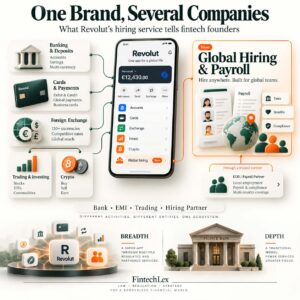

Revolut in Switzerland.
Would Buying a Bank Have Been the Smarter Strategy?
Revolut has made its next move in Switzerland
The fintech group has applied for a Swiss banking licence and announced plans to invest CHF 150 million in the country over the next five years. With approximately 1.3 million customers already in Switzerland, the logic appears straightforward: Revolut has built the customer base; now it wants the local banking licence.
But was applying for a new licence really the best strategic route?
From a banking M&A perspective, there was another possibility worth considering:
Buy an existing Swiss bank.
Not simply to obtain a licence. To acquire an entire regulated banking platform.
Build versus buy
This is one of the fundamental decisions facing any financial group entering a regulated market.
The first option is to build.
Establish the legal entity. Capitalise it. Recruit the management. Create the governance structure. Prepare the regulatory documentation. Demonstrate the business model. Build the compliance and risk functions. Integrate the technology. Apply to the regulator. Answer questions. Make adjustments. Wait.
Eventually, if everything goes according to plan, the group receives its licence.
The second option is to buy.
Acquire an existing regulated institution with the people, governance, systems, operating history, regulatory relationships and infrastructure already in place.
This does not eliminate regulatory scrutiny. Far from it.
A Swiss bank acquisition requires regulatory approval, and a foreign acquirer of a Swiss bank will inevitably face detailed examination by FINMA. A change of control is not a shortcut around regulation.
But strategically, buying an existing bank and building a new bank are two very different propositions.
For a deeper examination of bank acquisitions, licensing, due diligence and the real cost of ownership, these issues are explored in detail in my book, What Nobody Tells You Before You Buy a Bank.
Revolut already has what most new entrants are trying to obtain
The unusual aspect of Revolut’s position is that customer acquisition is not its primary Swiss problem.
It already has approximately 1.3 million Swiss customers.
That changes the equation considerably.
A traditional foreign bank entering Switzerland might spend years building brand recognition and acquiring its first meaningful customer base.
Revolut has effectively done that part already.
Its challenge is now to place a Swiss banking infrastructure underneath an existing and substantial customer franchise.
And that is precisely where acquisition becomes interesting.
What could an acquisition have delivered?
There are small Swiss banks whose strategic value extends far beyond the banking licence itself.
Imagine acquiring an institution that already had:
- a FINMA-regulated banking operation;
- securities capabilities;
- an established Swiss operating structure;
- existing client deposits;
- experienced management and compliance personnel;
- proprietary financial technology;

What Nobody Tells You Before You Buy a Bank — An Insider’s Guide to Banking Licences, Due Diligence and the Real Cost of Ownership, by Rene Philippe Raymond Dubout. - an operating history with the Swiss regulator; and
- an international regulated footprint.
The acquisition would therefore not merely answer the question:
“How do we obtain a Swiss banking licence?”
It could answer a much larger question:
“What regulated capabilities can we add to the entire group?”
That distinction matters.
For a company of Revolut’s scale, an acquisition should not be assessed solely against the cost of applying for a licence. It should be assessed against the strategic value of the business being acquired.
CHF 150 million puts the question into perspective
Revolut has announced that it intends to invest CHF 150 million in Switzerland over five years.
That is a substantial commitment.
It means the relevant comparison is not simply the regulatory application fee versus the purchase price of an existing bank.
The real comparison is:
Total cost and strategic value of building a Swiss bank from scratch
versus
Total cost and strategic value of acquiring and transforming an existing Swiss bank.
The second route could potentially provide assets, deposits, employees, licences, technology, operational infrastructure and additional business lines from day one.
It also creates optionality.
A strategically selected acquisition could become more than Revolut Switzerland. Certain capabilities could potentially be integrated into, or developed for, the wider group.
That is where banking M&A becomes significantly more interesting than licence acquisition alone.
The cheapest licence is not necessarily the cheapest strategy
Financial institutions often focus too narrowly on the apparent cost of market entry.
A new licence looks inexpensive because there is no acquisition premium.
But the licence itself is only one component.

Management time has a value.
Regulatory execution risk has a value.
Recruitment has a cost.
Technology integration has a cost.
Delayed market deployment has a cost.
And years have a value.
An acquisition is more expensive on day one because the buyer is purchasing an existing business.
But if that business eliminates several years of organisational development while adding assets and capabilities that the buyer would otherwise have to construct separately, the calculation can change completely.
Switzerland is particularly suited to a Buy vs Build analysis
Switzerland is not a jurisdiction where purchasing a bank means purchasing a licence and changing the name on the door.
FINMA will examine the transaction, the buyer, the ownership structure, management, governance, capitalisation, business model and risks.
That is exactly as it should be.
But there remains an important distinction between regulatory approval for the acquisition and transformation of an existing regulated institution and the creation of an entirely new bank.
For sophisticated international groups, both alternatives should therefore be analysed before the decision is made.
At FintechLex, we regularly see the same mistake across banking, payments, crypto and other regulated financial businesses: companies decide that they need a licence before asking whether they should actually apply for one, acquire one, or acquire the business surrounding it.
Those are not the same decisions.
Was Revolut wrong?
It is too early to say.
Revolut may ultimately obtain its Swiss banking licence and build an extremely successful Swiss bank.
Its existing customer base gives it an extraordinary starting position.
But from an M&A perspective, the question remains legitimate.
If an appropriate Swiss bank could have been acquired — particularly one combining banking, securities, technology and international capabilities — would that have been a better use of capital than creating another institution from the ground up?
Perhaps.
And for a group already prepared to invest CHF 150 million in Switzerland, it is a question worth asking.
Because in regulated financial services, the obvious route is not always the fastest route.
And the fastest route is not always the one that creates the most value.
Sometimes, instead of applying for a banking licence, the more interesting question is whether you should buy the bank that already has it.
The broader strategic implications of Revolut’s arrival in Switzerland — including what it could mean for the competitive position of established Swiss banks — are examined separately in our analysis on Venture Capital Studio.
About FintechLex
FintechLex is a Swiss boutique advisory firm specialising in financial-services licensing, regulated-company acquisitions and banking M&A. We advise international investors and financial groups on the strategic choice between establishing a regulated business from scratch and acquiring an existing regulated institution.
Disclaimer: This article is a strategic analysis based on publicly available information. It does not suggest that Revolut considered, negotiated or rejected any particular Swiss bank acquisition, nor that any particular Swiss institution is currently available for sale.