

What Nobody Tells You Before You Invest in Crypto
This book is written for retail investors — ordinary people investing their own money in crypto, not professional traders, hedge funds or blockchain specialists.
Buying crypto can take five minutes. Understanding what happens to your money afterwards can take years.
For many retail investors, the process looks deceptively simple. Open an account, complete the identification process, fund it, choose a cryptocurrency and press “buy.”
The difficult questions often come later.
Who actually holds the assets? What happens if an exchange fails? How secure is the custody arrangement? What does a high yield really mean? How do you prove the source of funds when you eventually send substantial proceeds back to a bank? What tax consequences have you created? And how do you distinguish a legitimate opportunity from a sophisticated scam?
These are the questions at the centre of my new book:
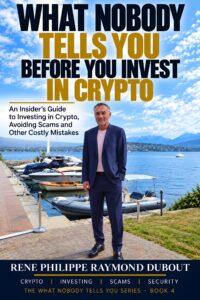
What Nobody Tells You Before You Invest in Crypto — An Insider’s Guide to Investing in Crypto, Avoiding Scams and Other Costly Mistakes.
📚 𝗡𝗼𝘄 𝗮𝘃𝗮𝗶𝗹𝗮𝗯𝗹𝗲 𝗼𝗻 𝗔𝗽𝗽𝗹𝗲 𝗕𝗼𝗼𝗸𝘀, with Amazon and Google Play Books coming shortly
It is the fourth title in the What Nobody Tell.s You series, and it is deliberately written for the retail investor who wants to understand the practical risks of crypto without becoming a trader, a programmer or a market technician.
The biggest risk is not always the price
Most people think of crypto risk in one way:
Will the price go up or down?
That matters, of course. But it is only one part of the picture.
An investor can make the correct call on the market and still lose money.
The exchange can fail.
The custodian can fail.
A lending platform can become insolvent.
A stablecoin can lose its peg.
A private key can be lost.
A scammer can persuade an investor to send funds to the wrong wallet.
A bank can ask questions about the source of proceeds that the investor is unable to answer because proper records were never kept.
This is why crypto needs to be understood as more than a speculative asset.
It is an ecosystem of assets, platforms, custodians, banks, wallets, legal rights and counterparties.
Each of those elements creates its own risk.
The asset and the platform are not the same thing
One of the most important lessons from the major crypto failures is that the asset itself and the institution holding it are completely different risks.
Bitcoin can continue to exist even if the exchange on which you bought it disappears.
A token can remain valuable while a platform holding customer assets becomes insolvent.
A trading interface can look sophisticated while the financial structure behind it is weak.
Retail investors therefore need to distinguish between:
the asset, the intermediary and the legal structure surrounding the investment.
That may sound obvious after the event.
It is not always obvious before money is transferred.
Custody matters
Crypto has introduced a new question for ordinary investors:
Who controls the keys?
If the investor leaves assets on an exchange, the exchange controls access.
If the investor chooses self-custody, intermediary risk is reduced, but personal responsibility increases substantially.
Lose the private keys, lose the recovery phrase, fall victim to malware or send the assets to the wrong address, and there may be nobody to call.
Institutional custody offers another route, but that creates its own questions about segregation, legal ownership, security procedures and insolvency treatment.
There is no single solution that removes all risk.
There are only different types of risk.
The important thing is to understand which one you are taking.
Getting into crypto is easy. Getting out can be much harder.
This is one of the most important issues for retail investors, and one of the least discussed.
Imagine that an investor buys cryptocurrency over several years and eventually makes a substantial profit.
The assets are sold.
The proceeds are transferred back to a traditional bank.
The bank may ask:
Where did the original investment capital come from?
Which exchanges were used?
Can the transactions be documented?
Which wallets were involved?
Were funds received from third parties?
Were peer-to-peer transactions used?
Were the assets routed through unregulated platforms?
Has the investor complied with applicable tax obligations?
These questions do not necessarily mean the bank suspects wrongdoing.
They reflect modern anti-money-laundering, source-of-funds and compliance requirements.
But an investor who kept no records can find that a successful investment has created an unexpected banking problem.
That is why one of the central messages of the book is simple:
Think about the exit before making the investment.
Crypto scams have become much more sophisticated
The old image of the obvious scam email is outdated.
Modern fraud can involve professional websites, realistic trading dashboards, fake customer-service teams, impersonation of legitimate businesses, social engineering and relationships developed over weeks or months.
Some victims are even allowed to make a small withdrawal at the beginning.
That creates trust.
The larger investment comes later.
By the time the investor realises what has happened, the money may already have passed through several wallets and jurisdictions.
The basic protection is therefore not technical brilliance.
It is discipline.
A legitimate investment can survive questions.
It can survive independent verification.
It can survive a delay.
If somebody says you must act immediately, guarantees unusually high returns, asks for secrecy or demands additional payments before your own money can be released, that is exactly the moment to stop and investigate.
Where does the yield come from?
Crypto investors are frequently offered the possibility of earning yield on their assets.
The book explains these mechanisms because retail investors should understand them.
It does not promote or recommend them.
The important question is not:
How high is the yield?
It is:
Where does the yield come from?
A return may depend on lending, leverage, staking, liquidity provision, smart-contract risk, counterparty exposure or the economics of a particular token.
Higher returns generally mean that someone is accepting additional risk somewhere in the structure.
If the source of the return cannot be explained clearly, the percentage advertised on the screen is of very little value.
Banking and crypto increasingly meet at the exit
For many investors, crypto feels separate from traditional finance while the investment is being made.
Eventually, however, the two systems meet.
That usually happens when substantial crypto proceeds need to enter the banking system.
At that point, banks may ask for documentation, transaction histories, proof of ownership, proof of original wealth and evidence explaining the economic background of the funds.
Retail investors who prepare properly can make that process much easier.
Those who do not may discover that the administrative side of a successful investment is far more complicated than the purchase itself.
This is an area where traditional financial due diligence and crypto risk increasingly overlap.
Why this book belongs on FintechLex
At FintechLex, much of our work concerns regulated financial businesses, banking, payments, licensing, acquisitions, compliance and financial due diligence.
Crypto sits directly inside that world.
The technology may be different, but the underlying questions are familiar:
Who is the counterparty?
Who holds the money?
What rights does the client actually have?
What happens if something goes wrong?
Is the business properly regulated?
Can the movement of funds be explained?
Can the structure withstand scrutiny?
Those questions matter whether the investment involves a bank, a payment company, a financial intermediary or a crypto platform.
A practical guide for ordinary investors
What Nobody Tells You Before You Invest in Crypto is not a book about predicting the next Bitcoin price.
It does not attempt to turn the reader into a professional trader.
It is written for the ordinary retail investor who wants to understand the risks before committing money.
The book follows the investment journey from the first purchase through exchanges, custody, market crashes, scams, stablecoins, yields, taxation, inheritance and, eventually, the return of crypto proceeds to the banking system.
The objective is straightforward:
to help investors ask the right questions before an expensive mistake answers them instead.
That is the purpose of the What Nobody Tells You series.
Good investment decisions usually begin long before the money is transferred.
New Release
What Nobody Tells You Before You Invest in Crypto
An Insider’s Guide to Investing in Crypto, Avoiding Scams and Other Costly Mistakes
By Rene Philippe Raymond Dubout
The What Nobody Tells You Series — Book 4
📚 𝗡𝗼𝘄 𝗮𝘃𝗮𝗶𝗹𝗮𝗯𝗹𝗲 𝗼𝗻 𝗔𝗽𝗽𝗹𝗲 𝗕𝗼𝗼𝗸𝘀, with Amazon and Google Play Books coming shortly.