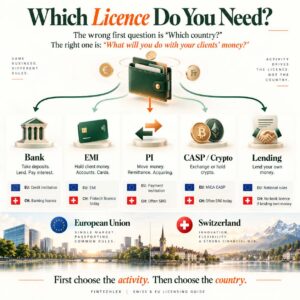
“I want a Swiss bank.” I hear it often. In most cases, what the person needs is not a bank at all.
What makes you a bank
In Switzerland, you need a banking licence if you accept deposits from the public on a commercial basis, and use them to finance lending or other activities. As a rule, accepting deposits from more than twenty people, or advertising that you do, makes it commercial.
The requirements
- Minimum fully paid-up capital of CHF 10 million. That is the legal minimum, and on its own it means nothing: in practice, today, a new bank with less than CHF 20 to 40 million will not get a licence.
- Capital adequacy, liquidity and risk diversification rules.
- A board of directors separate from management, with independent members.
- Full organisation: risk management, compliance, internal audit, IT security.
- Fit and proper people, and shareholders of good reputation.
- Annual regulatory audit and direct FINMA supervision.
FINMA classifies banks and securities firms into five supervisory categories, according to their size, importance and risk. The criteria are total assets, assets under management, privileged deposits and required capital; the thresholds are set in the Banking Ordinance. As a rough guide, by total assets:
- Category 1: extremely large, important and complex institutions, whose failure could destabilise the financial system (total assets of CHF 250 billion or more). Very high risk, continuous and intensive supervision.
- Category 2: very important and complex institutions (CHF 100 billion or more). High risk, close supervision.
- Category 3: large and complex institutions (CHF 15 billion or more). Significant risk.
- Category 4: medium-sized institutions (CHF 1 billion or more). Medium risk.
- Category 5: small institutions (below CHF 1 billion). Low risk, supervised mainly through quantitative indicators. Most Swiss banks are here, and any new bank starts here.
Since 2020, small banks in categories 4 and 5 that are very well capitalised and very liquid can opt for a simplified regime, with lighter requirements.
The alternatives
- The fintech licence, often called a “banking licence light”: a bank that is not really a bank. It allows you to accept deposits without investing them or paying interest on them, with lighter requirements than a bank. The well-known CHF 100 million cap applies to public deposits, in practice retail clients. Deposits from clients with professionally managed treasury, such as institutional and corporate clients, do not count as public deposits and are not capped. Crypto-based assets are not subject to that cap either. But in practice, the fintech licence is dead. The Federal Council has proposed to replace it with a new “payment instrument institution” licence, and I would not count on starting a new fintech licence application today. If this is the model you had in mind, plan for the new licence instead.
- Buying an existing bank: sometimes faster than applying, but the change of control requires FINMA approval of you.
- Partnering with a bank: for many fintechs, the most realistic route.
What nobody tells you
The legal minimum is not the real minimum. The law says CHF 10 million; FINMA will look at your business plan, your risks and your losses before break-even, and expect a great deal more. Let me be blunt: if you are planning a new Swiss bank with CHF 10 or 15 million, stop now. And the capital is only the start: a new bank needs years of losses before it breaks even, a board FINMA trusts, and shareholders who can put in more money when asked. Before you ask whether you can get a banking licence, ask whether you can afford to own a bank.
Considering a Swiss bank, a fintech licence or a bank acquisition? Contact FintechLex · insight@fintechlex.com
Last updated: October 2026. This article is general information, not legal advice.