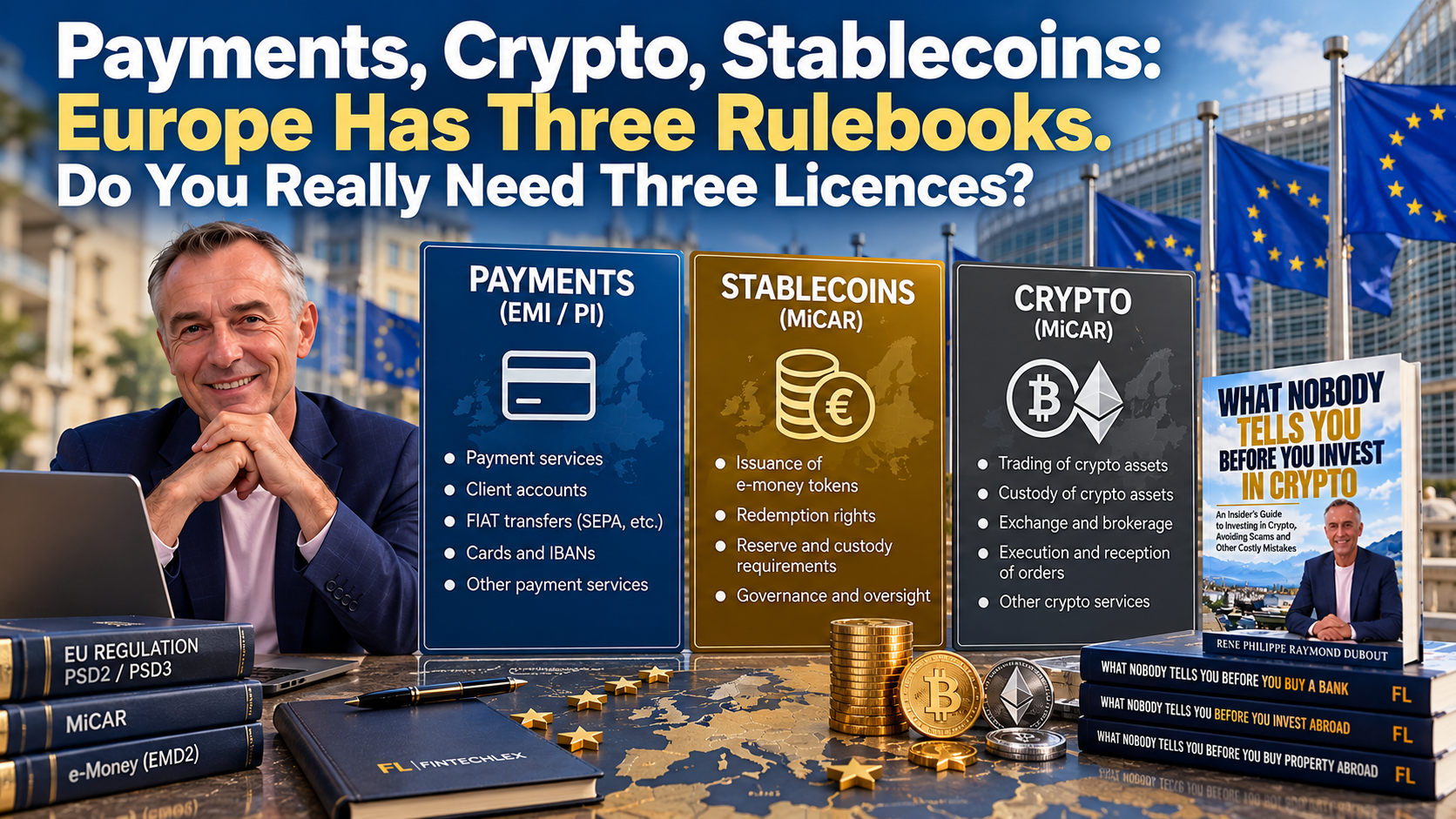
Europe now regulates fintech through three separate rulebooks: one for payments and electronic money, one for crypto services, and one for stablecoins. Founders keep asking me the same question: do I need three companies and three licences?
The short answer is no, not necessarily. Three regimes do not mean three companies. But each regime has its own logic, its own capital and its own traps, and the payments regime is about to change. Here is how an EMI and MiCA licence fit together, and what the new Payment Services Directive (PSD3) changes.
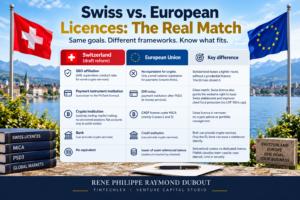
This article covers Europe only. In the next one, we will compare it with the new Swiss licences and with what remains possible under a Swiss SRO.
1. Payments and e-money today: two licences
Today, Europe distinguishes two types of payment firms.
- The payment institution (PI), licensed under the second Payment Services Directive (PSD2), provides payment services: payment accounts, transfers, card issuing and acquiring, money remittance, payment initiation and account information. Initial capital ranges from €20,000 for money remittance to €125,000 for most services.
- The electronic money institution (EMI), licensed under the E-Money Directive, can do all of that and also issue electronic money. Initial capital is €350,000, and own funds must be at least 2% of the average e-money outstanding.
Both must safeguard client funds, keeping them separate from their own money. Neither is a bank: they may not take deposits, and an EMI may not pay interest on e-money. Both can passport their licence to every country of the European Economic Area. For how they compare with a bank licence, see Which Fintech Licence Do You Need?.
2. What PSD3 and the PSR change
In April 2026, the Council and the European Parliament agreed the texts of two new instruments: PSD3, a directive that governs licensing, and the Payment Services Regulation (PSR), which applies directly and governs how payment services are provided. Formal adoption is still pending. Most rules will apply about 21 months after entry into force, so probably not before 2028.
The end of the separate EMI licence
PSD3 absorbs the E-Money Directive. Issuing e-money becomes one more payment service, under a single payment institution licence. The EMI as a separate category disappears; e-money issuance remains a specifically regulated activity within that licence.
Existing EMIs and PIs: a reconfirmation, not a new licence
Existing firms do not start from scratch. Under the agreed text, they can keep operating during a transition period that runs until 27 months after entry into force. In the meantime, they send their regulator the information it needs to check that they meet the new requirements. Where the regulator already has that evidence, it can confirm the licence automatically. Firms that comply are deemed authorised and stay on the register. Firms that do not are suspended until they comply.
What the regulator will check:
- Safeguarding: e-money funds received through a card or another payment instrument, which today can wait up to five business days before being safeguarded, must be protected by the end of the next business day.
- A wind-down plan: how the firm would close in an orderly way, and return client funds, if it fails.
- Governance and outsourcing: stricter rules, in line with the European rules on digital operational resilience, which already apply since January 2025.
- Capital: existing firms must meet the new levels when they are reconfirmed. For e-money, own funds remain at least 2% of the e-money outstanding.
Capital: what the agreed text says
Published analyses gave different figures. We went back to the agreed compromise text of 17 April 2026 (Article 5). It sets these minimums:
| Activity | Today | Agreed PSD3 text |
|---|---|---|
| Money remittance only | €20,000 | €40,000 |
| Payment initiation | €50,000 | €50,000 |
| Most payment services (accounts, transfers, cards, acquiring) | €125,000 | €150,000 |
| Issuing e-money | €350,000 | €250,000 |
The amounts add up: a firm that issues e-money and also provides payment services needs €400,000. These are the figures of the agreed text, not yet law, and they could still move before formal adoption. If your business plan depends on them, write to us.
Fraud and liability under the PSR
The PSR builds on the check that the payee’s name matches the account number, already required for euro transfers since 9 October 2025 under the Instant Payments Regulation. It extends the provider’s liability in some impersonation frauds and tightens open banking rules. These are conduct rules: they apply directly in every Member State, with no national transposition.
What this means for buyers of EMIs
An EMI bought today will have to go through reconfirmation under PSD3. A buyer must therefore check not only the licence, but whether the firm can pass the new test: capital, safeguarding, wind-down plan, governance. We cover the rest of the checklist in EMI for Sale in Europe: What to Check.
3. Crypto services: one MiCA licence, three classes
For crypto services, the Markets in Crypto-Assets Regulation (MiCA) created a single licence: the crypto-asset service provider (CASP). It covers ten services, and the minimum capital depends on which ones the firm provides:
| Class | Services | Minimum capital |
|---|---|---|
| Class 1 | Reception and transmission of orders, execution of orders, advice, placement, portfolio management, transfers | €50,000 |
| Class 2 | Class 1, plus custody and exchange of crypto-assets for money or for other crypto-assets | €125,000 |
| Class 3 | Class 2, plus operating a crypto trading platform | €150,000 |
If a quarter of the firm’s annual fixed overheads is higher, that amount applies instead. The requirement can be met with own funds, an insurance policy, or a combination of both. Each service must be listed in the authorisation: a Class 3 firm is not automatically authorised for everything. And MiCA never covers tokenised securities or derivatives: those remain under the financial markets rules.
A CASP licence can be passported across the European Union. The transition period for firms that operated before MiCA ended on 1 July 2026 at the latest. Today, providing crypto services in the EU without a licence, or without one of the notification routes below, is no longer possible.
Banks can provide crypto services by notifying their regulator. Investment firms can do the same, but only for crypto services equivalent to those they are already licensed for. An EMI may provide custody and transfers of the e-money tokens it issues itself, by notification. For any other crypto service, an EMI needs a CASP licence. On how MiCA has reshaped the market, see MiCA: Europe’s Trojan Horse.
4. Stablecoins: there is no single “stablecoin licence”
MiCA distinguishes two kinds of stablecoins, with very different rules.
E-money tokens (EMTs)
An e-money token is pegged to one official currency, such as the euro or the dollar. Legally, it is treated as electronic money. Only a bank or an EMI may issue one, after notifying and publishing a white paper. There is no separate issuer licence. The holder may redeem at par at any time, the issuer may not pay interest, and at least 30% of the funds received must be held in separate accounts at banks.
One difference matters: an e-money token in a currency that is not an EU currency, such as the US dollar or the Swiss franc, is subject to the same usage cap as asset-referenced tokens (see below).
Asset-referenced tokens (ARTs)
An asset-referenced token references another value or right, or a combination: a basket of currencies, gold, or other assets. Its issuer needs a specific MiCA authorisation and must be established in the EU, with own funds of at least €350,000, 2% of the reserve, or a quarter of fixed overheads, whichever is highest. A bank does not need the authorisation, but its white paper must be approved and it must notify its regulator at least 90 working days before issuing.
Two exemptions exist: small issues, with an average amount outstanding below €5 million, and tokens offered only to qualified investors. They escape the authorisation, though not every rule.
Use as money is capped. Where a token is used as a means of exchange within one currency area for more than 1 million transactions and more than €200 million a day, on a quarterly average, the issuer must stop new issuance and present a plan to bring use down.
Where a token becomes “significant” (by number of holders, value or transactions), stricter requirements apply. For a significant asset-referenced token, the European Banking Authority takes over supervision of the issuer. For a significant e-money token issued by an EMI, it supervises specific obligations, alongside the national regulator.
5. Where the regimes overlap
The three rulebooks were written separately, and they collide on one point: e-money tokens are both crypto-assets under MiCA and electronic money under PSD2.
In practice, transferring or holding e-money tokens for clients can be a payment service, depending on how the service works. In June 2025, the European Banking Authority gave crypto firms a grace period to sort this out. It ended on 2 March 2026. Since then, where its services qualify as payment services, a CASP needs a payment licence of its own or must work through a licensed payment partner. A pending application allows it to continue only under conditions set by its regulator.
PSD3 partly fixes this. A licensed payment institution will be able to provide crypto services on e-money tokens, linked to its payment services, by notifying its regulator 40 working days in advance, without a separate MiCA licence. It does not open the door to Bitcoin or Ether. Peer-to-peer transfers of e-money tokens without an intermediary are excluded from the payment rules.
6. Three regimes, how many companies?
One company can hold several authorisations. An EMI can issue an e-money token, and the same company can hold a CASP licence for custody and exchange. One company, several regulated activities, several sets of obligations.
| Activity | Today | After PSD3 | Rulebook |
|---|---|---|---|
| Payment services and e-money | Payment institution, or EMI to issue e-money | One payment institution licence; e-money issuance is a specific service, with its own capital added | PSD2 and E-Money Directive, then PSD3 and PSR |
| Crypto services | CASP licence (3 classes) | Unchanged; a PI may notify certain services on e-money tokens | MiCA |
| Issuing e-money tokens | Bank or EMI, white paper notified | Bank or payment institution with e-money services | MiCA and payment rules |
| Issuing asset-referenced tokens | Specific MiCA authorisation; banks need an approved white paper | Unchanged | MiCA |
Is it wise to put everything in one company? Not always. Separating payments from crypto custody and trading limits the damage of a hack and keeps liabilities apart. I have recommended that structure to clients for years. In Europe, it is mostly a choice, though a regulator can still require a separate entity where other activities could impair the institution’s soundness or its supervision.
The number of licences does not measure the quality of regulation. What matters is whether client assets are protected, risks are controlled and responsibilities are clear.
Planning a payment, e-money or crypto business in Europe, or buying an EMI before PSD3? Write to insight@fintechlex.com.
Read the full series on the new licences, in Switzerland and in Europe:
- Switzerland’s Two New Licences: What Goes to the Payment Licence, What Goes to the Crypto Licence, and What Is Left for the SRO
- EMI, MiCA and Stablecoin Licences in Europe: Three Regimes, and What PSD3 Changes (this article)
- Switzerland vs the EU: Which Swiss Licence Matches Which European Licence?
Based on PSD2, the E-Money Directive, MiCA, the PSD3 and PSR texts agreed in April 2026 (Council compromise of 17 April 2026, not yet adopted), and the European Banking Authority’s no-action letter of June 2025 and opinion of February 2026. General information, not legal advice.