Swiss crypto licence vs MiCA:In our last article, we mapped the European rulebooks for payments, crypto and stablecoins. Switzerland is now building its own system, with two new licences: the payment instrument institution and the crypto institution.
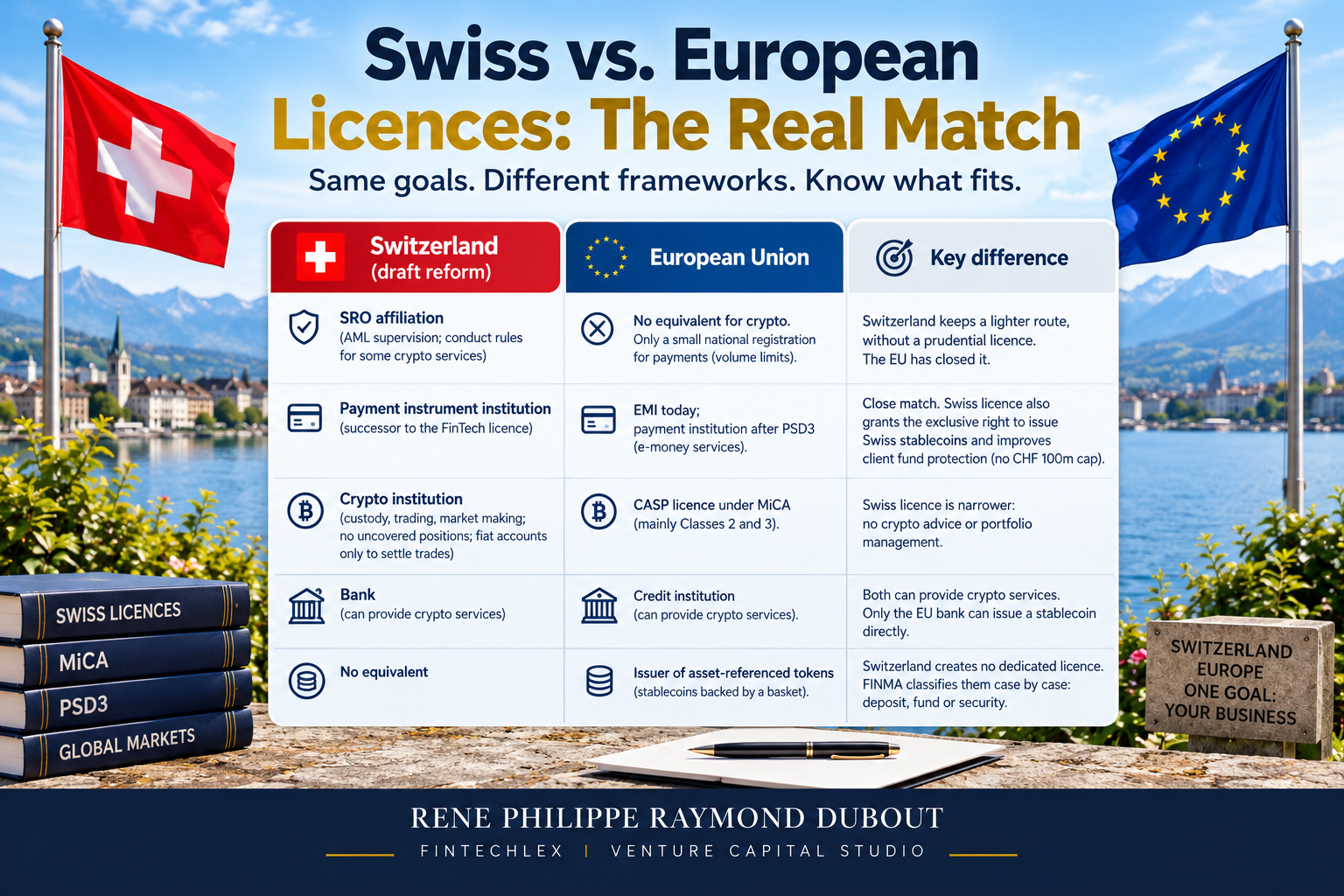
So the question clients now ask is simple: which Swiss licence matches which European licence? Here is the side-by-side view, comparing the Swiss crypto licence with MiCA, the Swiss payment licence with the EMI, and the Swiss SRO with… nothing at all.
A reminder on timing: the European rules are in force (MiCA) or agreed (PSD3, formal adoption pending, probably applying from 2028). The Swiss reform is still a draft: the consultation closed on 6 February 2026, and the bill is not yet before Parliament.
1. Face to face: the licences
| Switzerland (draft reform) | European Union | The main difference |
|---|---|---|
| SRO affiliation (anti-money laundering supervision only). What stays there: businesses that neither hold client money nor hold or trade crypto for clients, such as currency exchange, crypto-only portfolio management, and payment services that never hold client funds. Precious metals trading and lending, including leasing and factoring, also stay on the SRO: the reform does not touch them. The draft adds conduct rules for some crypto services. | No equivalent for crypto. The national crypto registrations ended with MiCA’s transition period on 1 July 2026. For payments, only a small national registration with volume limits. | Switzerland keeps a lighter route, without a prudential licence. The EU has closed it. |
| Payment instrument institution (successor to the FinTech licence). It also absorbs SRO activities: any finance business that accepts client money could need it, including SRO companies holding client funds on settlement accounts, unless the Federal Council keeps an exception, and stablecoin issuers that today rely on a bank guarantee. | EMI today; payment institution with e-money services after PSD3 | Close match. But only the Swiss licence has the exclusive right to issue Swiss stablecoins (as defined in the draft: one currency, issued in Switzerland). It also improves on the FinTech licence: client funds are kept out of the bankruptcy estate, and the CHF 100 million cap disappears. |
| Crypto institution | CASP licence under MiCA, mainly Classes 2 and 3 | The Swiss licence is narrower: custody, trading for clients, market making, with no uncovered positions and fiat accounts only to settle trades. Crypto advice and crypto portfolio management do not need it: no licence, but new conduct rules under the Financial Services Act. |
| Bank | Credit institution | Both can provide crypto services (in Switzerland, through the cascade of Article 6, also open to some securities firms). Only the EU bank can issue a stablecoin directly. |
| No equivalent | Issuer of asset-referenced tokens (stablecoins backed by a basket) | Switzerland creates no dedicated licence. FINMA classifies them case by case: deposit, fund or security (see section 3). |
2. Activity by activity
The licence names do not tell the whole story. What matters is what you actually do. Here is where each activity lands:
| What you do | Switzerland today | Switzerland under the draft | European Union |
|---|---|---|---|
| Exchange or broker crypto for clients | SRO | Crypto institution, even without custody: trading in its own name for clients, or quoting prices for its own account, including OTC desks | CASP, Class 1 or 2 |
| Hold crypto for clients | SRO if held individually; bank or FinTech licence if held collectively | Crypto institution, in both cases | CASP, Class 2 |
| Run a crypto trading platform | SRO | Crypto institution | CASP, Class 3 |
| Crypto advice only | No SRO needed: no client assets handled | Outside the crypto licence; conduct rules may apply | CASP, Class 1 |
| Crypto portfolio management | SRO (FINMA portfolio manager licence only if the portfolio includes financial instruments) | No licence; SRO, plus new conduct rules under the Financial Services Act | CASP, Class 1 |
| Staking for clients | SRO if assets stay individually segregated; pooled staking can require a banking licence | Crypto institution, with a separate client agreement | Depends on the structure; often custody under MiCA |
| Non-custodial wallet | Outside regulation in most cases | Unchanged | Outside MiCA |
| Hold client money, make payments | FinTech licence or bank; accounts used only to settle transactions can stay under an SRO | Payment instrument institution | Payment institution or EMI |
| Issue a stablecoin in one currency | Bank or FinTech licence, or a bank default guarantee (FINMA Guidance 06/2024) | Payment instrument institution only. An SRO company cannot issue; a bank needs a separate company | EMI or bank (e-money token) |
| Issue a basket-backed stablecoin | Depends on FINMA classification: bank, fund or securities rules | Unchanged: no dedicated licence | Asset-referenced token authorisation |
| Trade Swiss stablecoins for clients | SRO; FinTech licence or bank if held collectively | SRO: secondary trading is not further regulated, apart from custody and anti-money laundering rules. Holding them for clients needs the crypto institution or payment instrument institution licence | Not allowed: the Swiss issuer is not authorised in the EU |
| Trade or hold foreign stablecoins for clients | SRO; FinTech licence or bank if held collectively | Crypto institution: foreign stablecoins count as crypto-assets with trading character | CASP licence, and only for coins from an issuer authorised in the EU |
| Trade precious metals for clients | SRO. Refiners trading bank precious metals are supervised by the Precious Metals Control Office instead; buying old gold needs a separate registration | Unchanged | No EU licence; national anti-money laundering rules |
Two lessons stand out.
First, the SRO is a Swiss specificity. In Europe, MiCA ended the era of simple national registrations. In Switzerland, a crypto business that does not hold client assets or trade for clients can still operate under an SRO, even after the reform, though the draft adds conduct rules for some crypto services. For crypto advice and crypto portfolio management, Switzerland remains lighter than Europe.
Second, Switzerland draws a harder line on stablecoins. In the EU, a bank or an EMI can issue an e-money token in the same company that does everything else. In Switzerland, only a payment instrument institution may issue a stablecoin in one currency, an SRO company cannot issue at all, and even a bank would need a separate company. Trading is another matter: an SRO company can still trade Swiss stablecoins, as long as it does not hold them for clients, but trading or holding foreign stablecoins for clients will need the crypto institution licence. We explained why in Stablecoins: When Even a Bank Needs a Separately Licensed Subsidiary.
3. Basket-backed stablecoins: two opposite approaches
This is where the two systems differ most. The EU gives basket-backed stablecoins one fixed category, with strict conditions. Switzerland has no category at all: it places each coin into an existing one, depending on how it is built.
The EU: one category, fixed by law
Under MiCA, unless the token is a financial instrument, a stablecoin backed by a basket of currencies, commodities or other assets is an asset-referenced token. The rules are known in advance:
- Issuer: a specific MiCA authorisation, and the issuer must be established in the EU. A bank does not need the authorisation, but its white paper must be approved and it must notify at least 90 working days before issuing.
- Capital: at least €350,000, 2% of the reserve, or a quarter of fixed overheads, whichever is highest.
- Reserve: segregated, protected if the issuer fails, held in custody, with strict investment rules.
- Holders: a right to redeem at any time at the market value of the basket. No interest.
- Use as money is capped: where the token is used as a means of exchange within one currency area for more than 1 million transactions and more than €200 million a day, on a quarterly average, the issuer must stop new issuance and present a plan to bring use down.
- Large tokens: a “significant” token moves to supervision by the European Banking Authority, with own funds of 3% of the reserve.
Two exemptions exist: small issues, with an average amount outstanding below €5 million, and tokens offered only to qualified investors. They escape the authorisation, though not every rule.
And a foreign issuer without EU authorisation cannot offer its token to the public or have it admitted to trading in the EU.
Switzerland: FINMA decides case by case
Note first that a foreign stablecoin, even one pegged to a single currency, is not a Swiss stablecoin under the draft: subject to its classification, it is treated as a trading crypto-asset. FINMA applies “substance over form”: it looks at what the holder can claim, what backs the token, and above all who bears the risk of the reserve. Its own indicative classification gives this:
| Backing | What the holder gets | Likely Swiss treatment today |
|---|---|---|
| Basket of currencies | Redemption claim; the issuer bears the reserve risk | Deposit from the public: banking licence, FinTech licence (up to CHF 100 million, no interest) if the structure fits, or a bank default guarantee (FINMA Guidance 06/2024). Not a public deposit if all holders are banks, insurers, pension funds or institutional investors with a professional treasury |
| Basket of currencies | Redemption claim; the holders bear the reserve risk | Collective investment scheme: fund rules |
| Precious metals | Contractual claim against the issuer | Deposit, like a bank precious metals account, with the same exception for professional holders |
| Other commodities | Contractual claim against the issuer | Security, possibly a derivative |
| Commodities | Real ownership right, legally transferred with the token, with no irregular deposit (article 481 of the Code of Obligations) | No prudential licence for the issue; anti-money laundering rules in most cases. A mere promise to deliver is not enough |
| Basket of commodities, real estate or securities | Claim that depends on the value of the basket | Collective investment scheme, probable |
The deposit rules protect retail clients:
where a coin is offered only to banks, insurers, pension funds or institutional investors with a professional treasury, the funds are not deposits from the public, and neither a banking licence nor the CHF 100 million limit applies.
After the reform, the FinTech licence disappears, and the new payment instrument institution may issue only stablecoins pegged to a single currency. A basket-backed coin that qualifies as a deposit would therefore need a banking licence. And no licence for the issue does not mean no licence for the rest: if the token counts as a crypto-asset with trading character, holding or trading it for clients will need the crypto institution licence.
The anti-money laundering rules almost always apply. Where a coin is used widely for payments, the operator of the payment system may also need a licence, if FINMA considers it necessary for the functioning of the markets or the protection of their participants.
The classification, together with the activity, then decides who may trade the coin for clients:
| If FINMA classifies the token as… | Switzerland today | Switzerland under the draft |
|---|---|---|
| A crypto-asset (neither a security nor a fund) | SRO-affiliated company; FinTech licence or bank if held collectively | Crypto institution, bank, or securities firm holding client accounts, even without custody where the firm trades in its own name for clients or quotes prices |
| A security | Securities firm or bank, when trading in its own name for clients, on a trading venue or over the counter | Unchanged: outside the crypto licence |
| Units of a fund | Financial service providers under the Financial Services Act. An offer to retail clients needs a fund approved by FINMA; otherwise, qualified investors only | Unchanged |
Side by side: tokens referencing a basket
| European Union | Switzerland | |
|---|---|---|
| Category | Asset-referenced token, fixed by law, unless the token is a financial instrument | No standalone equivalent category: deposit, fund, security or crypto-asset, case by case |
| Issuer | MiCA authorisation, established in the EU; an EU credit institution needs only an approved white paper | No dedicated licence; depends on the classification |
| Foreign issuer | Locked out without EU authorisation. Exemptions: an average amount outstanding below €5 million, or an offer and holding reserved to qualified investors. A white paper is still required | Possible if the classification allows it, subject to the Swiss rules on offering |
| Capital | The highest of €350,000, 2% of the average reserve, or a quarter of fixed overheads; 3% of the reserve for a significant token | Depends on the classification |
| Interest to holders | Forbidden, for issuers and CASPs | No general ban for basket-referenced tokens: the legal structure decides. The new Swiss single-currency stablecoins may not pay interest |
| Use for payments | Above both 1 million transactions and €200 million a day as a means of exchange in one currency area, on a quarterly average, the issuer must stop new issuance and submit a plan within 40 working days | No cap; the operator of a payment system may need a licence |
| Who can trade it | A CASP licensed for the service, or a financial institution notified under MiCA Article 60, for tokens from an authorised issuer, subject to the exemptions | Depends on the classification and the activity: SRO company, crypto institution, or only banks and securities firms |
The EU is harmonised but closed.
Most rules are known in advance, though MiCA has its own classification questions and exemptions, but you need an authorised issuer in the EU, and the payment cap limits the coin’s use as money.
Switzerland is flexible but uncertain.
A foreign issuer is possible and there is no cap, but the classification decides everything: the same coin can be traded by a small SRO company or only by a bank, depending on how it is built. For any issuer planning a basket-backed stablecoin with Swiss activity, a ruling from FINMA before launch is not a luxury.
4. What the comparison does not show
No passport
A European licence can be passported to the 30 countries of the European Economic Area, for the services it covers, after notification. A Swiss licence gives no passport. For a business that wants European clients, this is often the deciding factor, whatever the quality of Swiss supervision.
One company or two
In Europe, one company can be an EMI, issue e-money tokens and hold a CASP licence. An EMI can even hold and transfer its own e-money tokens for clients after a simple notification, without a separate CASP licence (MiCA, Article 60). In Switzerland, Lenz & Staehelin read the explanatory report as granting the new licences only to separate legal entities. The report does not say it in those words, but its reasoning goes beyond banks. It states that accepting client funds, and the requirements attached to it, are “not compatible with the activities of other financial institutions”. That is why the payment instrument institution sits outside the cascade, and why a bank must set up a separate legal entity to obtain this licence. Whether one company could hold both new licences is not addressed expressly. Given that reasoning, we would not plan on it until FINMA’s practice is known.
In our view, this separation follows from how the Financial Institutions Act was built in 2015: each licence is defined by its activity, and only the cascade of Article 6 lets one licence cover another. The draft deliberately leaves the payment instrument institution out of that cascade, and the report ties the bank separation to exactly that choice. Common ownership is not the issue: a bank can hold the payment institution as a subsidiary. Planning a structure around the new licences? Talk to us.
Transition
Under draft Article 74b, licence holders get one year to meet the new requirements, and businesses newly subject to a licence get one year to apply and to meet the licensing conditions. They may continue until FINMA decides, provided they stay affiliated to an SRO and supervised by it.
Capital
For the two new Swiss licences, the minimum capital is left to the ordinance, which has not been published. In Europe, crypto capital is known: €50,000 to €150,000 under MiCA, as a floor, since a CASP needs the higher of that amount or a quarter of its fixed overheads, in own funds or insurance. The PSD3 compromise text sets €150,000 for most payment services and €250,000 for e-money, added together for firms doing both, though it is not yet law. On the Swiss side, the figures that matter most are not known yet.
5. Which one is better?
Neither, in absolute terms. The European system is wider and passportable, but heavier for small crypto businesses. The Swiss system keeps a light route through the SRO, but imposes stricter separation on banks for stablecoins and provides no EU passport.
In practice, the choice depends on four questions: where are your clients, do you hold their assets, which tokens do you handle and do you trade them in your own name for clients or as a counterparty, and do you want to issue a stablecoin? Under the Swiss draft, a business that holds nothing for its clients can still need the crypto licence. Many of our clients end up with both: a Swiss company for the Swiss ecosystem, and a European licence for the European market.
Not sure which licence, or which combination, fits your business? Write to insight@fintechlex.com.
Read the full series on the new licences, in Switzerland and in Europe:
- Switzerland’s Two New Licences: What Goes to the Payment Licence, What Goes to the Crypto Licence, and What Is Left for the SRO
- EMI, MiCA and Stablecoin Licences in Europe: Three Regimes, and What PSD3 Changes
- Switzerland vs the EU: Which Swiss Licence Matches Which European Licence? (this article)
Switzerland: Federal Council consultation draft of 22 October 2025 amending the Financial Institutions Act, and FINMA Guidance 06/2024, and the 2019 FINMA supplement to its ICO guidelines on stablecoins (indicative classification). European Union: MiCA, PSD2, the E-Money Directive and the PSD3 and PSR compromise texts (Council text of 17 April 2026, not yet adopted). General information, not legal advice.