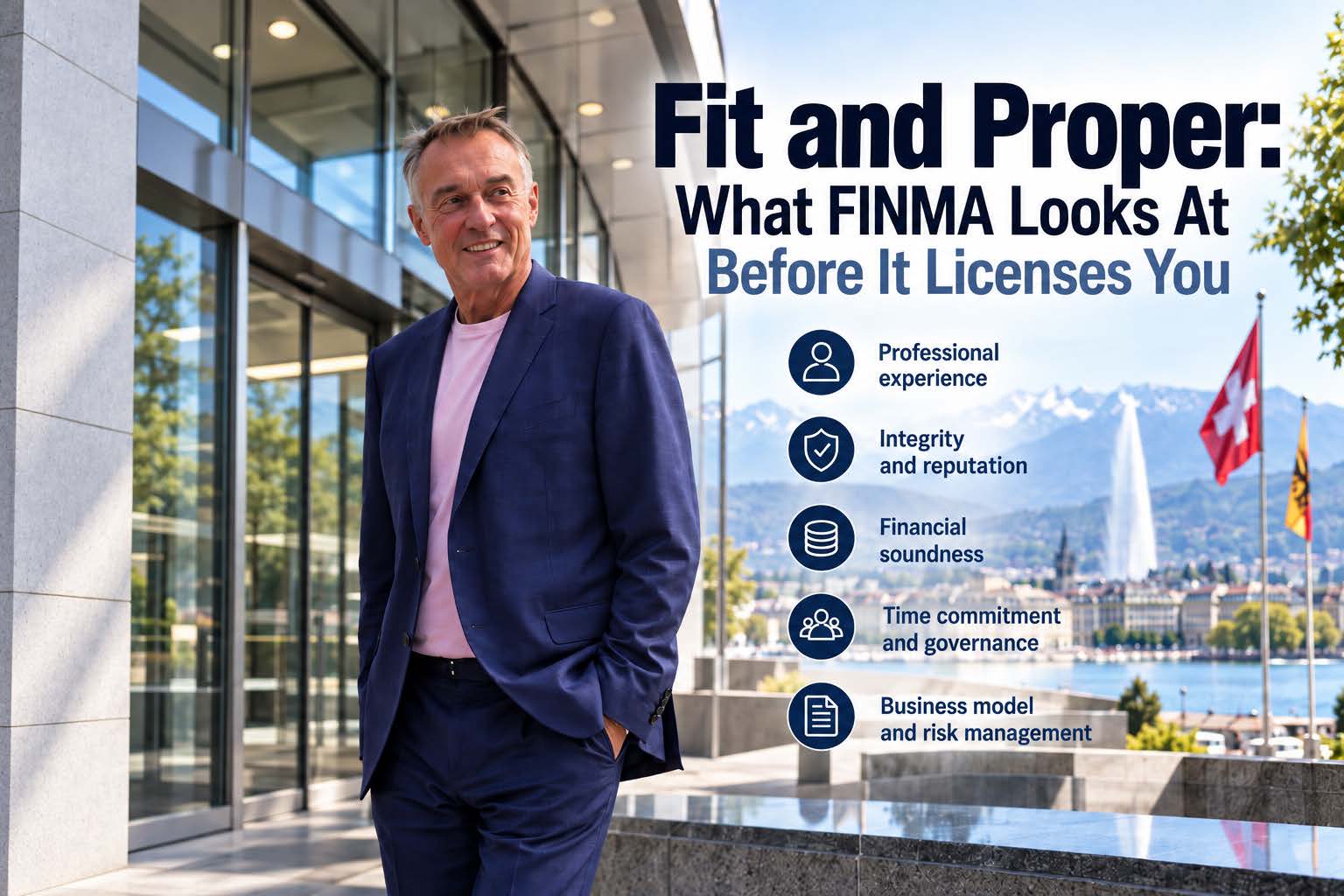
Every FINMA licence, whatever the activity, rests on one condition that no business plan can replace: the people who run and own the institution must guarantee irreproachable business conduct. In practice, it is where many applications slow down, and some end.
This guide explains who FINMA looks at, what it looks for, and how to prepare. It is part of our guide to doing financial business in Switzerland.
Who FINMA assesses
- The board of directors, including its chair.
- Executive management: the CEO and the other members of management.
- The holders of qualified participations: shareholders with a significant direct or indirect stake, usually 10% or more, or significant influence by other means.
Indirect owners count. A holding company, a trust or a foundation at the top of the chain will lead FINMA to the individuals behind it. The shareholder nobody mentioned is usually the one FINMA finds.
What “irreproachable business conduct” means
FINMA looks at all the character-related and professional factors that allow a person to run a supervised institution properly. Two points matter:
- It is assessed against the role. A person can be fit for one position and not for another. A good compliance officer is not automatically a credible CEO of a bank.
- It covers both integrity and competence. A clean record is not enough without the experience the position requires; experience is not enough with an unexplained past.
What FINMA checks
- education, training and professional experience;
- the person’s financial situation;
- extracts from the commercial register, the debt enforcement and bankruptcy registers and the criminal record;
- reports from auditors, other supervisors, professional bodies and courts, and any criminal, administrative or employment proceedings.
FINMA keeps its own database for these assessments, including past findings. A history with another supervisor, in Switzerland or abroad, will surface.
For shareholders: influence, not just reputation
For a qualified shareholder, the question is whether his influence could be detrimental to the prudent and sound management of the institution. Source of funds, financial strength, other business interests and the group structure all come into it. This is the same test FINMA applies when someone buys an existing institution: see Buying a Bank or an EMI: How the Regulator’s Approval Really Works.
What sinks an application
- An ownership chain that cannot be explained in one page, down to the individuals.
- A source of wealth that is asserted rather than documented.
- Undisclosed history: a past proceeding is a question; a hidden one is an answer.
- Nominee directors who lend their name but do not run anything. FINMA expects the people on paper to be the people in charge.
- A management team assembled at the last minute, without the experience the licence requires.
And after the licence
Fit and proper is not a one-time test. Every new board member, manager or qualified shareholder is assessed again, and FINMA can order an institution to remove a person who no longer meets the requirement. For what each licence demands of its people, see The Swiss Banking Licence and The Swiss Portfolio Manager Licence.
Ask us to review your people and ownership file before FINMA does, or write to insight@fintechlex.com.
This article is for general information only and does not constitute legal advice.