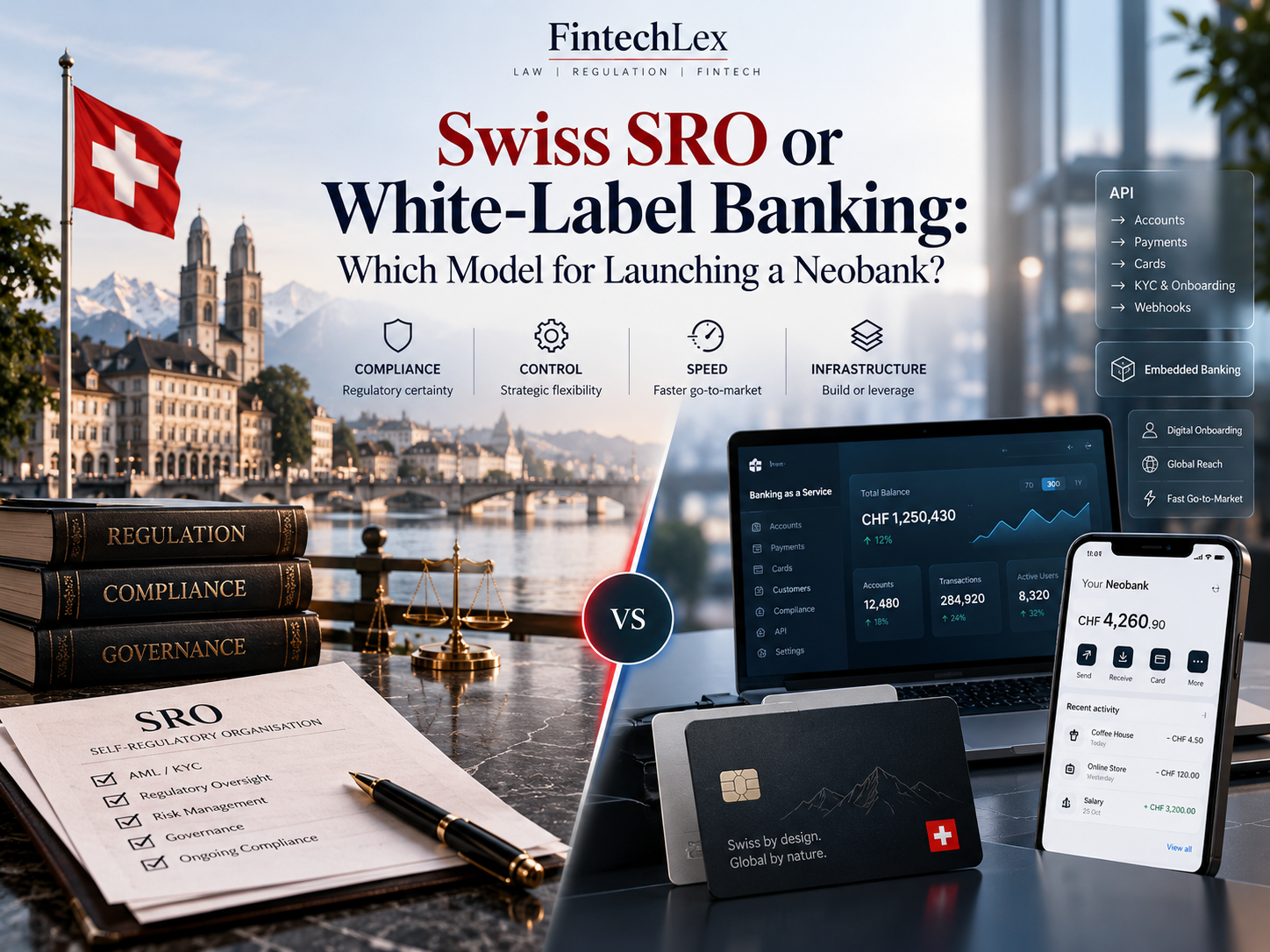
White Label Banking: Two architectures can produce the same visible customer experience—an app, a card and an IBAN. On the other hand, they do not provide the same autonomy, regulatory perimeter or ability to recover if the banking partner exits.
By Rene-Philippe Raymond Dubout · FintechLex Insight · October 2026
The starting point
Anyone planning to launch a neobank in Switzerland eventually reaches the same strategic fork. The first route is pure white-label banking: the operator relies entirely on the regulated permissions, accounts, cards, payment rails and compliance framework of an established provider. The second route uses a two-layer architecture: a Swiss company affiliated with a FINMA-recognised self-regulatory organisation (SRO), connected to a white-label provider for the banking infrastructure that falls outside the company’s own regulatory perimeter.
To the customer, both models may look almost identical. Behind the interface, however, they allocate regulatory responsibility, operational control and exit risk very differently.
Model 1 — Pure white-label banking
Under a pure white-label model, the operator does not necessarily hold a financial authorisation of its own. It uses the regulated infrastructure of a licensed banking or payment institution, while presenting the service under its own brand.
The provider may supply accounts, IBANs, cards, payment rails, foreign-exchange services, transaction monitoring, screening and other compliance functions. This can shorten the route to market and reduce the burden of building a regulated operation from the ground up.
Advantages
- Faster implementation in many cases.
- Lower initial regulatory and operational investment.
- Access to established banking and payment infrastructure.
- A significant part of the prudential and compliance framework is managed by the licensed provider.
Limitations
The commercial simplicity comes with structural dependency. If the provider changes its risk appetite, increases its prices, restricts a market, terminates the relationship or withdraws a service, the operator may have limited room to manoeuvre.
Customer data, onboarding files, transaction histories, card programmes and operational procedures may also be difficult to migrate unless portability and exit assistance were negotiated at the outset. A white-label contract therefore needs to be assessed not only as a launch agreement, but also as an exit agreement.
Model 2 — A Swiss SRO company as the foundation
The alternative is to establish a Swiss company and seek affiliation with a FINMA-recognised SRO where the planned activities fall within the scope of the Swiss Anti-Money Laundering Act. The company then has its own AML governance and is supervised by the SRO within the approved perimeter.
SRO affiliation is not a banking licence. It does not, by itself, authorise the company to accept public deposits, issue bank accounts or provide every service associated with a neobank. Banking, safeguarding, card issuing and certain payment services may still need to be supplied by an appropriately licensed partner.
The difference is that the operator owns more of its regulatory organisation. Its corporate structure, AML framework, policies, governance and business relationships are not merely features rented from a single provider.
What can survive a change of provider
- The Swiss legal entity and its corporate governance.
- The SRO affiliation, subject to continuing compliance and any required notifications or approvals.
- Internal AML policies, risk classifications and control procedures.
- Commercial relationships and brand assets owned by the company.
- A greater part of the operational architecture, where contracts and data rights have been drafted correctly.
What does not automatically survive
- IBANs, accounts or cards issued under the former provider’s licence.
- Payment rails and safeguarding arrangements tied to that provider.
- Customer migration rights that were not secured contractually.
- Services outside the SRO company’s own regulatory perimeter.
Practical comparison
| Criterion | Pure white label | SRO + white label |
|---|---|---|
| Launch speed | Often faster | Slower: incorporation, AML governance and SRO admission |
| Initial investment | Generally lower | Higher |
| Own regulatory status | Not necessarily | Yes, under AMLA within the approved perimeter |
| Commercial autonomy | Low to medium | Greater, but still limited by the banking partner |
| Change of provider | Risk of significant reconstruction | More portable structure, but regulatory and operational migration is still required |
| Banking services | Provided under the partner’s licence | Still provided under the partner’s licence when outside the SRO perimeter |
| Exit resilience | Highly dependent on the contract | Stronger foundation, subject to data, migration and continuity rights |
The real difference: designing the exit
The central question is not whether one model eliminates dependence on a banking partner. Neither does. The question is how much of the business remains intact if that partner changes.
In a pure white-label structure, the provider may control most of the regulated and operational stack. In an SRO-plus-white-label structure, the provider remains essential for services outside the SRO perimeter, but the company retains more of its own compliance organisation and corporate infrastructure.
Key takeaway: The distinction is not that an SRO structure replaces the banking partner. It does not. The distinction is that it can allow the company to retain more of its own regulatory organisation and AML infrastructure if the provider changes.
Which model should you choose?
Pure white label may be suitable when:
- Speed to market is the overriding priority.
- The planned service remains within the provider’s permitted markets and risk appetite.
- The operator accepts greater dependence in exchange for a lighter initial structure.
- The agreement provides credible data access, migration support and exit assistance.
SRO + white label may be suitable when:
- The founders want a Swiss regulated foundation for activities within the AMLA perimeter.
- The long-term strategy includes services beyond a single provider’s product catalogue.
- Greater control over AML governance and business continuity is important.
- The project is intended to become a durable financial business rather than only a branded distribution channel.
A regulatory framework in motion
Swiss financial regulation continues to evolve, including proposals affecting payment services and crypto-asset activities. If you select today a structure, you should test it against the current legal framework and the project’s likely development over several years.
The correct sequence is to define the activities, customer journey, flow of funds, custody model, jurisdictions and exit scenario before choosing the regulatory architecture or signing a provider contract.
Questions to settle before signing
- Who owns the customer relationship and the customer data?
- Can KYC and transaction records be exported in a usable format?
- What happens to accounts, cards and balances if the agreement ends?
- Which services are delivered under the provider’s licence, and which under the Swiss company’s own perimeter?
- What notice period, transition assistance and migration obligations apply?
- Can the operator add other providers or business lines?
- Which regulatory approvals or notifications would be required for a migration?
Conclusion
On the one hand, pure white-label banking can provide a faster and less capital-intensive route to market. A Swiss SRO structure combined with licensed banking infrastructure usually requires more work at the outset. On the other hand, it create a more durable foundation and a stronger negotiating position.
The decisive issue is not the appearance of the front end. It is the ownership of the regulatory, contractual and operational assets behind it—and whether those assets remain usable when the original banking partner is no longer available.
FintechLex can assist with regulatory architecture, provider selection, contractual review and the design of migration and exit provisions.
Sources and disclaimer
White Label Banking Principal reference points include the Swiss Financial Market Supervisory Authority (FINMA), the Swiss Anti-Money Laundering Act and publicly available information concerning Swiss banking-as-a-service arrangements. This article is general information only and does not constitute legal, regulatory, tax or investment advice. Each project requires a fact-specific analysis.