
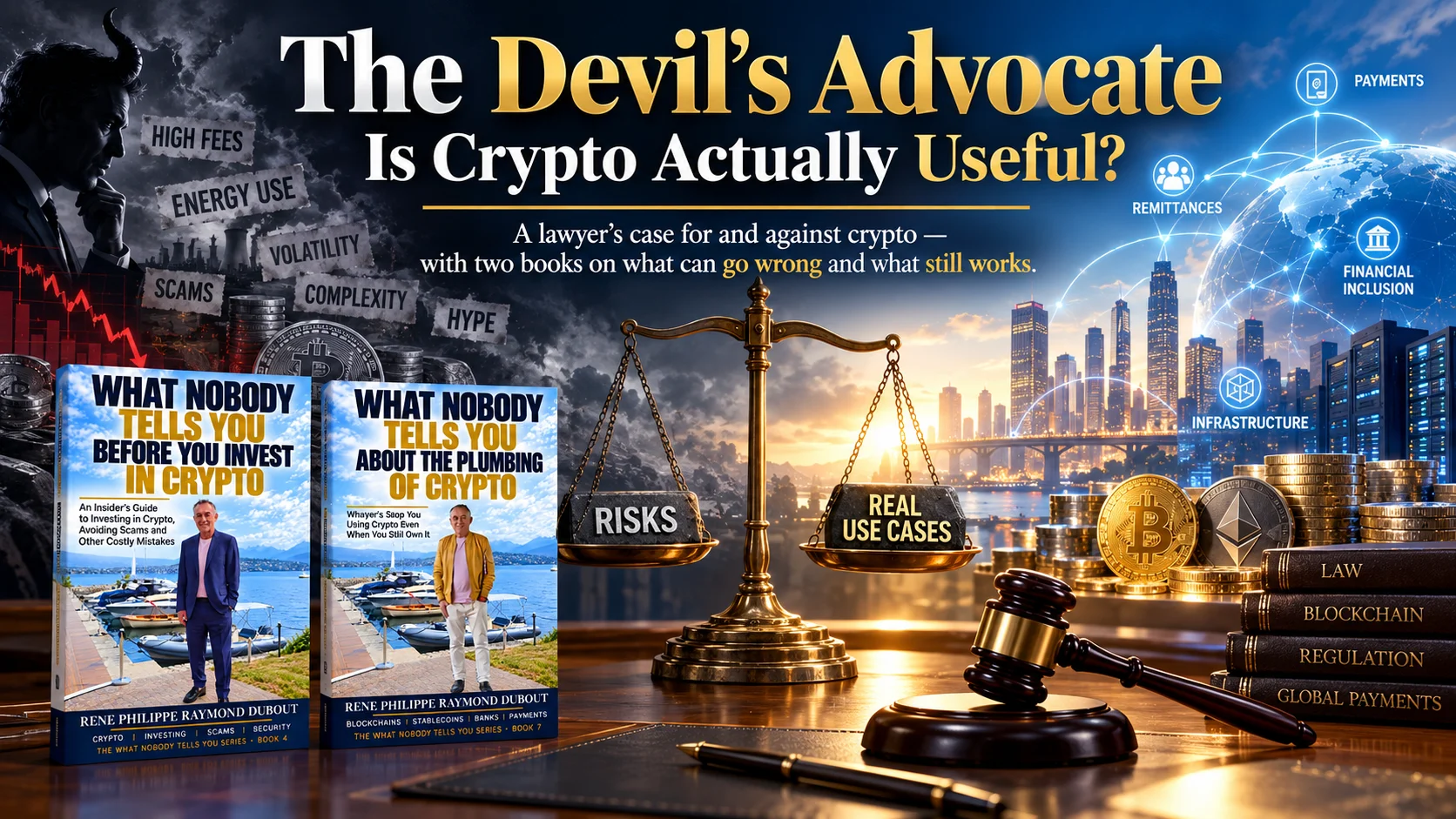

All that electricity. All those data centres. All those new “solutions”, each one stacked on top of the last, each one with its own fee. After seventeen years of crypto, it’s a fair question for the ordinary user: where is the benefit? Where is the saving? What does it actually bring, apart from new ways to make money out of thin air?
I’ve spent more than twelve years advising clients who build crypto businesses, and I’ve written two books on the subject. I’ve never bought a bitcoin. So let’s do what lawyers do best: put the accused on trial, hear both sides, and then deliver a verdict.
The case for the defence
1. Sending money home
A worker in Europe sending money to his family in the Philippines or Kenya can still pay a hefty fee. The World Bank puts the worldwide average cost of remittances at around 6%. Some transfers take days. With a stablecoin, the blockchain transfer can arrive in minutes, often at a much lower cost. The final saving depends on what it costs to buy the stablecoin and turn it into spendable money at the other end.
The family doesn’t always need a bank account: depending on local services, it may receive the money through an agent, a mobile wallet or a shop that accepts it. For the more than a billion adults who still lack a financial account, an additional route to receiving money can mean real access.
2. Dollars when your own currency collapses
In Argentina, Turkey, Nigeria or Lebanon, families have seen inflation, currency depreciation or financial crises eat into their savings. Where access to dollars is restricted or expensive, you cannot necessarily walk into a bank and obtain them on reasonable terms.
A dollar stablecoin on a phone can provide access to a dollar-linked asset without opening a dollar bank account. For someone watching their local currency lose value, that can be a practical solution.
3. Transparency
Transactions on public blockchains such as Bitcoin and Ethereum leave records that investigators can follow. That visibility helped trace funds stolen from Binance on 29 October 2026. By 30 October, Binance reported approximately $3 billion frozen on-chain through cooperation with authorities, issuers and other partners. Freezing the money is, of course, only a step towards recovering it.
Try following a suitcase of cash that way.
4. No bank holiday
Blockchain transfers operate 24 hours a day, seven days a week. A transfer sent on Friday evening does not have to wait for the banks to reopen on Monday.
The network does not keep banking hours. Whether you can immediately turn the tokens into local spending money is another question.
5. Being your own bank
In Cyprus in 2013, uninsured depositors at Laiki Bank and Bank of Cyprus bore substantial losses through the banks’ restructuring. Deposits above the €100,000 protection threshold were exposed.
Bitcoin you hold in your own wallet, with your own keys, is not a deposit on your bank’s balance sheet. It cannot be used in that bank’s bail-in. No bank stands between you and those coins.
6. Getting help across borders
By 11 March 2022, just over two weeks after Russia’s full-scale invasion, the Ukrainian government and an NGO supporting the military had received approximately $63.8 million in crypto donations, according to Elliptic.
Crypto provided an additional international fundraising channel. It also offered an alternative where conventional platforms refused particular campaigns: Patreon had suspended the Ukrainian NGO Come Back Alive’s page because of its military activity.
7. Tokenisation
Turning rights in property, bonds or fund units into tokens can allow faster settlement and smaller investment tickets, opening access to assets previously beyond an ordinary investor’s budget.
There is also the less glamorous plumbing: making the payment and the asset transfer happen together, automating agreed conditions and reducing the work of reconciling separate records. These are potential benefits the Bank for International Settlements itself examines. Some countries are already building it: see how Thailand is preparing baht stablecoins, tokenisation and on-chain settlement.
Some of the most useful applications may happen behind the scenes, without the customer ever needing to buy a bitcoin.
The case for the prosecution
1. The middlemen are back
Crypto promised to get rid of the middlemen. It created new ones: the exchange, the bridge, the wallet provider, the stablecoin issuer, the yield platform. There can be a fee at almost every step.
And the defence’s local agent or mobile wallet? They may take their cut too. The middleman just changed his name.
Even where the technology lowers the cost, who keeps the saving? The customer, or the intermediary? A cheaper payment network does not automatically produce a cheaper bill.
2. The bank is still in the picture
As long as you live, pay rent and buy groceries in euros, baht or pesos, you need a reliable way to turn your tokens into something you can spend.
You can trade directly with another person or find a merchant who accepts crypto. But much of the ecosystem, including major stablecoin reserves and conversion services, still depends on banks and payment institutions.
And conventional payments have moved on too. Instant euro transfers already work around the clock, including weekends. Being available on Sunday is no longer an argument that belongs exclusively to crypto.
3. Cash does the job
Want to protect your savings with dollars? Where you can obtain them freely, dollar notes do that too, without requiring a blockchain or a mining network.
Which raises another question about the defence’s strongest example: are people buying stablecoins because they want crypto, or because they want dollars?
Perhaps part of the revolution is simply a new way to get hold of an old currency.
4. The freeze
The defence’s argument about holding your own bitcoin does not work the same way for centrally issued stablecoins.
This week’s Binance hack demonstrated how much power issuers retain. A stablecoin can sit in your own wallet and still be blocked. Depending on the circumstances, an issuer may act under a legal order or its own compliance procedures. You can find yourself unable to move the money before you have had a chance to explain yourself.
This time, that power helped stop a thief. Next time, an innocent holder could get caught by a mistake.
Leaving your bank for a stablecoin issuer is not automatically freedom. It’s a new landlord.
5. No way back
Send to the wrong address, fall for a scam, and the money may be gone. There is no automatic chargeback. Holding crypto does not give you the protection of an insured bank deposit.
Sometimes investigators recover funds. Sometimes a platform covers the loss: Binance has said it will absorb the financial impact of this week’s theft. That is a company’s commitment, not a universal protection built into crypto.
6. You are your own security guard
Being your own bank also means being your own vault, your own guard and your own insurance. Lose access to your keys and every usable backup, and your money can be lost forever.
Estimates of lost bitcoins run into the millions. The exact number is uncertain: coins that have not moved for years are not necessarily inaccessible. But the risk of permanently losing access is real.
7. The criminals are customers too
Ransomware, investment scams, money laundering and state hackers all found uses for crypto.
TRM Labs attributes the Binance attack to North Korea’s TraderTraitor group with high confidence. Binance’s preliminary investigation points to a compromised engineer’s laptop, although the full attack path has not been confirmed. And within a day, fake executives were already contacting worried users: the scam after the hack. This week alone gives the prosecution a substantial Exhibit A.
8. Volatility
It’s hard to call something “money” when it can lose a third of its value in a month.
Stablecoins address that problem, but introduce others: the quality of the reserves, the issuer’s reliability and the ability to redeem. Even a token intended to track one dollar can trade below it. In March 2023, when Silicon Valley Bank failed, USDC, one of the largest dollar stablecoins, fell to about 87 cents. “Stable” describes the objective, not an unconditional guarantee.
9. The tax trap
Depending on the country, swapping one token for another can trigger a taxable disposal, even if no money reaches your bank account. The UK, for example, expressly includes such exchanges in its capital gains rules.
Now try reconstructing hundreds of transactions across several wallets when the tax office asks.
10. The energy bill
Bitcoin’s design deliberately consumes electricity to secure its network.
To be fair, not all blockchains are the same. Ethereum cut its energy consumption by more than 99% when it changed its system in 2022. Stablecoins can run on networks that use a fraction of Bitcoin’s energy.
But the data-centre image people have of crypto is mostly Bitcoin’s, and it’s earned.
11. A useful technology is not an investment case
Even if the defence proves that blockchain can improve payments or financial infrastructure, it has not proved that the token someone is selling you is worth buying.
The service can succeed while investors lose money. The savings may go to the operator, the customer or the issuer, with little benefit for the person holding a speculative token.
“This technology has a future” is not the same as “this token is worth the price.”
My verdict
Crypto is useful at the edges: for people the banking system serves badly, in countries where the local currency is broken, and for some cross-border transfers. There, it brings real value, and it would be dishonest to deny it.
There are also credible applications in the financial plumbing: settlement, automation and tokenisation. The ordinary customer may benefit without ever seeing a wallet address.
But for a European with a bank account, a salary and a pension, I remain unconvinced that adding crypto to everyday finances usually improves the experience. Too often, it adds layers, fees and risks to something that already works.
And whatever route you take, the useful comparison is the whole journey: what you pay, what the recipient can actually spend, how long it takes, and what happens when something goes wrong.
The paradox of the week sums it all up: the same crypto world that lets you lose your money forever also lets an issuer freeze the thief’s.
Crypto isn’t good or bad. It’s a tool. The question is who holds the switch, and who pays the toll.
Prosecution or defence: which side are you on?
Give me one ordinary situation where crypto leaves the user better off, after every fee, conversion and cash-out. What did it cost, and what was the alternative?
Want to understand what nobody tells you about crypto?
My two books go further: What Nobody Tells You Before You Invest in Crypto, for the investor, and What Nobody Tells You About the Plumbing of Crypto, for what happens behind the scenes. Both are available on Amazon, Apple Books and Google Play.
If you are building a crypto or payments business, or need a licence, write to us at insight@fintechlex.com or on WhatsApp +41 787 983 770.
Sources: World Bank; Central Bank of Cyprus; Elliptic; Binance’s incident update of 30 October 2026; TRM Labs; European Commission; Circle; Chainalysis; Ethereum.org; Bank for International Settlements; HMRC. Incident figures reflect the cited updates and may change.
Rene-Philippe