Binance says the hack cost it about $6.3 billion. The attack started on the evening of 29 October, and the second wave came almost immediately. Not against Binance this time. Against its users.
This morning, a “Richard Teng” replied to one of my LinkedIn comments under the real Binance co-CEO’s post. He was friendly and direct: “Let’s connect”, followed by a Telegram link. The profile had 6 followers. The real Richard Teng has a verified badge and his post had thousands of reactions. The Telegram handle was spelled with a double “e”.
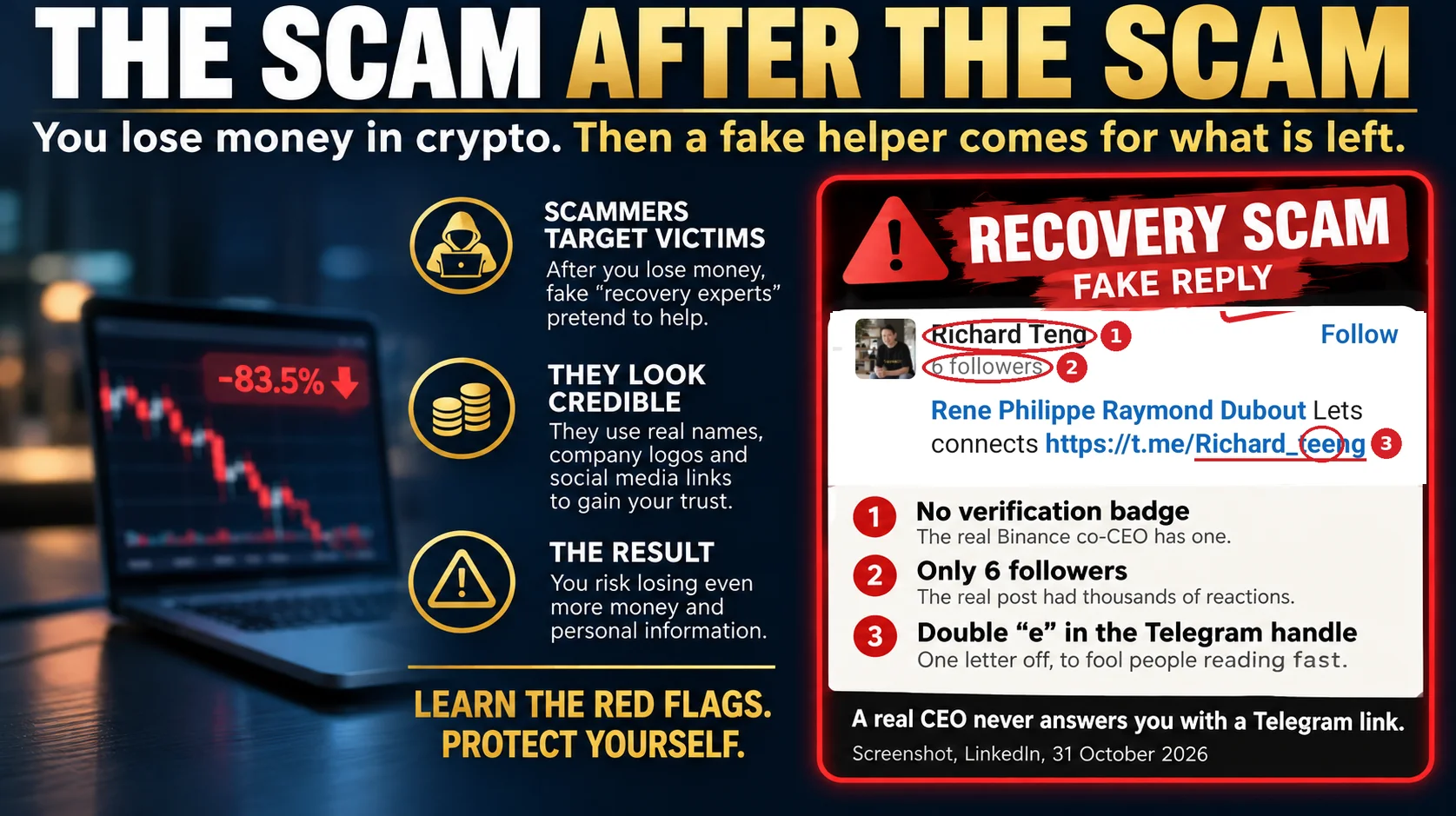
This is the scam after the hack. After major hacks, scammers tend to use the same pattern: worried users look for answers, and scammers are waiting for them, dressed as the people they trust.
How the scam works
- They choose their moment. After a hack, people are anxious about their funds and ready to believe anyone who seems to have answers.
- They impersonate a real person. A CEO, a support agent, a “recovery specialist”. Same photo, same title, one letter different.
- They move you off the platform. Telegram, WhatsApp, a private link. There, nobody else sees the conversation, and it becomes much harder for anyone to warn you.
- Then comes the ask. A “verification” of your wallet, a form to “secure” your account, a fee to “recover” lost funds. The goal is always the same: your money, or the private keys that control your crypto.
Six checks before you reply to anyone
- The verification badge. Check for it and for the verified details, but don’t rely on the badge alone to decide that an account is genuine.
- The follower count. An account claiming to be the CEO of a global exchange with 6 followers is a major warning sign.
- The spelling. Check the name, the handle and the link letter by letter. Scammers rely on you reading fast.
- The channel. If someone claiming to be a CEO invites you to discuss your account or your money on Telegram, stop, and check with the company through its official channels first.
- The request. Never give anyone your seed phrase or your private key, and never send money to someone who contacted you and says you must pay before you get your money back.
- The source. Check announcements only on the company’s official website and verified accounts.
If you’ve already been contacted, or have already paid
Stop all contact immediately and don’t send anything more. Report the profile on the platform. Keep every message, address and transaction reference. Contact the real company only through its official website. Report the fraud to the police where you live. And beware of strangers who contact you, promise they can certainly recover your money and ask you to pay upfront: you may be about to be scammed a third time.
The lesson
The details of the Binance hack are still under investigation. But the scam I saw has a clear goal: make you believe you are talking to someone you can trust, then get you to send money or reveal sensitive information. A familiar name, a profile photo and a CEO title don’t make a message trustworthy. Don’t rely on technology alone. Stopping for a thirty-second check may let you see the warning signs before you lose money.
If you or your company have been targeted, or need advice on crypto, custody or compliance, write to us at insight@fintechlex.com or on WhatsApp +41 787 983 770.
Sources: Binance official statement on the incident, 30 October 2026; statement by Binance co-CEO Richard Teng, 30 October 2026; press coverage of the Binance hack (CoinDesk, CNN, The Block), 30 October 2026.
Rene-Philippe