
Most EMIs for sale are a licence and a promise. This one is a licence, two card scheme memberships, a direct line into the SEPA system and a team that already runs it.
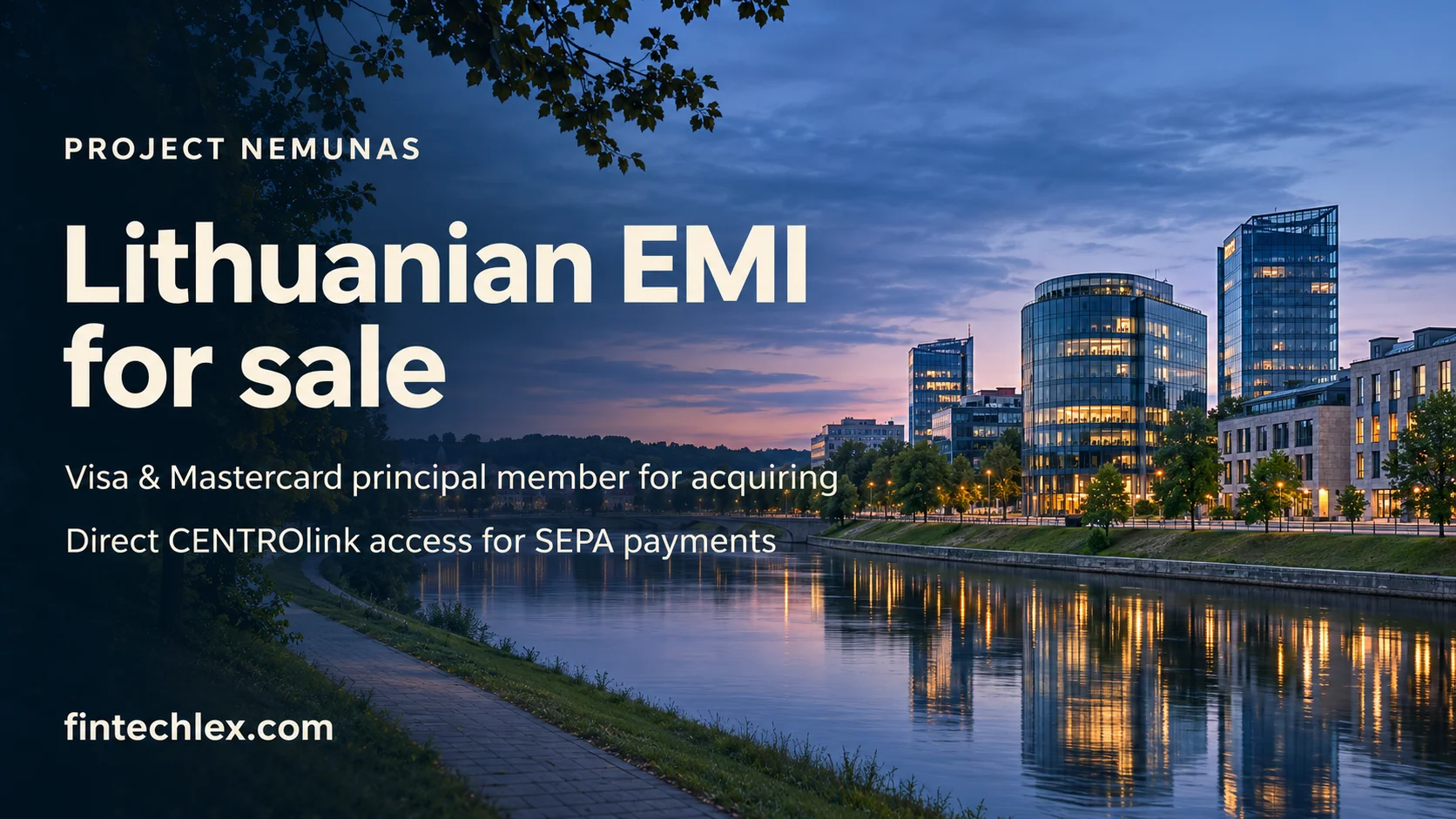
FintechLex has been mandated to present the sale of 100% of a fully licensed Lithuanian electronic money institution (EMI). The company holds a full, non-limited EMI licence from the Bank of Lithuania, is passported to the other 29 states of the European Economic Area, is a principal member of Visa and Mastercard for card acquiring, and connects directly to CENTROlink, the Bank of Lithuania’s payment system, for SEPA credit transfers and SEPA Instant. Project name: Nemunas. Reference: FL-EMI-2611.
The company at a glance
- Entity: Lithuanian private limited company (UAB)
- Licence: full, non-limited electronic money institution licence, supervised by the Bank of Lithuania
- Passporting: passported to the other 29 EEA states
- Permitted services: issuing and redeeming e-money, cash placement and withdrawal, payment transactions, issuing payment instruments, acquiring of payment transactions
- Card schemes: principal member of Visa and Mastercard for card acquiring
- Clearing: direct CENTROlink participant, SEPA credit transfers and SEPA Instant
- Current services: business IBAN accounts, SEPA and SEPA Instant, international payments, foreign exchange, open banking, card acquiring, white-label and API services
- Banking partners: five banking and payment-provider partners, disclosed under NDA
- Clients: limited existing activity, details under NDA
- Price: on request
Why this is not the usual EMI for sale
Anyone who has looked at EMIs for sale knows the menu. You find plenty of licences. What you rarely find is a licence with everything that makes it usable, because each of those things is a separate, slow application of its own.
The licence. A full EMI licence in the European Union takes a year or more to obtain from scratch, and needs at least 350,000 euros of initial capital, a business plan the regulator believes and people it trusts. I explained the three ways in, and what each really costs, in White Label, Your Own EMI Licence, or Buy an EMI?
The card schemes. Being a principal member of Visa and Mastercard means the company deals with the schemes directly, under its own membership, instead of borrowing someone else’s through a sponsor. Getting there is a project in itself: capital requirements, compliance reviews, technical certification. Principal membership for acquiring is what lets a payments company sign up merchants itself and build merchant acquiring or payment-facilitation models, not just accounts and cards.
The rails. Direct participation in CENTROlink gives the institution its own access to SEPA and SEPA Instant through the Bank of Lithuania, without depending on a correspondent bank to move euros. For any EMI, losing a correspondent bank is the classic way to go from operating to stranded in a few weeks. Direct access does not remove every banking risk, but it removes that one for euro payments.
The team and the platform. The company runs on a working technology stack: core banking for accounts and payments, an integrated back office, foreign exchange and treasury functions, AML and KYC tools, third-party card processing, web and mobile channels, and API connectivity. An operating team is in place. In other words, a buyer does not buy a shell and then spend a year making it work.
A clean starting point
Legacy client activity is limited. Some buyers see that as a weakness; I see it as an advantage. You do not inherit a large book of someone else’s clients, with someone else’s risk profile and someone else’s compliance history. You step into an operational platform and roll out your own business plan, which is exactly what the regulator will want to review when you apply for approval.
Who should look at this
- Payment and fintech groups that want an EU base with card acquiring and SEPA access in a single entity
- Merchant acquirers and payment facilitators that need their own Visa and Mastercard principal membership
- Embedded finance and B2B platforms that want to offer accounts, payments and cards under their own brand, using the existing API and white-label services
- Groups outside Europe, including in Asia, that need a licensed, passported entry point into the European market
How the sale works
The transaction is the acquisition of 100% of the shares. As with any EMI, the buyer must be approved by the Bank of Lithuania before taking control, and the card schemes and service providers must also give their consent. Count on the regulator looking closely at your source of funds, your background and your business plan.
The process runs in five steps:
- 1. NDA: signature of a non-disclosure agreement
- 2. Information pack: full company and licence details
- 3. Indicative offer: with proof of funds
- 4. Due diligence: legal, regulatory and technical
- 5. Approval and closing: change of control approval by the Bank of Lithuania
The name of the company, its banking partners, client portfolio, safeguarding arrangements and technical documentation are released only under a signed NDA. Before you buy any EMI, read EMI for Sale in Europe: What You Are Really Buying, What It Costs, and What Can Go Wrong. We will go through the same list with you on this one.
Interested?
Price on request. Write to us at insight@fintechlex.com or on WhatsApp +41 787 983 770, and please quote Ref. FL-EMI-2611. For our other licensed companies and services, see our EMI licence and acquisition page.
All information is indicative, has been provided by the seller and has not been independently verified. It remains subject to due diligence and to a binding agreement. This post does not constitute an offer to sell or a solicitation of an offer to buy any shares or assets.
Rene-Philippe