
EMIs and payment institutions for sale
Licensed companies in Europe, the UK and Asia, ready to take over. Details under confidentiality.
See the companies for sale →Contact us
Prefer to apply for your own licence? Our EMI licence service →
When a large financial group wants an e-money licence in the European Union, it increasingly goes shopping in Vilnius rather than filing an application. In 2026, the Bank of Lithuania approved the acquisition of Blue EMI LT by the UK payments group Checkout, and the central bank announced that Lloyds Banking Group was set to acquire Curve Europe, an electronic money institution (EMI) licensed in Lithuania since 2020. These buyers have armies of lawyers. They still chose to buy.
They are right, in my view. A Lithuanian EMI gives you a licence that is passported across the European Economic Area, a team, an IBAN offering and often a direct connection to the Bank of Lithuania’s payment system. But the Bank of Lithuania of 2026 is no longer the regulator that handed out licences to everyone in 2018. When you buy an EMI, you buy its past. This article is the due diligence checklist I would use before signing. For the general picture, what an EMI is worth and what it really costs, read my complete guide to buying an EMI in Europe.
The Bank of Lithuania in 2026: friendly, but no longer forgiving
The Bank of Lithuania still likes fintech. It also no longer forgives much. A few decisions from this year tell the story better than any speech:
- Paytend Europe, March 2026: e-money licence revoked after an inspection found serious and systematic failures in anti-money laundering controls and internal control. The company had to stop all financial services the same day.
- AlphaPay, July 2026: payment institution licence revoked after multiple breaches. The licence had already been suspended in April, with access to client fund accounts restricted.
- Nayax Europe, 2026: a EUR 90,000 measure for breaches of client funds safeguarding and related internal controls, found in a scheduled inspection.
- Verified Payments, August 2026: barred from taking new clients after the regulator found that it had missed its capital requirement for a large part of the inspected period and had made large loans to its sole shareholder for personal use.
Read these cases as a buyer. Every one of those problems existed long before anyone outside the company knew about it. If you had bought one of those EMIs six months earlier, you would have bought the problem with it.
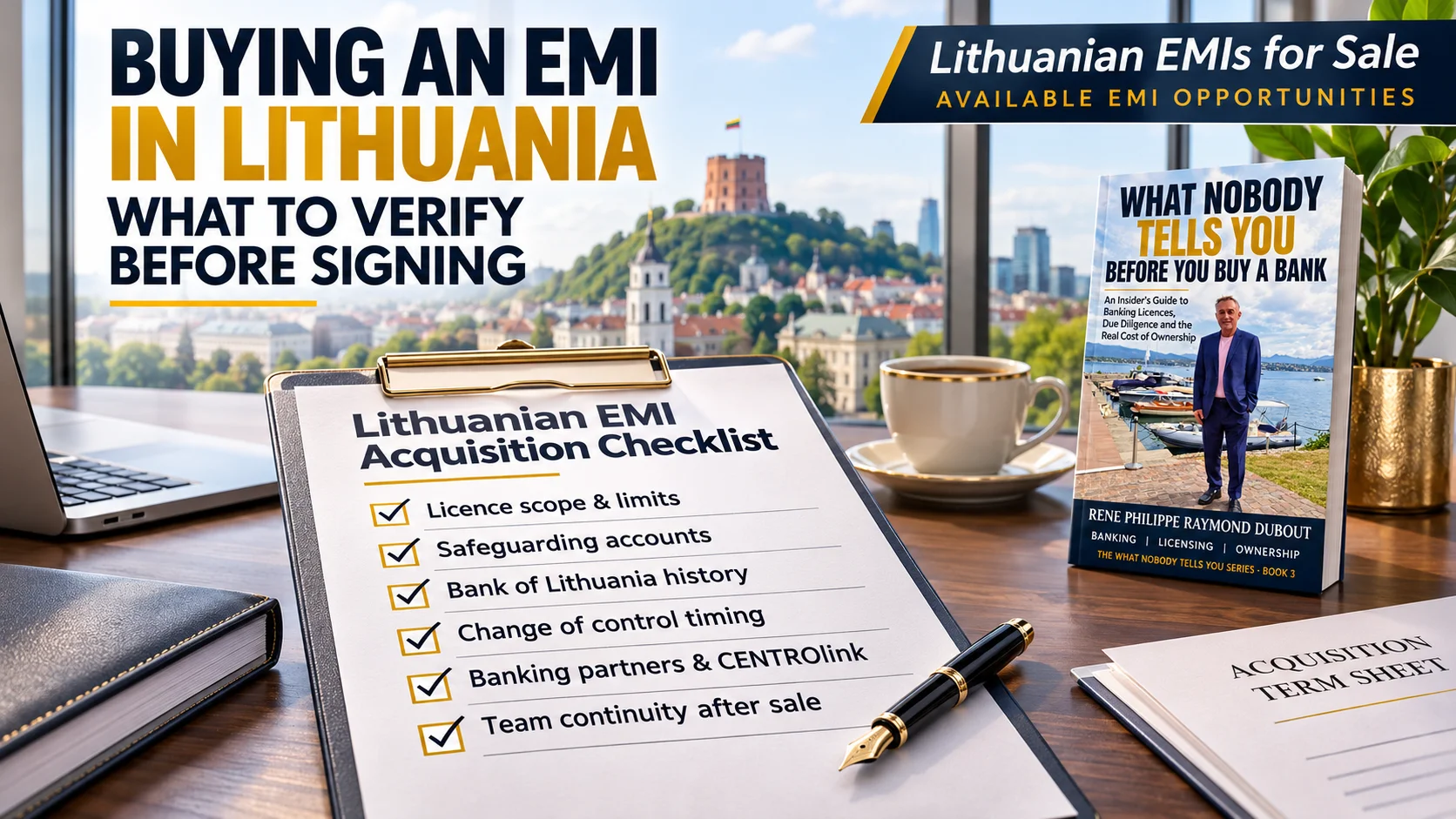
The checklist before you sign
1. The licence itself. Is it a full licence or a restricted one? A restricted licence works in Lithuania only, so there is no European passport to speak of. Which services does the licence actually cover, and to which countries has the EMI notified its passport? A licence that covers e-money issuance but not acquiring is a different business from the one in the teaser.
2. The inspection history. Ask for every inspection report, every supervisory instruction, every administrative agreement and every remediation plan, with the evidence that the remediation was completed. Then check the Bank of Lithuania’s published decisions yourself. A seller who says “there was a small inspection, nothing serious” should be able to show you the letter that says so.
3. Safeguarding. This is the first thing the regulator checks, and the first thing that goes wrong. Where exactly is client money held, in which banks, under which agreements? Is it reconciled every day? Who audits the safeguarding arrangement, and what did the last audit say? The Nayax case shows that a well-known group can still be caught here.
4. Capital and money owed by the shareholders. Ask for the own funds calculation month by month, not just at year end. Look for loans to the shareholder, to related companies or to directors. The Verified Payments case is the textbook example: an EMI is not a piggy bank for its owner, and the regulator now checks.
5. CENTROlink and the IBANs. Many Lithuanian EMIs sell IBANs and SEPA payments. Find out how: is the EMI a direct participant in CENTROlink, the Bank of Lithuania’s payment system, or does it reach SEPA through another institution? The rules changed on 1 November 2026. The Bank of Lithuania no longer signs new contracts for indirect access through itself, and from 1 January 2027 an institution can host another one in CENTROlink only if it has been a participant for at least 12 months, has executed at least 100,000 payment orders in the past year, and produces an independent audit of its anti-money laundering, fraud and sanctions controls. If your target depends on someone else’s access, ask how long that access will last.
6. Banks and card schemes. Which banks hold the safeguarded funds and the operating accounts, and will they keep the EMI after the change of owner? Is the EMI a principal member of Visa or Mastercard, or does it issue cards through a sponsor? I explained the difference in Visa and Mastercard principal membership or BIN sponsorship. The scheme memberships and banking relationships are often worth more than the licence.
7. The people. The Bank of Lithuania approves managers and key function holders. Which of them stay after the sale? If the money laundering reporting officer or the head of compliance leaves the day after closing, you are buying a licence without the people the regulator approved to run it.
8. The change of control. Do not close before the Bank of Lithuania has approved you. This is not theory. Paysera, Lithuania’s largest EMI, bought Contis before the regulator’s assessment was over. The Bank of Lithuania objected to the deal in April 2025, fined Paysera EUR 400,000 and froze its voting rights in the company it had bought. The acquisition was only approved in November 2025. If Paysera could not shortcut the process, neither can you. The file itself is explained in Buying a Bank or an EMI: How the Regulator’s Approval Really Works.
9. What it will cost to run. For 2027, the supervision fee for EMIs is up to 0.65% of annual income from e-money and payment services. And a new supervisor is coming: the European Anti-Money Laundering Authority (AMLA) will collect data from payment and e-money institutions with a reference date of 31 December 2026, to select those it will supervise directly, possibly from 2028. Budget for the compliance team you will need then, not the one you have today.
Why buying still makes sense
On paper, the Bank of Lithuania decides on a licence application within three months of a complete file. In practice, a file is rarely complete the first time, and a new EMI then needs months more to build its banking partners, its scheme memberships and its CENTROlink access. A clean EMI with a few years of history already has all of that.
The stricter supervision works in favour of the serious buyer. The weak EMIs are being closed. The ones that survive an inspection are worth more, because the regulator has already tested them. Your task is simply to make sure you are buying one of those, and that is what the checklist is for.
How FintechLex can help
- EMIs for sale: we present licensed EMIs in Lithuania and elsewhere in Europe, under confidentiality. One of them is a Lithuanian EMI with principal Visa and Mastercard membership and direct CENTROlink access.
- Due diligence: we go through the checklist above with you, document by document, before you sign.
- The change of control file: we prepare the notification to the Bank of Lithuania and the documents on the buyer, the source of funds and the new business plan.
- Your own licence: if buying is not the right route for you, see our EMI licence and acquisition service.
Buy the EMI, not its past. Write to us at insight@fintechlex.com or on WhatsApp +41 787 983 770.
Rene-Philippe
Sources: Bank of Lithuania, decisions of the Financial Market Supervision Committee (2025 and 2026), including on Paytend Europe (4 March 2026), AlphaPay (22 July 2026), Verified Payments (5 August 2026) and the acquisition of UAB Finansinės paslaugos Contis by Paysera LT (April and November 2025); Bank of Lithuania resolutions on CENTROlink rules in force from 1 November 2026; Bank of Lithuania 2027 supervision fees; European Banking Authority, draft reporting framework for the AMLA eligibility data collection (August 2026); LRT on the acquisition of Curve Europe by Lloyds Banking Group (May 2026) and of Blue EMI LT by Checkout (2026); ECOVIS ProventusLaw regulatory updates (2026).
This article is for general information only and does not constitute legal advice.