
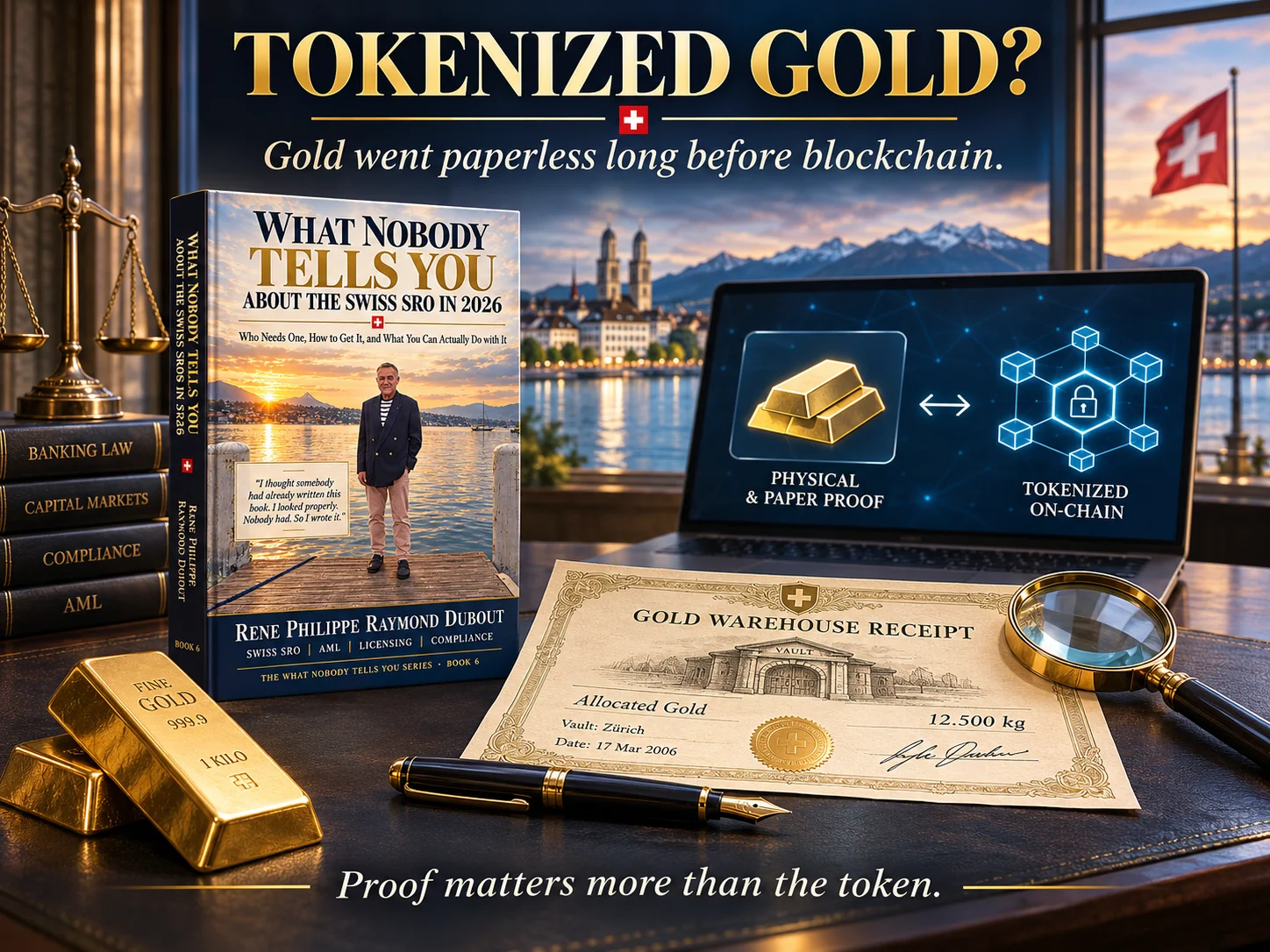

Every week, someone asks me whether they should buy tokenized gold, or build a gold token of their own. My honest answer surprises them: for me, tokenized gold is the fashion of the moment. Gold went paperless long before anybody spoke of blockchain, and in Switzerland the law already gives you a tool that does the job without a token. The token can come last, if at all, and when it comes, it comes with its own fees.
So before you buy, ask what the token really adds compared with what already existed. In most cases, the answer is: a new way of moving the paper, and a few more people taking a fee.
Gold went paperless long before blockchain
Dematerialized gold is almost four hundred years old. Every generation has found a new form for the same idea: the gold stays in the vault, and a document travels in its place.
- London, 17th century. Merchants left their gold with goldsmiths and received a receipt with their name and the amount deposited. The receipts became negotiable and slowly turned into the banknote.
- United States, 1863 to 1933. Gold certificates, paper notes that could be exchanged for gold coin, were authorised by Congress in 1863 and used in everyday commerce. In 1933 the government ordered everyone to hand in their gold coins, bullion and gold certificates. The paper was only as good as the promise of the state behind it.
- The internet, 1996. e-gold let users pay each other online in grams of gold. It grew to five million accounts by 2009, when transfers were suspended after its operators were prosecuted in the United States. Thirteen years of digital gold, without a single blockchain.
- Zurich, 2006. Zürcher Kantonalbank launched the first gold ETF in Europe, fully backed by physical gold stored in Switzerland. Holders could ask for the bars, delivered in Switzerland, in standard bars of about 12.5 kilos.
Each time, a piece of paper or a line in a register says that you own gold sitting in a vault. The token is simply the latest register. That does not make it useless, but it does not make it a revolution either.
Tokenized gold: what right do you really have, and under which law?
A token can make you the owner of gold in a vault, or give you only a claim against the issuer. On a good day you will not see the difference. On the day the issuer fails, you will: an owner takes back his gold, a creditor queues with the others. The Swiss regulator, the Financial Market Supervisory Authority (FINMA), made the point as early as 2019: when a token gives only a contractual claim on gold held as bank precious metal, it probably qualifies as a deposit, like a precious metal account at a bank.
Then ask which law governs that right. The gold behind Tether Gold sits in Switzerland, but the company that issues the token, and whose terms decide what you own, does not. The four questions to ask about the bar itself, where it is, who holds it, whether you can get it out and whether the bars match the tokens, are in Tokenised Gold in Switzerland: The Bar Matters More Than the Token.
The small saver buys the token, the big one gets the gold
With the two biggest gold tokens, PAX Gold and Tether Gold, you need about 430 tokens, one full London Good Delivery bar of around 12 kilos and well over a million dollars, before you can ask for physical gold. PAX Gold delivers only to vaults in the United Kingdom, Tether Gold only to an address in Switzerland. Below that, all you can do is sell your tokens for dollars. To be fair, the gold ETF had the same rule with its 12.5-kilo bars. The token has not solved that problem. It has only put it on a blockchain.
The Swiss warehouse receipt already does the job
Under the Code of Obligations, an authorised warehouse keeper can issue a receipt that represents the gold itself: handing over the receipt transfers the bar without it leaving the vault. I described how a gold business can be built on it, then on the same receipt with a QR code, then on a token, in the three stages of a gold business in Switzerland. Two points make the receipt even stronger than people think:
- It serves as collateral. Pledging the receipt creates a pledge on the gold it represents (article 902 of the Civil Code), so a bank or a lender can take your bar as security without moving it.
- It is discreet. On a public blockchain, anyone can follow every movement of an address. A receipt with a QR code that leads back to the warehouse confirms the transaction to those who need to see it, and to nobody else.
Swiss law itself treats the token as one more format for the same receipt (article 1153a of the Code of Obligations). It does not create a new right. If someone still wants it after that, fine, but it comes last.
What the token really adds: fees
In fairness, the two big gold tokens charge no storage fee for simply holding them. You pay elsewhere, at the entrance, at the exit and along the way:
- Issuance and redemption fees: Tether Gold charges 0.25 percent when you buy from or sell back to the issuer, with a minimum purchase of 50 tokens and a verification deposit of 150 USDT. Paxos charges its own creation and redemption fees, and since 1 September 2026 a 0.05 percent fee on conversions between PAX Gold and gold held directly.
- Network fees: each transfer on the blockchain costs a fee, paid to the network and not to the gold.
- Exchange spreads: if you hold fewer than 430 tokens, your only exit is the market, and the market takes its margin.
- The cost of the layer itself: the platform, the smart contract audits and the compliance team. The issuer recovers them somewhere, and that somewhere is you.
None of this is a scandal. It is simply the price of a technology layer that a Swiss warehouse receipt does not need.
Swiss VASP: if you still want to issue a gold token
Switzerland remains, in my view, the best place to do it: the vaults, the refiners and the law are here. But the token brings regulation with it. Trading precious metals for clients, and transferring or holding crypto assets for them, are both financial intermediation under the Anti-Money Laundering Act. A gold token issuer is therefore a Swiss VASP (virtual asset service provider) and must join a self-regulatory organisation (SRO), with the client checks, procedures and annual audit that come with it. The details, and the line not to cross towards a banking licence, are in my article on tokenised gold in Switzerland.
My advice is simple. Start with the warehouse receipt. Add the QR code. Tokenize only if your clients really ask for it, and once you know who owns what.
How FintechLex can help
- Before you buy: we read the terms of a gold token with you and tell you what you really own and how you get your metal out.
- Before you build: we structure your gold business in Switzerland at the stage you need, from the warehouse receipt to the token.
- If you tokenize: SRO affiliation for the issuing company, or a ready-made Swiss company already affiliated with an SRO; see our SRO licence and company acquisition service.
Write to us at insight@fintechlex.com or on WhatsApp +41 787 983 770.
Rene-Philippe
Sources: Swiss Code of Obligations, articles 482 and 1153a; Swiss Civil Code, articles 902 and 925; Anti-Money Laundering Act, article 2; FINMA, supplement to the ICO guidelines on stablecoins (11 September 2019); Paxos, PAX Gold redemption and fee terms; Tether Gold (TG Commodities), redemption and fee terms; Zürcher Kantonalbank, ZKB Gold ETF; Bureau of Engraving and Printing, gold certificates fact sheet; history of e-gold (1996 to 2009).
This article is for general information only and does not constitute legal, tax or investment advice.