
EMIs and payment institutions for sale
Licensed companies in Europe, the UK and Asia, ready to take over. Details under confidentiality.
See the companies for sale →Contact us
Prefer to apply for your own licence? Our EMI licence service →
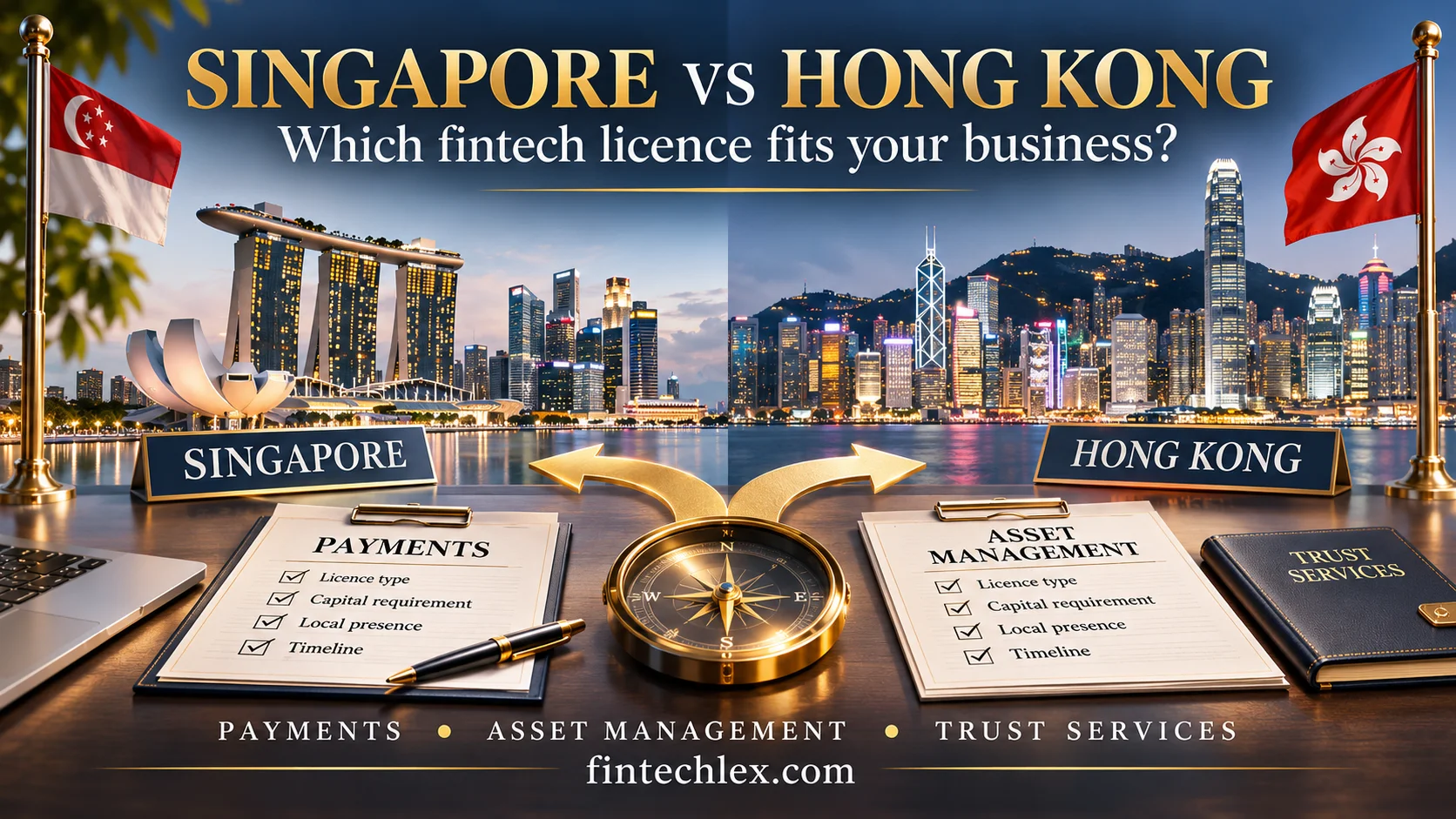
Clients from Europe and Asia ask me the same question every month: should my fintech go to Singapore or to Hong Kong? Both are serious financial centres, both speak English, both have regulators that answer the phone. My answer is always the same: it depends on what you do. For payments, Singapore is the reference, but the queue is long. For asset management and trust business, Hong Kong is often lighter and faster. And in both places, buying a licensed company is often faster than applying for a new licence.
Singapore vs Hong Kong fintech licence: the short version
| Singapore | Hong Kong | |
|---|---|---|
| Payments | Standard or Major Payment Institution licence (MAS) | Money service operator licence (Customs), still the usual route for remittance and money changing; stored value facility licence (HKMA) for wallets |
| Minimum capital for payments | S$100,000 (about US$78,000) for a standard institution or S$250,000 (about US$195,000) for a major one, plus a security deposit for a major institution | HK$25 million (about US$3.2 million) paid-up capital for a stored value facility; no such capital threshold for a money service operator |
| Asset management | Capital markets services licence for fund management (MAS) | Type 9 licence (SFC) |
| Minimum capital for asset management | S$250,000 (about US$195,000) base capital for a manager serving accredited and institutional investors | HK$100,000 (about US$12,800) liquid capital if the firm holds no client assets |
| Official timeline | Payments: MAS warns of a wait of more than a year. Fund management: within 6 months. | Type 9: 15 weeks from formal acceptance of the application |
Payments: Singapore is the reference, but the queue is long
Singapore’s Payment Services Act gives you two main licences. A standard payment institution stays under transaction and e-money thresholds and needs base capital of S$100,000 (about US$78,000). A major payment institution has no volume ceiling, needs base capital of S$250,000 (about US$195,000) and must also lodge a security deposit with the Monetary Authority of Singapore (MAS) of S$100,000 or S$200,000 (about US$78,000 or US$156,000), depending on its volumes.
Two conditions surprise foreign founders. The company must have a permanent place of business in Singapore, and at least one executive director who is a Singapore citizen or permanent resident, or one executive director on an Employment Pass plus another director who is a citizen or permanent resident. In other words, you cannot run a Singapore payment licence from Geneva or Bangkok with a nominee at a serviced office.
Then comes the queue. On its own application form, MAS currently warns applicants that the estimated waiting period is more than a year, and that it cannot give a better estimate. That is before any questions MAS asks along the way.
Hong Kong works differently, and it has two doors. The first is the money service operator licence from the Customs and Excise Department, for remittance and money changing. It is much lighter, there is no HK$25 million to put on the table, and it is still widely used today. Two of the best-known payment names in Hong Kong prove it: Currenxie serves its clients under a money service operator licence, and so does Airwallex’s Hong Kong company. When Airwallex wanted the bigger licence, it did not apply for one. It bought UniCard, a company that already had it. What a money service operator licence does not allow is holding customer balances in a wallet. For that you need the second door, a stored value facility licence from the Hong Kong Monetary Authority (HKMA), which requires paid-up capital of at least HK$25 million (about US$3.2 million), and the HKMA treats that as a minimum, not a target. That register is short and full of large groups and banks. So the question in Hong Kong is simple: do you move money, or do you hold it?
For a real payments business in Asia, my advice: the Singapore major payment institution licence is the one the market respects, and the fastest way to get one is to buy a company that already holds it. We have one for sale; see Singapore Major Payment Institution for sale, and our EMIs and payment institutions for sale for the rest of the list.
Asset management: Hong Kong is lighter and faster
In Hong Kong, asset management is Type 9 regulated activity under the Securities and Futures Commission (SFC). You need at least two responsible officers for each activity, and every executive director must be approved as a responsible officer. If the firm undertakes not to hold client assets, there is no minimum paid-up capital and the liquid capital requirement is HK$100,000 (about US$12,800). The SFC’s performance pledge is 15 weeks from the formal acceptance of a complete application.
In Singapore, a fund manager needs a capital markets services licence from MAS. A manager serving accredited and institutional investors needs base capital of S$250,000 (about US$195,000) and must have at least two investment professionals based in Singapore. MAS aims to process these licences within six months.
On paper, Hong Kong wins on capital and on time. In practice, the 15 weeks only start once the SFC has accepted a complete file, and finding two responsible officers with the right experience is often the real bottleneck. That is why many of our clients prefer to take over a Hong Kong company that already holds its Type 9 licence, with officers in place.
Trust business: Hong Kong has two layers
In Hong Kong, anyone who carries on a trust or company service business needs a TCSP licence (trust or company service provider) from the Companies Registry, after a fit and proper test. A company that also wants trust company status under the Trustee Ordinance must have issued share capital of at least HK$3 million (about US$385,000), and even then it still needs the TCSP licence. Many founders discover the second layer too late.
We currently present several Hong Kong companies for sale: asset managers with Type 4 and Type 9 licences, and a trust company with a TCSP licence. See Hong Kong trust and asset management companies for sale.
What nobody tells you: the bank account
The licence is only half the job. In both centres, the hardest step for a foreign-owned company is often the bank account. A Hong Kong company that is not really based in Hong Kong will find it practically impossible to open an account with a prestigious bank. Singapore banks ask the same questions about substance. Plan the banking before you pay for the licence, not after. We explained the alternatives in Hong Kong company bank accounts.
Buy or apply?
If your timeline is measured in months, buy. If you have two years and a team on the ground, apply. Buying is not a shortcut around the regulator: in both centres, the new owner must still be approved, as I explained in how the regulator’s approval really works. But approval of a new owner is usually faster than a new licence from scratch, and you start with a company that already has its systems, its officers and often its bank.
To discuss your project or receive details of the companies for sale, under confidentiality, write to insight@fintechlex.com or contact us on WhatsApp +41 787 983 770.
Rene-Philippe
Sources: Currenxie and Airwallex, regulatory disclosures on their Hong Kong licences; Monetary Authority of Singapore, licensing for payment service providers, Form 1 (application for a payment service provider licence), fund management licensing and service commitment; Payment Services Act 2019; Hong Kong Monetary Authority, stored value facilities regime; Payment Systems and Stored Value Facilities Ordinance; Customs and Excise Department, money service operators licensing guide; Securities and Futures Commission, types of intermediary and application procedures; Securities and Futures (Financial Resources) Rules; Companies Registry, licensing of trust or company service providers and trust company registration.
This article is for general information only and does not constitute legal advice.