
Ask ten people why criminals like crypto and nine will give you the same answer: because it’s anonymous. It’s one of the oldest selling points of bitcoin, and one of the most persistent myths in finance.
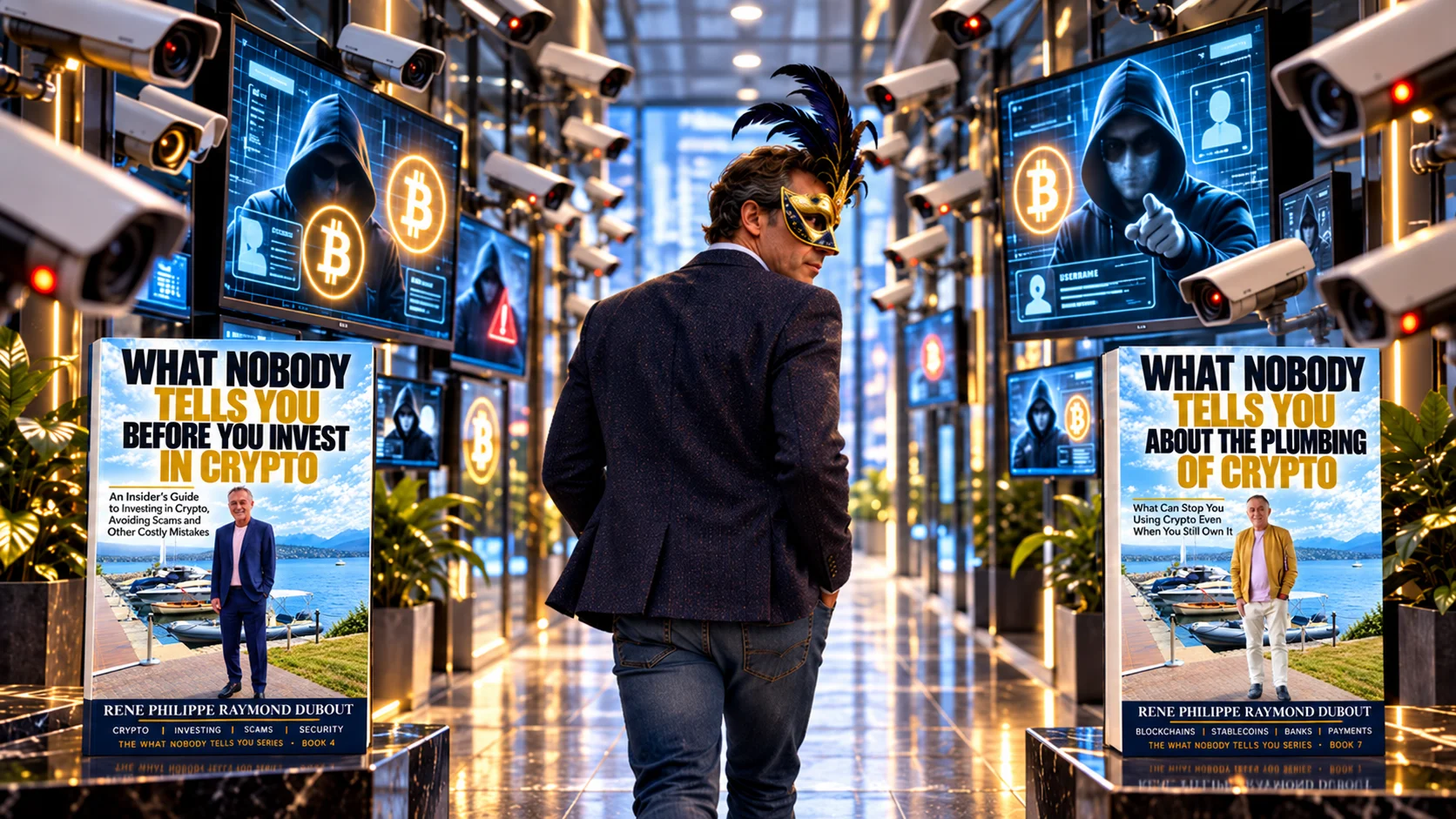
Bitcoin is not anonymous. It is pseudonymous. The difference sounds like a lawyer’s quibble. In practice, it is the difference between hiding and wearing a mask in a room full of cameras.
What “pseudonymous” actually means
When you use bitcoin, your name never appears on the blockchain. What appears is an address, a long string of letters and numbers. That’s the pseudonym.
But everything that address does is public, permanent and visible to anyone in the world: every payment received, every payment sent, every amount, every date. Nothing is ever deleted. A bank statement is private and kept for ten years. A bitcoin address is a public bank statement kept forever.
So the address has no name. Until the day it does.
How an address gets a name
All it takes is one link between the address and a real person. And those links are everywhere:
- An exchange: to buy or sell bitcoin for euros or dollars, you almost always go through an exchange, and a regulated exchange knows your passport, your address and your bank account.
- A delivery: you paid for something that was shipped to your home.
- A careless moment: you posted your address online, or reused it for a payment someone can identify.
Once one address is linked to you, investigators can follow the money forwards and backwards, through every transaction, for years. Specialised firms such as Chainalysis, Elliptic and TRM Labs do exactly that for governments, banks and exchanges.
The Binance hack: a live demonstration
The record $6.3 billion Binance hack at the end of October 2026 has given us a textbook case.
According to on-chain analysis reported by CoinDesk, 18,270 bitcoin left Binance and were split into 19 wallets within about half an hour. Everyone can see them. Every move the hacker makes from now on will be watched by thousands of analysts in real time.
Stablecoins could be frozen by their issuers within hours. Bitcoin has no issuer and no one to call. The hacker cannot make it disappear. He can only wait, and hope that one day a coin reaches an exchange, a broker or a swap service that doesn’t check where it came from.
And here is the irony: to prepare the attack, according to TRM Labs, the hacker funded his operation through Tornado Cash, a “mixer” designed to blur the trail. If crypto were truly anonymous, he wouldn’t have needed one.
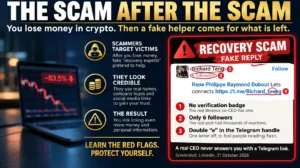
The hack also produced another trap for victims, which I described in Fake CEOs, Real Losses: How Scammers Exploit a Crypto Hack.
Waiting doesn’t help either
In 2016, around 120,000 bitcoin were stolen from the exchange Bitfinex. The thieves were patient. Almost six years later, in February 2022, US investigators had followed the coins to a couple in New York and recovered about $3.6 billion, then the largest financial seizure in the history of the US Department of Justice. Both later pleaded guilty: he was sentenced to five years in prison, she to 18 months.
In 2021, after the Colonial Pipeline ransomware attack in the United States, the FBI recovered most of the bitcoin ransom within a month by tracing it to a wallet it could access.
The blockchain has a very long memory. Time is not on the thief’s side.
So is there such a thing as anonymous crypto?
There are tools built for privacy: so-called privacy coins such as Monero, which hide amounts and addresses, and mixers that shuffle coins between many users. But they come with a price. Most regulated exchanges refuse privacy coins, several mixers have been targeted by authorities, and using them is itself a red flag for any compliance officer. Trying to be invisible is the fastest way to become interesting.
What it means for you
If you hold crypto legally, this is good news. The transparency that catches thieves also protects you: your funds can be traced if they are stolen, and your history can prove where your money came from when a bank asks.
If you thought crypto was a way to stay off the radar, it’s time to think again. Bitcoin may be the most traceable money ever invented. If you want discretion, cash is still king.
Anonymity was one of the reasons people bought crypto in the first place. It was never true.
For a wider look at what crypto is really useful for, read The Devil’s Advocate: Is Crypto Actually Useful?
Want to go further?
I cover what crypto really is, and what it isn’t, in my books What Nobody Tells You Before You Invest in Crypto, for investors, and What Nobody Tells You About the Plumbing of Crypto, on the infrastructure behind it: exchanges, wallets, custody and the risks nobody explains.
If you are building a crypto or payments business and need to get compliance right from day one, write to us at insight@fintechlex.com or on WhatsApp +41 787 983 770.
Sources: US Department of Justice, press release, 8 February 2022 (Bitfinex); US Department of Justice, press release, 7 June 2021 (Colonial Pipeline ransom recovery); CoinDesk, “Binance hacker took over 18,270 bitcoin that no one can freeze”, October 2026; TRM Labs, analysis of the Binance hack, October 2026; TRM Labs, “Ilya Lichtenstein sentenced for role in Bitfinex hack”, November 2024.
Rene-Philippe