
 By Rene Philippe Raymond Dubout · · Updated
Every week, someone sends me a stablecoin project with words I am expected to know. Mint, burn, MPC, off-ramp, Travel Rule. The people who write these documents usually know what the words mean. The people who sign the contracts often do not, and that is where the trouble starts.
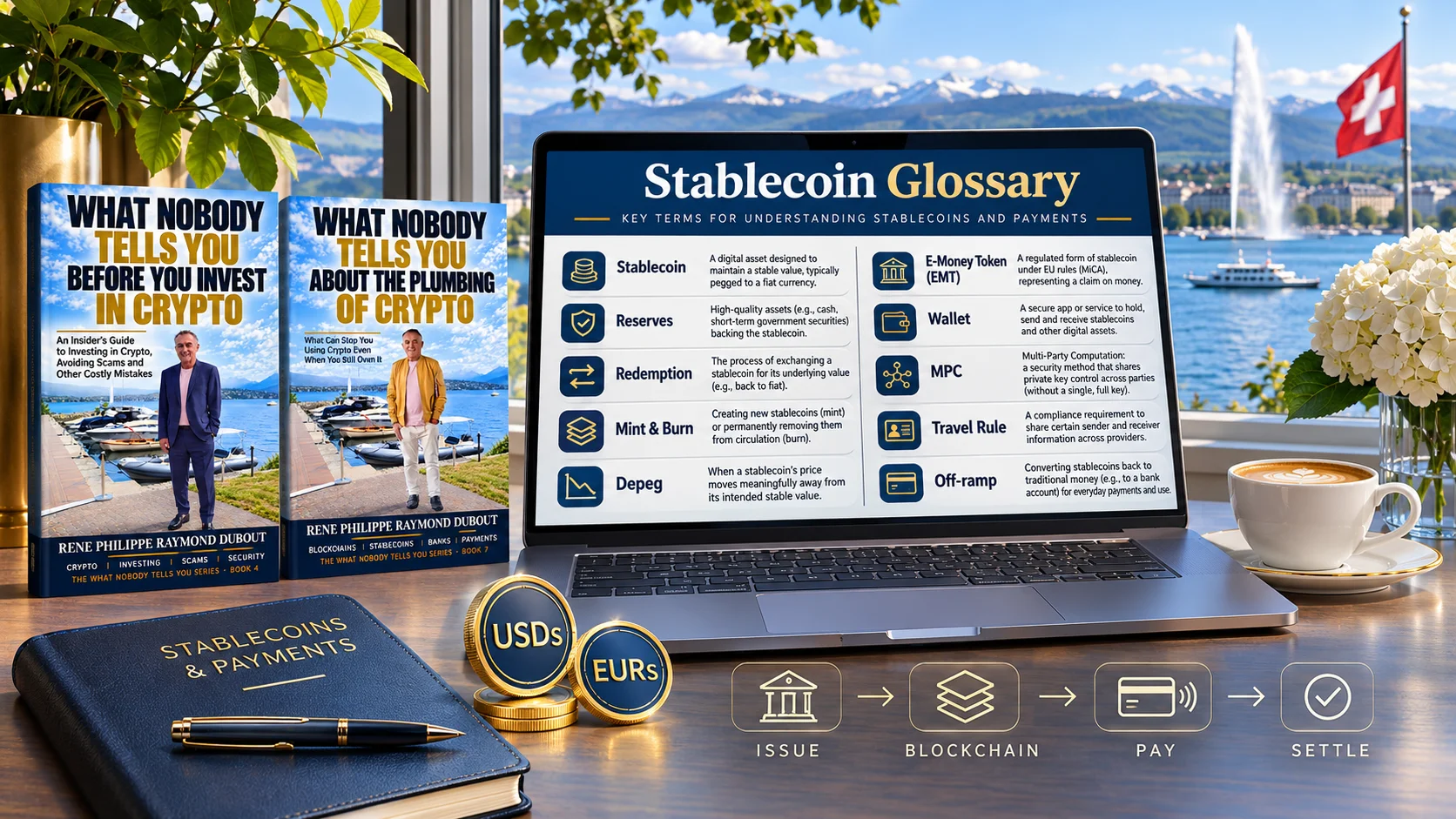
So here is my stablecoin glossary: the terms a fintech founder, a payments team or an investor needs before the first meeting, explained in plain words. Where it matters, I add the question I would ask, because in this business the definition is the easy part. The question is what keeps your money safe.
The money
Stablecoin. A crypto token designed to keep a stable value, usually one US dollar or one euro. The word describes an intention, not a guarantee. Some have held their value for years. Others have collapsed in a weekend.
Peg and par value. The peg is the value a stablecoin aims to hold: one dollar, one euro. Par value is that target. The market price is something else: what buyers actually pay for the coin on a given day. Most of the time the two are the same. The whole business model depends on keeping it that way.
Issuer and legal claim. The issuer is the company that creates the coins and holds the reserves. The legal question is simple and often unanswered: who owes you the money? Under MiCA, the holder of an e-money token has a claim against the issuer. Elsewhere, the terms may give a direct claim only to verified customers of the issuer, and none to someone who bought the coin on an exchange. Holding a token does not automatically mean owning a share of the reserves.
Fiat-backed stablecoin. A stablecoin backed by ordinary money and safe assets held by the issuer: bank deposits, short-term government debt. USDT and USDC are the best known. The question to ask: backed by what, held where, and checked by whom?
Crypto-backed stablecoin. A stablecoin backed by other crypto assets, usually worth more than the coins issued to absorb price swings. More transparent on the blockchain, but only as stable as the collateral behind it.
Algorithmic stablecoin. A stablecoin that tries to hold its value with code and incentives rather than reserves of real money, typically by creating or destroying a second token to push the price back to the peg. It works as long as people believe in the second token. TerraUSD was one, until it lost its peg in May 2022 and took tens of billions of dollars with it. When someone offers you one, my advice is short: read “algorithmic” as “not backed by real money”.
Reserves. The assets that back the coins in circulation. What matters is not only the amount, but the quality (cash or risky investments?), the location (which bank, which country?) and who has a right to them if things go wrong.
Segregation and bankruptcy remoteness. Two different questions that are often confused. Segregation means the reserves are kept apart from the issuer’s own money, in the accounts. Bankruptcy remoteness means they are legally out of reach of the issuer’s creditors if it fails. The first is bookkeeping. The second is what protects you. Ask for both, and ask the lawyers, not the marketing team.
Reserve yield. The interest earned on the reserves, usually from short-term government debt. It goes to the issuer: that is how stablecoin issuers make money. Under MiCA, an e-money token cannot pay interest to its holders. If a platform promises you a return on your stablecoins, ask where it comes from, and what the platform is doing with your coins to pay it.
Attestation. A report by an accounting firm confirming the reserves at a given date. It is not a full audit. An attestation tells you the money was there on the day of the photograph. It does not tell you what happened the day before.
Proof of reserves. A method, popular with crypto exchanges, of showing on the blockchain the assets they hold. Some versions also include customer balances, but even then it does not cover every liability, nor prove that the assets are free of other claims. It is not an audit either.
Mint and burn. Minting creates new coins when someone pays money in. Burning destroys them when money is paid out. In a well-run stablecoin, the coins in circulation follow the reserves, one for one.
Redemption. The right to give your coins back to the issuer and receive real money. This is the heart of a stablecoin. For an e-money token under MiCA, the rule is clear: the holder can redeem at any time, at par value, and in principle without a fee. Outside that framework, the issuer sets its own terms, and they can include minimum amounts, fees and access reserved to verified, often large, customers. Everyone else sells on an exchange at the market price. The question to ask: which regime applies to the coin you hold?
Depeg. When a stablecoin trades away from its peg, for example at 0.97 dollars. A small depeg for a few hours happens. A large or lasting one is a warning that the market no longer believes in the reserves or the redemption.
Tokenised deposit. A bank deposit represented as a token. Unlike a stablecoin, it is a claim on a bank, with the bank’s regulation and, depending on the country, deposit protection behind it. Same technology, very different legal nature.
E-money token (EMT). The MiCA name for a stablecoin that refers to one official currency, such as the euro or the dollar. In the European Union, it can only be issued by a bank or an electronic money institution, and it cannot pay interest to holders.
Asset-referenced token (ART). The MiCA name for a token that aims at a stable value by referring to something other than a single official currency: a basket of currencies, a commodity such as gold, or a combination. A different authorisation, different rules, and much less common in practice.
How it moves
Blockchain. The shared ledger that records who holds what. Stablecoins are issued on blockchains such as Ethereum, TRON or Solana.
Native and bridged stablecoin. A native stablecoin is issued by the issuer itself on a given blockchain. A bridged version is a copy created by a third party, backed by native coins locked somewhere else. Same name, same logo, but a different risk: the bridged coin depends on the bridge, and the issuer may not redeem it.
Contract address. The unique address of a token’s program on a given blockchain. It is the only reliable way to identify a coin. Scammers create tokens with the same name and logo as real stablecoins. Always check the contract address against the issuer’s official list.
Wallet. Software or a device that holds the keys to your coins. The wallet does not hold the money itself; the money lives on the blockchain. Lose the keys and you lose access to the money.
Custodial and self-custody wallet. With a custodial wallet, a company holds the keys for you, like a bank. With self-custody, you hold them yourself. The first adds a counterparty risk. The second adds the risk of losing everything through one mistake.
Private key. The secret code that authorises transfers. Whoever has it can move the funds. There is no help desk and no reversal.
Seed phrase. A list of 12 or 24 words from which the private keys can be rebuilt. Anyone who asks for your seed phrase, whatever the reason, is trying to rob you.
MPC (multi-party computation). A way of splitting control of a key between several parties, for example two out of three must agree before money moves, without the full key ever existing in one place. Common among institutional custodians.
Smart contract. A program on the blockchain that runs automatically when its conditions are met. It can be used to perform a legal contract, but it is not the contract itself. The program will execute what it was written to do, even if that is not what the parties agreed. The parties’ rights are decided afterwards, by the contract and the law, and getting the money back is another story.
Gas. The network fee paid to process a transaction, usually in the blockchain’s own token. On TRON, part of it takes the form of resources called Bandwidth and Energy. Some services pay it for you, and charge you for it elsewhere.
Finality. The moment a transfer can no longer be reversed on the blockchain. Three questions hide behind the word: is the transfer technically final, is the debt legally settled, and can the recipient actually use the money? A transaction marked “confirmed” does not answer all three, and may not even be technically final yet. A payments business must know when to credit a customer, and that depends on the chain.
Bridge. A service that moves tokens from one blockchain to another. Useful, but bridges have been among the most hacked pieces of crypto infrastructure. Every bridge adds a party you have to trust.
In and out
On-ramp. The service that turns ordinary money into stablecoins: you pay euros or dollars, you receive tokens.
Off-ramp. The reverse: tokens in, money in a bank account out. Often the slowest step, because it is where crypto meets the banking system and its compliance checks.
Liquidity. Enough money ready on both sides so that payments go through without waiting and without moving the price. A payout business without liquidity in the destination currency is a business that keeps customers waiting.
Spread and slippage. The spread is the difference between the buying and the selling price, often where the real conversion fee hides. Slippage is the difference between the price you expected and the price you got, usually on large or fast orders. Neither appears on the fee schedule.
FX risk. A dollar stablecoin can stay at exactly one dollar and still lose you money, if your costs are in Swiss francs, euros or baht. A stablecoin is stable against its own currency, not against yours.
OTC desk. A broker that handles large trades directly, outside the public exchange order books, to avoid moving the market. Large stablecoin trades often go through them.
The rules
MiCA. The EU regulation on markets in crypto-assets, fully in force since 30 December 2024. It sets the rules for stablecoin issuers and for crypto service providers across the European Union.
CASP. Crypto-asset service provider: a firm authorised under MiCA to provide specific crypto services, such as running an exchange, custody or brokerage. The authorisation covers the services listed in it, and the firm can offer them in other EU member states after a notification procedure.
EMI (electronic money institution). A company licensed to issue electronic money and provide payment services, under the EU’s Electronic Money Directive. Together with banks, EMIs are the only firms allowed to issue e-money tokens in the European Union.
PI (payment institution) and PSD2. A payment institution is licensed under the EU’s second Payment Services Directive (PSD2) to execute payments, but not to issue e-money. Why it matters for stablecoins: transferring e-money tokens for clients can also be a payment service. The European Banking Authority said so in June 2025, and since 2 March 2026 a CASP that does it needs its own payment licence or must work with, or as an agent of, an authorised payment firm. An EBA opinion of 12 February 2026 lets supervisors allow some applicants to keep operating while their application is assessed, under strict conditions: no marketing and no new clients for those services. It is not a general exemption, and a MiCA licence alone does not settle the question.
Custody. Holding and managing crypto assets, or their keys, on behalf of clients. How it is regulated varies a lot. In the EU it is a MiCA service. In the UK it moves under full FCA authorisation in 2027. In Switzerland, depending on the model, it can mean affiliation to a self-regulatory organisation for anti-money laundering purposes, which is not supervision by FINMA, or a FINMA licence. The question to ask: if the custodian fails, are my assets separated from its own, or am I just one more creditor?
KYC (know your customer). Checking who your customer is before doing business with them: identity, address, source of funds.
KYT (know your transaction). Screening blockchain addresses and transfers for links to sanctions, scams, hacks or other crime. On a public blockchain, money carries its history with it.
Travel Rule. The obligation for crypto providers to send the name and details of the sender and the recipient along with a transfer, as banks do for wire transfers. In the EU it applies to every transfer between crypto providers, whatever the amount. Rules vary by country.
Freeze. Most large fiat-backed stablecoin issuers can freeze coins at a given address, for example at the request of law enforcement. Good news if your coins were stolen. Worth knowing if you believed a stablecoin was beyond anyone’s control.
The words that cost money
If you only keep six terms from this list, keep legal claim, reserves, redemption, custody, finality and off-ramp. They decide who owes you the money, whether it is there, whether you can get it back, who holds it, when it is really yours and how you turn it into money your suppliers accept. Every stablecoin problem I have seen in practice came down to one of them.
If you want the full picture, I wrote What Nobody Tells You About the Plumbing of Crypto, on the miners, stablecoin issuers, banks and bridges that sit between you and your money. And if you are deciding how to launch, read White Label Crypto Under MiCA: Can You Run Your Business on Someone Else’s CASP Licence? and How Much Does an EMI Really Cost?, since in the EU only a bank or an EMI can issue a euro or dollar stablecoin.
How FintechLex can help
We advise fintechs, payment companies and investors that want to issue, hold, accept or move stablecoins: choosing the right licence and jurisdiction, setting up the company that carries the crypto activity, checking the issuer, the custodian and the banking partners, and preparing the application. Tell us what you want to build, and we will tell you which words in your contracts deserve a second look.
Write to us at insight@fintechlex.com or on WhatsApp +41 787 983 770.
Rene-Philippe
Sources: Regulation (EU) 2023/1114 on markets in crypto-assets (MiCA), in particular articles 48 to 50 on e-money tokens; Regulation (EU) 2023/1113 on information accompanying transfers of funds and certain crypto-assets (Travel Rule); FATF Recommendation 16; European Banking Authority, no-action letter on the interplay between PSD2 and MiCA (10 June 2025) and opinion of 12 February 2026; Directive (EU) 2015/2366 (PSD2); Directive 2009/110/EC (Electronic Money Directive); TRON developer documentation on Bandwidth and Energy; press reports on the collapse of TerraUSD (May 2022).
This article is for general information only and does not constitute legal or investment advice.