

What one Geneva bank did after the SNB dropped the euro floor, and why almost nobody noticed
On 22 October 2026, the Swiss National Bank published the summary of its September discussion. One sentence took me straight back to 15 January 2015: “An increased willingness to intervene is no longer necessary in the current environment.” The same text notes that the franc’s low volatility has made it more attractive as a funding currency for carry trades.
A calm market. Traders borrowing francs because nothing moves. A central bank telling everybody it is relaxed. I am no currency wizard and I’m not predicting anything. But the last time the franc looked this quiet and everybody felt this safe, it did not end gently. So this is a good moment to tell a story almost nobody told.
The day the franc broke
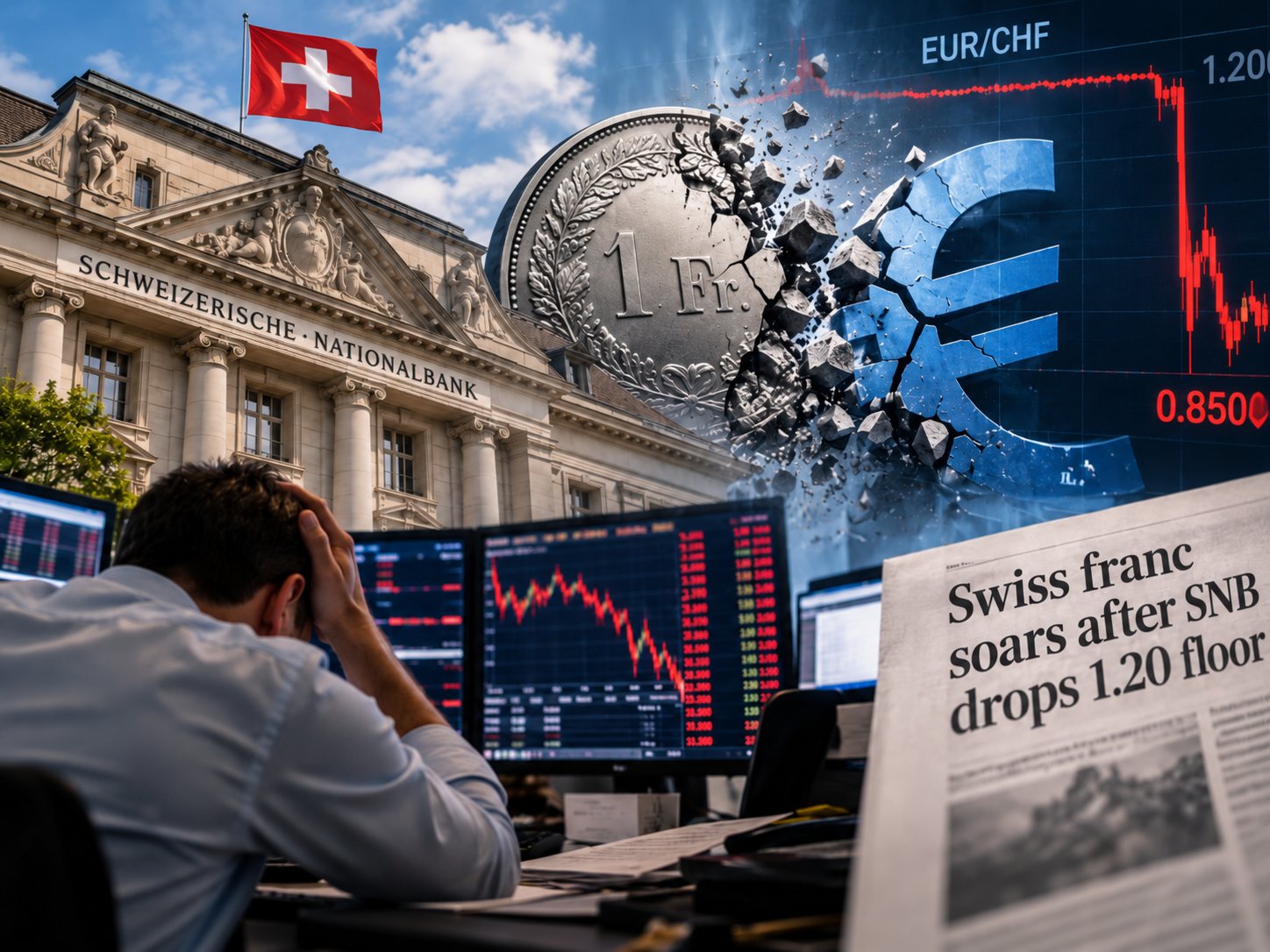
On 15 January 2015, at 10:30 in the morning, the Swiss National Bank dropped the 1.20 floor it had held under the euro since 2011. Within minutes the franc jumped close to 30%. There was nobody on the other side of the trade. Stop-losses executed far from where clients had placed them, and thousands of trading accounts finished the day below zero.
In other words, clients who believed they could only lose their deposit woke up owing money to their broker. Some owed more than they had ever put in.
The bill landed fast. Alpari UK went into administration the next day. FXCM was left with about USD 225 million of negative client balances and needed a USD 300 million rescue loan from Leucadia. In Switzerland, Swissquote set aside CHF 25 million. Those were the headlines, and they ran for weeks.
What Dukascopy did
On 19 January 2015, four days after the shock, Dukascopy Bank in Geneva published a short statement. Its client agreements, and the rules it was regulated under, allowed it to claim the negative balances. It decided not to. In its own words, it took an “exceptional decision” to release customers from the obligation to cover them.
Two details matter more than the headline. First, the bank said it had not cancelled or negatively adjusted a single trade done on 15 January. The price you got was the price you kept. Second, it invited the rest of the industry to follow the same approach, to rebuild customers’ trust.
I’ll be honest: if I hadn’t been close to the people at Dukascopy at the time, I would never have heard about it. I suspect most of you didn’t either.
For the record, I don’t own a single Dukascopy share, I don’t even have an account there, and nobody paid me to write this. I gave interviews on Dukascopy TV over the years, like many people in the industry at the time. Nobody paid anybody. I just think good behaviour deserves at least one article.
What the others did
Here I have to correct my own memory. Dukascopy was not alone in writing off the debts. By 22 January, Finance Magnates had a list of several dozen retail forex brokers that had publicly said they would forgive negative balances, among them OANDA, FxPro, eToro and AvaTrade. I suspect many of them did it for a simple reason: chasing thousands of small debts across many countries costs more than it brings back.
Others took the opposite road, and that is where it gets interesting:
- Interactive Brokers booked a loss of about USD 121 million in the first quarter of 2015, and was still saying years later that it continued to actively pursue collection of those debts.
- Saxo Bank confirmed trades at one price on the morning of 15 January, then amended them hours later at much worse rates. One UK client went from a positive balance of about GBP 41,000 to a negative balance of about GBP 739,000. In 2017 the UK Financial Ombudsman ordered Saxo’s UK arm to put him back where he was. The Danish regulator, for its part, found Saxo’s repricing method acceptable but reprimanded it on two points.
- FXCM announced on 28 January that it would forgive about 90% of its clients, in certain jurisdictions only.
So what set Dukascopy apart was not the forgiveness itself. It was the combination: a Swiss bank, not a small offshore broker; all the clients with a negative balance, not a percentage; four days, not two weeks; and not a single trade repriced after the fact. Saxo, another bank, did the exact opposite on that last point.
Why nobody praised it
So why did a bank that behaved better than most get no applause? I see five reasons, and none of them has much to do with Dukascopy.
- Nobody writes about the plane that landed. A broker that goes bust hurts tens of thousands of people, and that is a story. A bank that quietly absorbs its clients’ losses is just a bank doing its job. Journalists are paid to find the fire, not to count the houses that didn’t burn.
- It got lost in a list. Within a week, dozens of brokers had announced some form of forgiveness. Dukascopy’s name ended up as one line among sixty. When everybody claims to be generous, nobody stands out, even the one that was generous without small print.
- It looked like crisis PR. In the middle of a panic, every firm was putting out reassuring statements. For anyone who wasn’t a client, one more press release saying “we are solid and we look after you” sounded like the others.
- Praising a broker looks like advertising. A financial journalist who writes “this bank did the right thing” risks being accused of doing its marketing. Regulators don’t hand out medals either. Their job is to punish what went wrong, not to applaud what went right.
- The difference was in the details. “Not a single trade repriced” and “all clients, not 90%” are the points that mattered. They are also exactly the kind of points that disappear when a story is cut to three paragraphs.
There is a sixth, less flattering reason. Dukascopy was a mid-sized bank in Geneva, not a London giant with a press office on speed dial. In finance, as elsewhere, the loudest voice is not always the most honest one.
Three years later, it became the law
The best praise Dukascopy got came from the regulators, and they never mentioned its name. From 1 August 2018, the European Securities and Markets Authority made negative balance protection compulsory, account by account, for retail clients trading CFDs in the EU. In plain English: a retail client can no longer lose more than what is in his account.
What one Geneva bank did by choice in January 2015, every broker serving retail clients in Europe now has to do by obligation. In France we say: c’est dans le besoin qu’on reconnaît ses amis. It is when you are in trouble that you find out who your friends are. The regulators found out on 15 January 2015, and wrote it into the rules.
What this means if you choose, build or buy a broker
If you are a trader, don’t only read the press. The press tells you who failed. It rarely tells you who behaved. Ask the broker what it did on 15 January 2015. If it wasn’t around yet, read what its contract says it will do the day the next central bank surprises everybody, and whether it can amend your trades after confirming them. Believe me, that day will come.
If you are building or buying a brokerage, the lesson cuts the other way. The terms and conditions, the hedging, the capital buffer and the liquidity providers are what decide whether you become the Dukascopy or the Alpari of the next shock. A licence lets you open the door. The way you behave on the worst day decides whether clients come back through it.
Sources
- SNB: Monetary policy assessment of September 2026, summary of discussion
- Finance Magnates: Swiss bank Dukascopy will reimburse traders with negative balances
- investingLive (ForexLive): Dukascopy clears negative client balances
- Finance Magnates: Brokers forgiving negative balances following the CHF crisis
- Swissinfo: FXCM faces losses as Swiss shock leaves Alpari UK insolvent
- Finance Magnates: Swissquote sets aside CHF 25 million
- CNBC: FXCM to forgive most clients for negative balances
- FinanceFeeds: Interactive Brokers continues to collect debts from the SNB event
- Finance Magnates: UK Financial Ombudsman rules against Saxo in SNB dispute
- Saxo Bank: Reprimands by the Danish FSA
- ESMA: Final product intervention measures on CFDs and binary options
Setting up, licensing or buying a brokerage? Talk to us before you sign. We help clients set up, license and acquire brokerages, payment institutions and banks, and we look at exactly these questions: the client terms, the liquidity, the capital, and what happens on the worst day. Contact us at insight@fintechlex.com or on WhatsApp at +41 787 983 770.
Rene-Philippe