
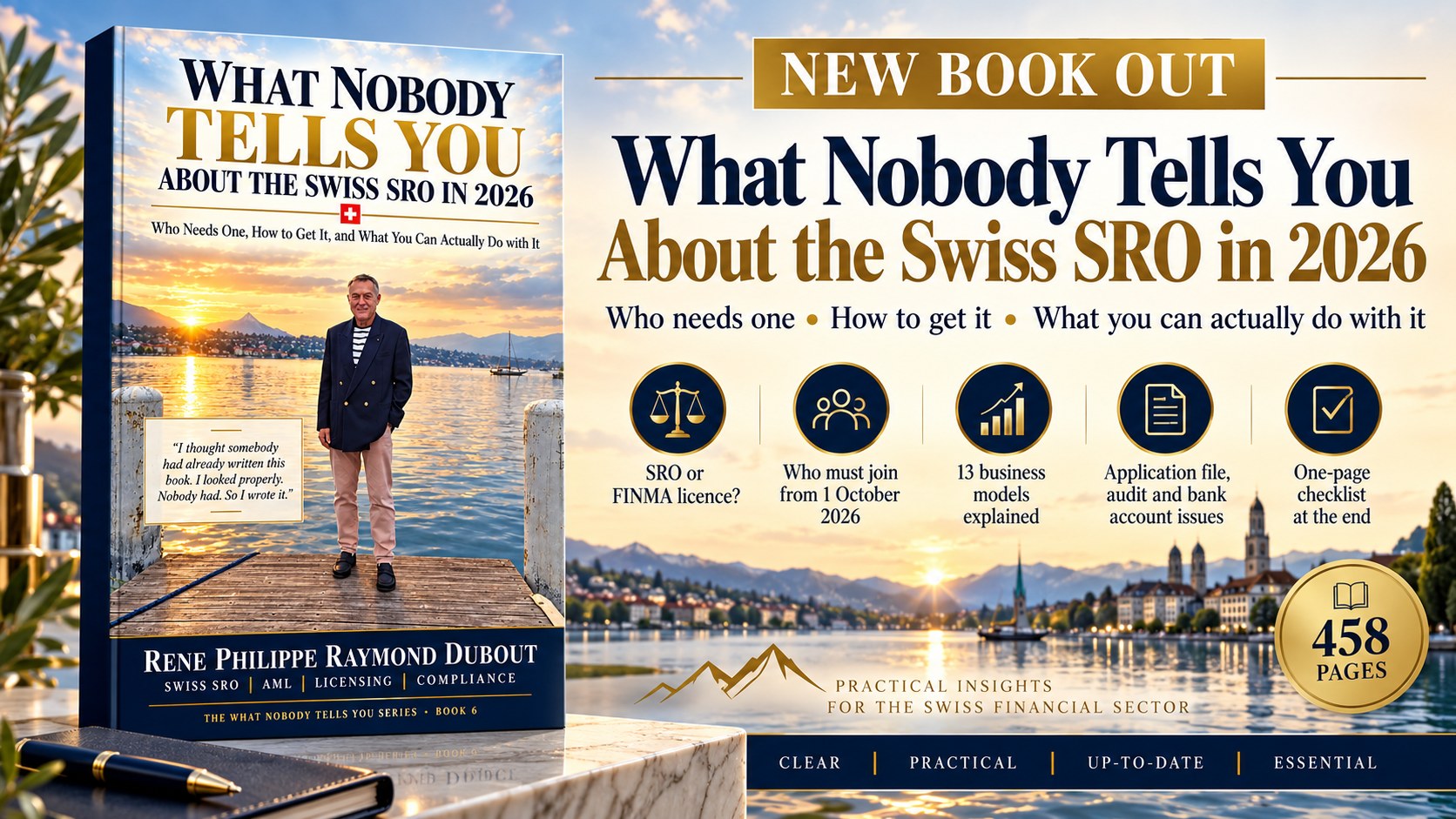

Every week, somebody writes to me with the same sentence: “I need a Swiss SRO licence.”
Sometimes he is right. Sometimes he needs something else entirely. And quite often he has no idea what an SRO is, what it costs, or what it allows him to do. Somebody told him that a Swiss SRO is the cheapest and fastest way to run a “regulated” financial business in Switzerland, and he believed it. The first part is true. The second part is where the trouble starts.
So I wrote a book for that person. What Nobody Tells You About the Swiss SRO in 2026 is now available on Apple Books, Amazon (Kindle and paperback) and Google Play.
Why it took six books
I am Swiss, I am a Swiss lawyer, and I like the SRO system. It should have been the first book of the series. I waited because I was sure somebody had already written it. The Anti-Money Laundering Act has been in force since 1998, and so many companies have gone through an SRO since then that the book had to exist somewhere.
Then I looked properly. Commentaries written by lawyers for lawyers, yes. Marketing pages promising an “SRO licence in four weeks”, plenty. A book that takes an entrepreneur from the first question to the annual audit and the bank account, in plain words: nobody had written it. So I did.
Not a universal licence, but far more than most people think
Switzerland has given the world watches, chocolate, fondue and raclette. In my view, the SRO belongs on the same list. It is the Swiss army knife of fintech: one small company, one membership, and you can exchange currencies, transfer money, lend, hold crypto for clients or act as escrow agent, under real anti-money laundering supervision, without building a bank.
But you do not cut down a tree with a Swiss army knife. Some activities need a FINMA licence, and the reform will move more of them there. The real question is where the line runs, before you spend money on the wrong structure. That is the line this book draws, business model by business model.
New since 1 October 2026: advisers too
The revised Anti-Money Laundering Act came into force on 1 October 2026. The SRO is no longer only for payment companies, currency exchanges and crypto businesses. Lawyers, notaries, fiduciaries, company formation and domiciliation providers and real estate professionals who take part in certain transactions (real estate deals, setting up or administering non-operating companies, buying or selling companies through them) are now caught as “advisers”.
Anyone already active as an adviser on 1 October must apply to an SRO before 1 December 2026. Two months, for a profession that has never had to write an anti-money laundering directive. And being a lawyer is not an exemption: only work linked to court or arbitration proceedings is. Chapter 2 explains who is caught, who is not, and what “taking part” really means.
What is inside
- Part One: Do You Need an SRO? The SRO in plain words, the new rules for advisers, SRO or FINMA licence, and how to choose your SRO.
- Part Two: The Application File. Can you be admitted, the file piece by piece, the business plan the SRO actually reads, the anti-money laundering policy, the legal opinion, the compliance officer, and realistic budgets and timelines.
- Part Three: Life After Admission. The annual audit, the bank account problem, crypto SRO companies, and what the reform will change.
- Part Four: Buy Instead of Apply. How to buy an existing SRO company without buying its problems.
- Part Five: Thirteen Business Models. Crypto exchange, custody, stablecoins, gold, art and freeports, tokenisation, international payments, merchant services, escrow, lending, crowdfunding, trade finance, and the businesses that sit next to finance.
For each business model, the same questions: Where does the money go? Who is the client’s counterparty? Is an SRO enough, or do you need a FINMA licence? What will the reform change? Every chapter ends with six things to remember and a decision table, and at the end you get the whole SRO file on one page, as a checklist.
Free updates until the end of 2026
Swiss financial regulation is moving. A draft reform of the Financial Institutions Act would create two new FINMA licences, for crypto institutions and payment instrument institutions. Until the end of 2026, we follow the reform, the crypto rules and the payment rules closely. At the end of December, everything important will be added, and the updated edition will be free of charge for every reader who already has the book, in the store where they bought it.
Who should read it
- The founder who wants to launch a payment, currency exchange, crypto, escrow or lending business in Switzerland.
- The investor who has been offered a “ready-made Swiss SRO company” and wants to know what he is really buying.
- The lawyer, notary, fiduciary or real estate professional who never thought he would need an SRO, and now has until 1 December.
Get the book
Rather not walk the route alone?
The book shows you the whole route. If you would rather not walk it yourself, FintechLex prepares SRO applications, and we have Swiss SRO-affiliated companies for sale, ready to operate. Write to us at insight@fintechlex.com or on WhatsApp +41 787 983 770.
Rene-Philippe