
 By Rene Philippe Raymond Dubout · · Updated
Lessons from Myanmar: juntas, embargoes, exchange controls and a vineyard
Bangkok, Monday night, 18 October 2004. I am on the balcony of my apartment, looking out over the city lights, the traffic far below finally quiet. A calm evening. Then the phone rings.
It is Paul, calling from Yangon. Paul runs our internet company in Myanmar, and right now he is inside our compound with the army all around it.
“Rene, you won’t believe what has happened.”
“No, but you are going to tell me.”
“The army has taken over Bagan Cybertech.”
Two days later, on the Wednesday, we were due to receive 20 million dollars for our shares. The contract was signed. Instead, our company belonged to the army.
I will come back to how we got there. But first, why I can talk about how to invest in a high-risk country, the kind of place where things like this happen.
I am not writing this from a textbook. In 2002 I started advising investments for clients in Myanmar, at a time when there was no open civil war, but the military government was politically very strict, people were not free, and an American embargo made almost everything difficult to obtain. Three quarters of the equipment you need for a modern business comes from the United States, so you can imagine the problem.
Even Coca-Cola and Pepsi were no longer imported. There was a local cola instead, and because everything was scarce, the old Coca-Cola and Pepsi bottles and caps were collected and reused. You could find yourself drinking a local cola from a Coca-Cola bottle with a Pepsi cap on it. That tells you everything about doing business under an embargo.
On top of that, there were exchange controls. The official rate was around 6 kyat to the dollar. In the street, the same dollar bought 800 kyat and more. Wire your investment through a bank and you were converted at the official rate. You can do the maths.
Turmoil, sanctions, or both?
Before anything else, get the diagnosis right. A country in turmoil and a country under sanctions are not the same thing, and the risks are not the same either.
- Turmoil without sanctions. A coup, a political crisis, an economic collapse, but money still moves in and out. The risk is on the ground: your partner, the regime, the safety of your people. Think of Thailand after the coups of 2006 and 2014.
- Sanctions without turmoil. The country is stable, sometimes boringly so, but you are blocked from the outside: banks, transfers, blacklists. Cuba has lived under an American embargo for decades with a very stable regime.
- Both at once. The hardest case. Myanmar and Russia today, among others.
The Myanmar I knew in 2002 was already in the third box: a junta, and American sanctions banning new investment by US persons since 1997. We felt those sanctions every day, because everything was missing. But as none of us was a US person, we carried no legal risk. Or almost none.
We paid the people on the project in dollars. One day I wired a reimbursement and wrote “air ticket Yangon” in the payment reference. The transfer was blocked by the Federal Reserve. We had to explain what the payment was for before the money was released. One word in a payment reference, and your money is frozen. A rookie mistake on my part, and a lesson I never forgot: whoever clears the dollar watches the dollar.
Some of the lessons below work in every box, such as choosing your partner and the person you send. Others, such as the way we moved money, only work where no sanctions apply to you or to the transaction.
Here is what I learned, decision by decision.
1. Decide whether you should go at all
The first decision is not how to invest. It is whether to invest. Look at the conditions, and look honestly at what you do.
If your business is commodities, Myanmar is hard to ignore. The country has practically everything in the ground. Difficult conditions or not, a natural resources company cannot pretend that country does not exist.
If you are building something truly high-tech in the middle of an American embargo, and you cannot get half of the equipment you need, it is probably not the moment. Unless, that is, you can source from other countries what the Americans will not supply. Check that first, before you fall in love with the market.
2. Choose who you send
This is underestimated, and it matters enormously. You do not send a man with a wife and young children to a country like that. In general, you need someone single, between 45 and 50, with real experience. Not too old either, but someone who has already seen a few things and will not panic at the first roadblock.
3. Choose your partner: the government or a private player?
In this kind of country, it is rare to be allowed to own 100% of a business as a foreigner. And even where you can, you should not. In a country in turmoil, a local partner is not optional.
So who do you partner with? Sometimes, the government is the right answer. Let us be honest: these are not always governments with clean hands, nor the kind of people you dream of doing business with. But if you want to operate safely, you tell yourself that the safest partner is the one holding the guns. We did exactly that. Let me tell you the story of Bagan Cybertech.
4. The Bagan Cybertech story
Around 2002, the government of Myanmar launched a tender for the country’s first private internet and internet telephony licence (voice over internet protocol). It was the early days of Skype.
My clients wanted to bid. They were a group of former military men, Scottish, English, Australian and New Zealanders, all veterans of the signals branches of their armies. In Thailand they ran a company providing telecommunications to offshore oil platforms, and years before they had even held one of the first mobile phone licences in Singapore, until their investor dropped them and they lost it. These were people who had dreamed of this kind of project all their lives. The two I knew best were Chris, a very good man who later left for Africa and whom I lost sight of, and Paul, the architect of the group. Paul still lives in Thailand, and we still see each other regularly.
The problem: we were small. Very small. On the other side of the table were heavyweights, including the Thai telecom group controlled by the family of Thailand’s then prime minister, Thaksin Shinawatra.
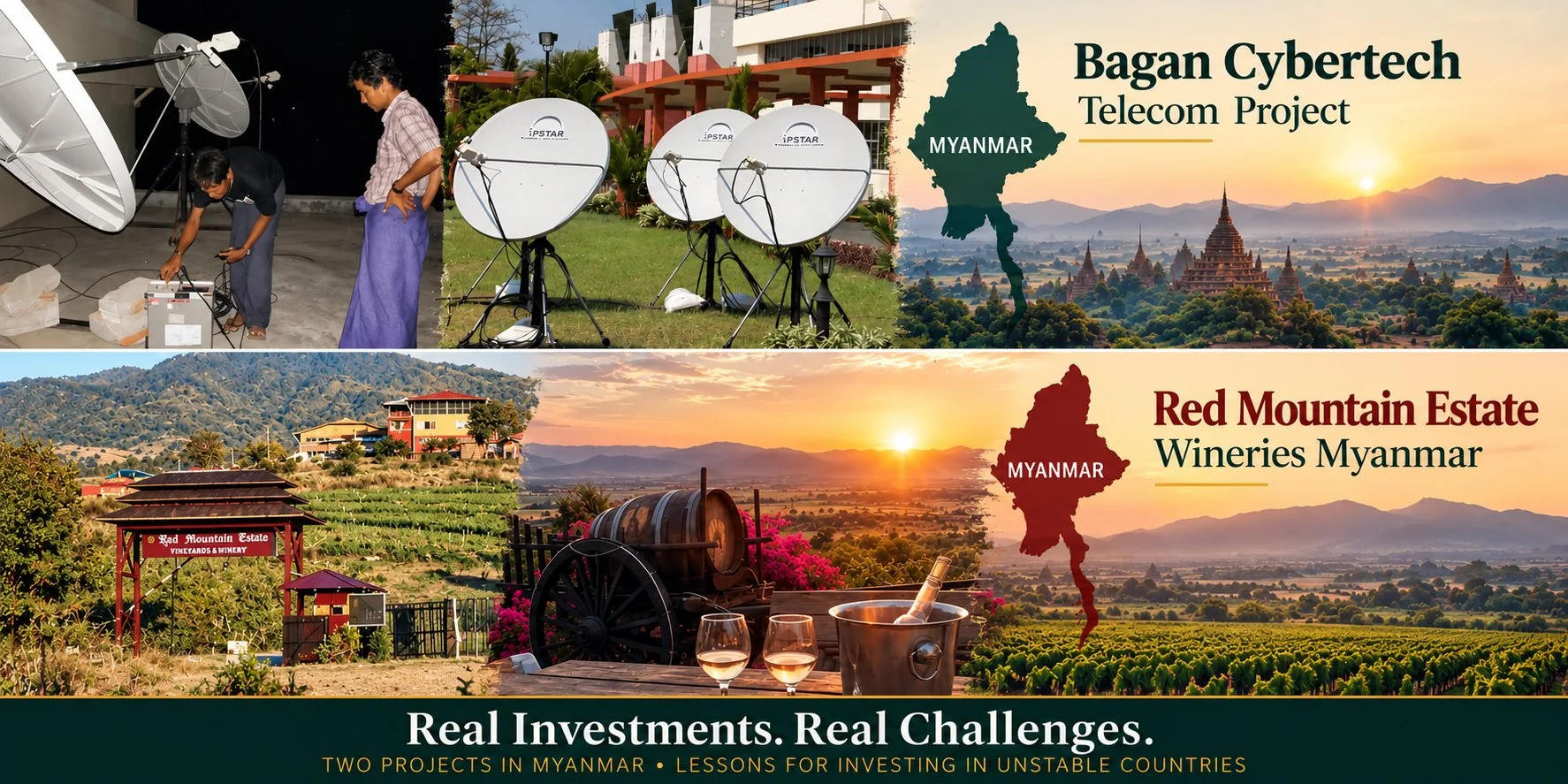
So how did we win? I already had another project in Myanmar and was flying in every week for two or three days. In Yangon there was a coffee shop, the local Starbucks if you like, except it could not be called Starbucks because of the embargo. The two young men running it were very nice, and they were the sons of General Khin Nyunt, at the time Secretary-1 of the junta, its number three, and the head of military intelligence. In plain words, the man in charge of the local KGB.
When my clients asked me if I could help, I thought of those two young men. We met, the connections followed, and the licence followed the connections. I became a partner in the venture.
Why did we get the licence? Because Myanmar’s first private internet provider was private in name only. We held 30%. Khin Nyunt’s sons held 30%. And Khin Nyunt’s military intelligence held 40%.
5. Nine months from greenfield to operational, and a room full of dollars
Here is the beautiful part. With partners who controlled borders and customs, we immediately obtained every import licence we needed. In the middle of an embargo, we got everything. We bought it all in Singapore: Dell equipment, the full package.
We went from greenfield to fully operational in nine months: buildings built, computers installed, big satellite dishes on the roof. Fascinating.
And it was a cash machine. Everybody wanted internet from the private operator, and we were paid in cash, in dollars. We had a room that was literally stuffed with dollar bills. Crazy. It ran like that for about a year.
Then a local investor offered to buy us out. We were delighted. The price for our shares was 20 million dollars, a very nice figure at the time. The contract was signed. Payment was due on a Wednesday.
And that is when Paul called me on that Monday night.
6. What happened
In August 2003 Khin Nyunt had swapped the uniform for a suit and become prime minister, in agreement with the other two leaders of the junta. He opened negotiations with Aung San Suu Kyi. He pushed the dialogue with her further than any junta leader before him. Too far, for the others.
On 18 October 2004, overnight, Khin Nyunt was removed and placed under house arrest. The same day, both his sons were arrested and jailed. The army took control of Bagan Cybertech.
Then the junta did something extraordinary. Khin Nyunt had so much power that the only way to get rid of him was to cut off his base entirely. Within days, the regime abolished his National Intelligence Bureau and dismantled the whole military intelligence apparatus. More than 3,000 officers were imprisoned, sacked or redeployed.
So there we were, invested in a company where our 40% shareholder no longer legally existed, our two 30% partners were in prison, and the army was in charge.
7. Would I do it again with the government? Yes.
The obvious lesson is that you should not always invest with the government. But the honest truth is that, in our case, there was no other way. We got the licence because we were partners with Khin Nyunt’s family. We delivered the project because we had the import licences. And we had the import licences because we were partners with the state. That project could not have been done without the government.
So even today, knowing everything I know, I would do it again the same way. Some opportunities only exist through the state. The real question is whether the upside is worth the day the state changes its mind.
8. Choosing a private partner: history matters
Now, if you go with a private local partner, who do you choose? Sometimes the answer goes back more than a hundred years.
Myanmar as a country was put together by the British, who conquered Burma in stages between 1824 and 1885. They took a mosaic of peoples, today the government officially recognises 135 ethnic groups, and made one country of it. Technically, Myanmar is not a nation with a single identity. It is an amalgam of ethnic groups and clans.
Over the years, several large ethnic groups signed ceasefires with the junta. Those groups were big, politically weighty, and, crucially, they kept their own armies.
That changes everything for an investor. Partner with one of those groups, and the government cannot easily interfere, because it cannot afford to antagonise the very groups it made peace with. And if one day the junta falls, your investment is still protected, because the first thing any new government will avoid is a fight with a dozen or so large, armed groups that cooperated with its predecessor. That is what a safe investment looks like in a country like Myanmar.
9. Red Mountain Estate: the project I am proudest of
My other project in Myanmar was in wine. The investors were a Japanese investor and a local partner: the Pa-O, through their chairman. The Pa-O are one of the three big groups of Shan State, alongside the Shan and the Wa. Together they created a wine estate, Red Mountain Estate, in Shan State, overlooking Inle Lake. It was not my money. I was their adviser.
It is still there and still selling wine today. It is one of the finest operations I have ever advised, because I was involved from start to finish on behalf of the investors. I wrote the business plan, set up the companies, structured the joint venture between the two partners, chose the staff and the contractors, and bought the equipment. I worked on it from 2002 until it was up and running a few years later when my mandate ended.
All the more satisfying given that I do not drink wine, do not particularly like it, and know nothing about it. Building a business is a profession. Loving the product is optional.
10. Getting money in, and out, under exchange controls
With Bagan Cybertech we were lucky in one respect: we did not invest cash. We brought know-how, expertise and the foreign connections to buy the equipment. So the exchange rate never hurt us, and when the army took the company we did not lose money. We lost what we were about to earn, which is not the same thing. Paul and his team stayed on and ran the operation for years, so they kept their salaries. Technically, I was the one who lost the most, because from then on it brought me nothing. Still, it was a fantastic adventure.
The vineyard was different. There, real money had to go in, from a Japanese investor, a very fine gentleman. And that is where exchange controls bite. Send a wire and every dollar is converted at about 6 kyat, when it is worth around 800 in the street. You are wiping out more than 99% of your money’s purchasing power on arrival. You get fleeced, badly.
So yes, a little had to be wired officially, and a little cash came in. But the structure did the heavy lifting:
- Everything bought abroad was paid abroad. Equipment was paid directly from outside the country, so no conversion at all.
- Local costs were settled by compensation with the local partner. When we had to contribute locally, we paid the dollar equivalent, at a realistic rate, into the local partner’s account abroad, and he put up the kyat in Myanmar. His share of the foreign spending was, in effect, repaid to us in local currency, which funded our local investment.
To give you an idea: to put 1 million kyat on the table locally, a wire at the official rate would have cost around 167,000 dollars. Through compensation at the street rate, around 1,250 dollars. Nobody sensible wires the first amount.
Getting out raises the same problem in reverse: how do you repatriate your investment from a country with exchange controls? Same answer. Your local partner usually has money abroad, and the compensation works the other way. You can always carry a little out in cash, but not much.
One warning, and I mean it. This mechanism was clever and legitimate in Myanmar in 2002. Done today, in a country under sanctions, the same arrangement can be treated as unlicensed money transfer, sanctions evasion or money laundering. What worked in 2002 can send you to prison in 2026. Get advice before you move a single dollar.
11. Investing in a sanctioned country today: check before you commit
If you want to invest in Myanmar, Russia or any other country in turmoil today, it is a different game from the one I played. Before you even think about partners and people, check the following.
- Check every sanctions list, not just the American one. The United States (OFAC), the European Union, the United Kingdom, and Switzerland (SECO) each have their own, and they do not always match. To take one example, since the 2021 coup Western governments have listed the Myanmar junta’s leaders and its military conglomerates by name.
- Check who is behind your partner. Under US rules, a company owned 50% or more by sanctioned persons is treated as sanctioned; under EU rules, ownership of more than 50% or control is enough. Its own name may appear on no list. In 2002, a partnership with the junta was a political risk. Today, it can be a legal dead end.
- Check that the money can actually move. Several Russian banks have been cut off from SWIFT since 2022, and Western banks refuse many payments linked to sanctioned countries, even perfectly legal ones. Remember my air ticket. If the money cannot get in, or out, the rest does not matter.
- Remember secondary sanctions. You do not need to be American to be hit. Helping a listed entity can put you on a list yourself.
- Check export controls. A large part of modern equipment and technology simply cannot be delivered any more, neither directly nor through a third country.
Before you get involved with any government, or with anyone close to it, check the sanctions. The rule is simple: check before you commit. Once you are in, it is too late.
What to remember before you invest in a high-risk country
- Decide first whether your sector justifies the country. Commodities, maybe. Embargo-dependent high-tech, probably not.
- Send the right person: experienced, unattached, steady.
- You will need a local partner. Choose between the state and a private player with your eyes open.
- The government can open every door, and close them all in one morning.
- Study the country’s history. In Myanmar, the safest partners were armed groups at peace with the regime.
- Under exchange controls, structure the money flows before you move a single dollar.
- Bring know-how before cash when you can. You can lose a profit without losing your capital.
- Know which box you are in: turmoil, sanctions, or both. Then check every sanctions list before you sign anything.
Before you take your money abroad
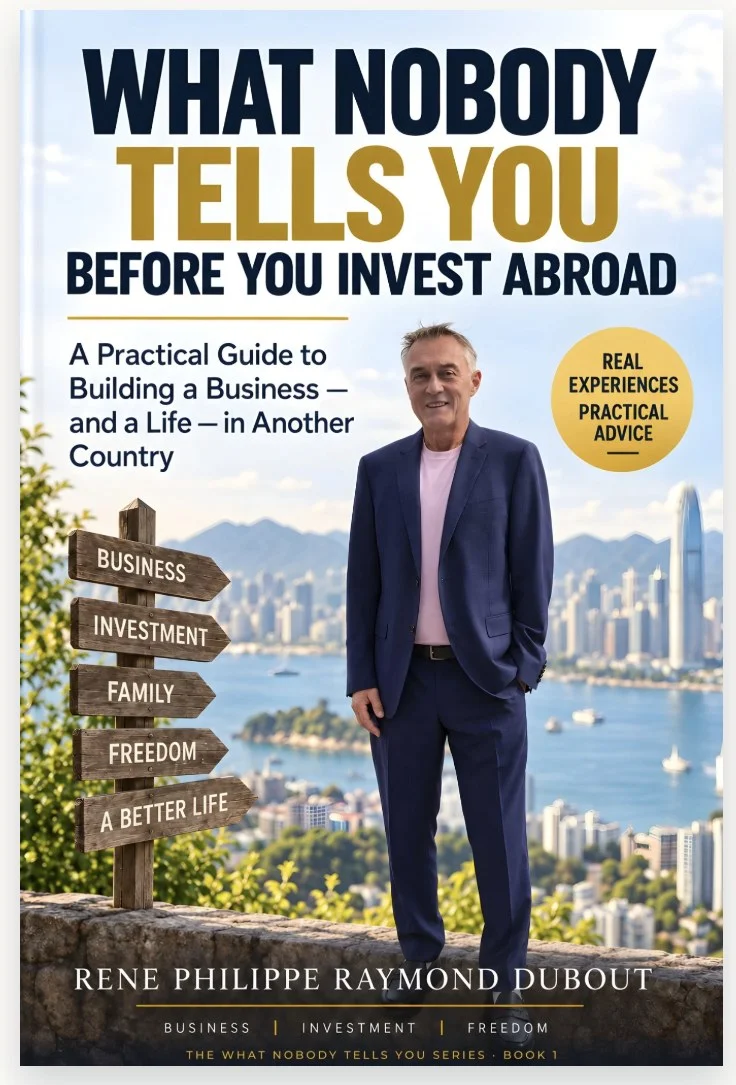
If this story speaks to you, my book goes further. It is about what actually happens when an entrepreneur takes his savings, his business and sometimes his whole life abroad, and about the questions that can destroy an investment long before anyone reads the law. Can you actually invest in that sector? Can you legally work in your own company? How much money will you really need? What happens if your local partner turns against you, if your accountant follows a bad instruction, if your bank asks you to prove where money you earned twenty years ago came from? And what happens if the investment works, but your life doesn’t?
Further reading: Comoros Fake Regulators, Gambia Fake Offshore Licences and Setting Up a Swiss Crypto Company from Asia in 2026.
Thinking of investing in a country like this? Talk to us before you commit. We have been on the ground: a licence won over coffee, a company seized by the army on a Monday night, money moved under exchange controls, and a vineyard still producing more than twenty years later. Our experience comes from the field, not from textbooks, and we know which questions to ask before the money moves. Contact us at insight@fintechlex.com or on WhatsApp at +41 787 983 770.
Rene-Philippe