
 By Rene Philippe Raymond Dubout · · Updated
Every few months, a prospect tells me he can get an offshore bank licence in the Comoros for a third of our fees, in a few weeks, and without putting up the capital a real regulator would ask for. He is right about the price and the speed. He is wrong about one detail: the licence is worthless. The Central Bank of the Comoros says so itself, in writing, and has said it more than once.
If you are looking at a “Mwali”, “Anjouan” or “Comoros International Banking Authority” licence, for a bank, a broker, a payment company or a casino, read this before you pay anyone.
Who can license a bank in the Comoros?
One institution: the Banque Centrale des Comores (BCC), the Central Bank of the Comoros. Under the constitution of the Union of the Comoros, banking and financial law belongs to the Union, not to the individual islands. The country is made of three main islands, Ngazidja (Grande Comore), Mwali (Mohéli) and Nzwani (Anjouan), and none of them has the power to license a bank on its own.
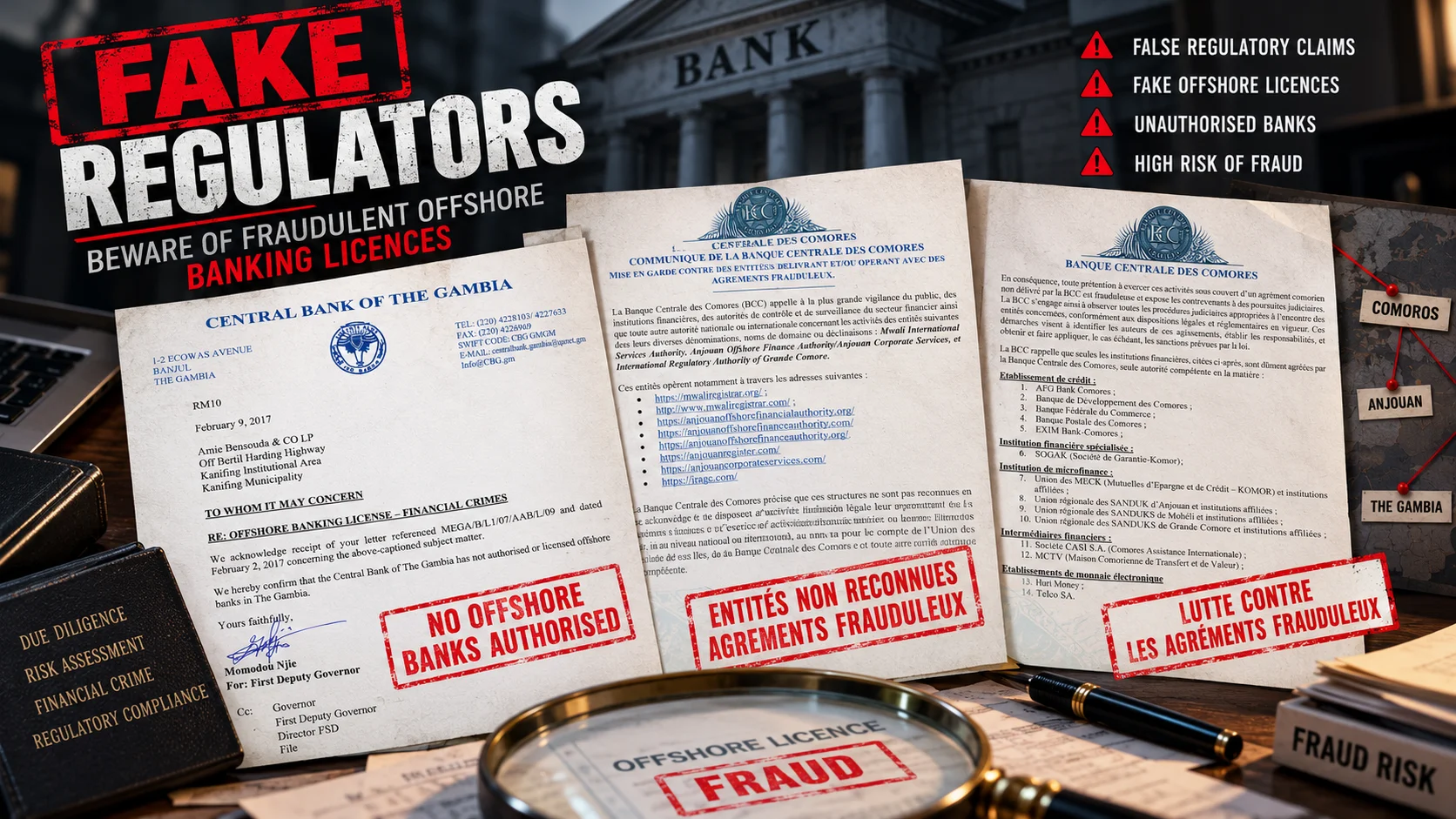
The central bank has published warnings naming “fictitious structures” that claim to issue banking and financial licences in its place, and the warning was republished in December 2025. Among the bodies it names:
- Mwali International Services Authority (MISA)
- Anjouan Offshore Finance Authority (AOFA) / Anjouan Corporate Services
- Comoros Services Ltd
- Comoros International Banking Authority (CIBA)
In other words, a licence from any of them is a piece of paper with a nice stamp. It does not make you a bank, in the Comoros or anywhere else.
The fake banks
The same central bank warnings list banks that claim a Comoros licence they do not have. Some say they are licensed by the central bank itself, others by MISA, CIBA or the Anjouan bodies. The names on the list include Exim Credit Bank, Dafri Bank, DTS Circle Bank, Wealth Bank Ltd, GSB Gold Standard Bank Ltd, Bliss Bank, Coriolis Bank Corporation, Revollet International Limited, Ray Next Bank Limited, Tri Bank, Forbes Private Bank, Foreign Finance Bank, International Finance Bank Ltd, Rochester Bank, Micro Capital Bank, Soleil Chartered Bank.
Does a bank that is not on the list have a valid licence? No. The list only shows the ones the central bank had spotted when it wrote it. The sellers of these licences have kept selling since. The only safe assumption is this: any licence issued by one of these “authorities” is fake, whether the bank is on a list or not.
This is not a new story
The International Monetary Fund looked at the Comoros offshore sector back in 2010 and concluded that the offshore institutions had no legal basis when they were created. Sixteen years later, the business is still running, because there is always a new buyer who wants a bank for peanuts.
The latest chapter is gambling. Since 2023, a body calling itself the Anjouan licensing authority has issued online casino licences; nearly 1,500 businesses appear on its register, and the Comoros government disputes their legal status. In October 2026, press reports said the Comoros government had asked the United Kingdom for help in investigating the network behind these licences, and was preparing legal action. When a government has to ask a foreign country for help against licences issued in its own name, you can guess how much those licences are worth.
The Gambia: same product, different country
The Comoros is not the first. A few years ago, a lot of people were selling “Gambia offshore banks”. It looked odd to me, so I did what any buyer can do and almost nobody does: I hired a lawyer in the Gambia and asked him to write to the central bank. The answer came on 9 February 2017, on Central Bank of The Gambia letterhead, in one sentence: the Central Bank of The Gambia “has not authorised or licensed offshore banks in The Gambia”.
In other words, every “Gambia offshore bank” sold at the time was sold without a licence from the only authority that could grant one. The cost of finding out was a lawyer’s letter. The cost of not finding out was, for some buyers, everything they put in.
The lesson is the same for both countries. There is no such thing as an offshore bank in the Comoros: the central bank, the only real regulator, says so itself. Full stop. If you want an offshore bank, it is not the Comoros and it is not the Gambia.
Why people still buy them
Because it works for a while. You get a certificate, a register entry, sometimes a SWIFT-looking code, and a website that says “licensed bank”. Then you try to open a correspondent account, connect to a card scheme or simply open an operating account for the company, and the compliance officer on the other side takes five minutes to find the central bank warning. Many of the SWIFT codes shown on these registers are fake as well.
At the end of the day, the cost is not the fee you paid. It is the money of your clients, your reputation, and in many countries a criminal file for taking deposits without a licence. In France, we say of someone acting recklessly that “he has bought himself the rope to hang by”. A fake bank licence is exactly that rope, sold with a certificate.
The five-minute test before you buy any offshore licence
You do not need a lawyer to spot most of these schemes. You need five minutes and a bit of healthy suspicion:
- Who signs the licence? In almost every country, banks are licensed by the central bank or the national financial regulator. An “island authority”, an “international services authority” or a private company selling licences is a red flag.
- Find the regulator yourself. Do not use the link the seller gives you. Search for the central bank of the country, go to its own website, and look for the licence register and for public warnings.
- Did anyone ask about your capital? A real regulator wants to know how much capital you bring, where it comes from, and who the shareholders and directors are. If nobody asked, it is not a regulator.
- Check the speed and the price. A real bank licence takes many months and real capital. A licence in weeks, for a fraction of the usual cost, is not a bargain. It is a product.
- Ask a bank. Before you pay, ask the bank you plan to work with whether it would accept the licence. Its compliance team will answer faster than any seller.
So what is the real route?
I am not saying that offshore banking is dead or that every small jurisdiction is a trap. There are jurisdictions that really license offshore banks, with real regulators and real rules: the Commonwealth of Dominica, Saint Lucia and the Seychelles, among others. Over the years I have helped clients build two banks from scratch. My point is that a licence is only worth what the regulator behind it is worth, and the cheap ones are cheap for a reason.
Depending on your project, there are three honest routes:
- Apply for a real offshore or onshore bank licence in a jurisdiction that actually grants them, such as Dominica, Saint Lucia or the Seychelles, and whose regulator correspondent banks recognise. It takes time and capital, but what you get at the end is a bank.
- Buy an existing licensed institution. A bank, an EMI or a payment institution that already has its licence, its banking partners and a clean compliance record. The regulator still has to approve you as the new owner, but you start from something that works. We currently have an offshore bank in Dominica for sale, ready to launch. For EMIs, see our EMI licence guide.
- Do you really need a licence? If what you want is accounts and cards for your clients, a white label solution may do the job without a licence of your own. See white label banking.
We help you choose the route, check what you are buying, and carry it through: licence applications, acquisitions of licensed institutions and the change-of-control files that go with them. Before you send money to anyone selling a licence, write to us at insight@fintechlex.com.
Sources: Banque Centrale des Comores, public warnings on fictitious licensing structures (republished December 2025); Central Bank of The Gambia, letter of 9 February 2017 on offshore banking licences; IMF Country Report No. 10/320 (2010); press reports on the Anjouan gambling licences and the Comoros request to the United Kingdom (October 2026).
This article is for general information only and does not constitute legal advice.