
 By Rene Philippe Raymond Dubout · · Updated
For years, Puerto Rico sold a simple story: an international bank on American soil, a 4% tax rate, and a licence for a few hundred thousand dollars of capital. Many people bought it. Some built real businesses; quite a few built problems. In 2024, Puerto Rico changed the rules, and the story is not the same any more.
If you are thinking about an International Financial Entity (IFE) in Puerto Rico, here is what it is today, what it costs in capital and people, and when another route makes more sense.
What is an IFE?
An IFE is a financial institution licensed under the International Financial Center Regulatory Act (Act 273 of 2012) and supervised by the Office of the Commissioner of Financial Institutions (OCIF). It replaced the older International Banking Entities created in 1989. An IFE can take deposits, lend, run custody and payment services and offer other financial services, but only to clients outside Puerto Rico: it cannot serve Puerto Rico residents, apart from a few exceptions in the law.
Is it a US bank? Not quite. Puerto Rico is US territory, the dollar is the currency and US anti-money-laundering rules apply, but an IFE is not a federally chartered bank, its deposits are not insured by the FDIC, and access to the Federal Reserve is not a right. That last point matters, as we will see.
The tax side
The tax incentives are still the main attraction. Under the decree granted through the Puerto Rico Incentives Code (Act 60), income from licensed activities is taxed at 4%, dividends paid to non-residents are not taxed in Puerto Rico, and the entity is exempt from property tax. The decree runs for 15 years and can be extended.
What changed in 2024
In February 2024, Puerto Rico adopted two laws reforming its international banking centre (Act 44-2024 for IFEs and Act 45-2024 for the older international banking entities). They came into force on 16 May 2024. In other words, Puerto Rico decided to keep fewer, stronger institutions. The main changes:
- Capital: a new IFE must have USD 10 million of capital, fully paid in when it receives its licence. Before the reform, USD 250,000 paid in was enough. Existing entities must climb to USD 10 million in stages, under a capital plan approved by the regulator.
- Free assets in Puerto Rico: a new IFE must also keep at least USD 1 million of unencumbered assets with local banks, on top of its capital.
- People: at least eight full-time employees in Puerto Rico, including two in compliance and a full-time compliance officer with real independence.
- Governance: an independent director with no ties to the owners, management in Puerto Rico, and books and records kept on the island.
- Controls: an annual auditor’s report on anti-money-laundering (Bank Secrecy Act) and sanctions (OFAC) compliance, and every owner, not only the 10% holders, must disclose their background. Any transfer of shares without the regulator’s prior approval is void.
- Crypto: an IFE may hold virtual assets in custody, but only after the regulator says it has no objection. It may not run a crypto exchange.
- Fees: the application alone now costs USD 50,000, non-refundable, and the other licence fees went up roughly tenfold.
At the end of the day, an IFE is now a serious bank project, with a serious budget, and no longer a licence you buy for a few hundred thousand dollars.
And do not expect speed. A contact in Puerto Rico told me that new applications now wait in a queue that can last eighteen months or more. I cannot promise the figure is still exact when you read this, but I would not plan a launch on anything shorter. The USD 50,000 application fee was designed to keep the tyre-kickers out of that queue; it does not buy you a place at the front.
Why Puerto Rico cleaned house
The reform did not come out of nowhere. In June 2022, the regulator closed Euro Pacific International Bank for lack of capital. In 2023, Bancrédito International paid a USD 15 million penalty to FinCEN, the US financial intelligence unit, for failing to run a proper anti-money-laundering programme. In its 2022 national risk assessment, the US Treasury singled out Puerto Rico’s international financial entities in a special section on money-laundering risks. A good number of IFEs were wound up or placed in liquidation over those years.
The good news is that it worked, at least on paper. In February 2024, the Treasury’s new risk assessment removed Puerto Rico’s IFEs from that list. The bad news for newcomers is that banks and the Federal Reserve have long memories. Access to a Federal Reserve account is not a right, and some IFEs have learned it the hard way in court. Your first problem in Puerto Rico will not be the licence; it will be finding correspondent banks willing to work with you.
Can you still buy an existing IFE?
You can, but read the small print of the 2024 reform first. Any transfer needs the regulator’s prior approval, every owner goes through a background check, and the buyer inherits the obligation to bring the capital up to USD 10 million under the entity’s capital plan. An IFE sold cheaply with USD 250,000 of capital is not cheap: the bill is just in the next chapter. When we told readers in 2024 that starting from scratch had become the only real option in Puerto Rico, this is what we meant.
Who is Puerto Rico still right for?
- A well-funded group that wants a regulated financial institution in a US jurisdiction, under US anti-money-laundering rules, serving clients outside Puerto Rico.
- A project that needs the US dollar and US time zones more than it needs a low budget.
- A team ready to live in Puerto Rico, at least the eight people the law requires, with a compliance function that can stand up to a correspondent bank’s questions.
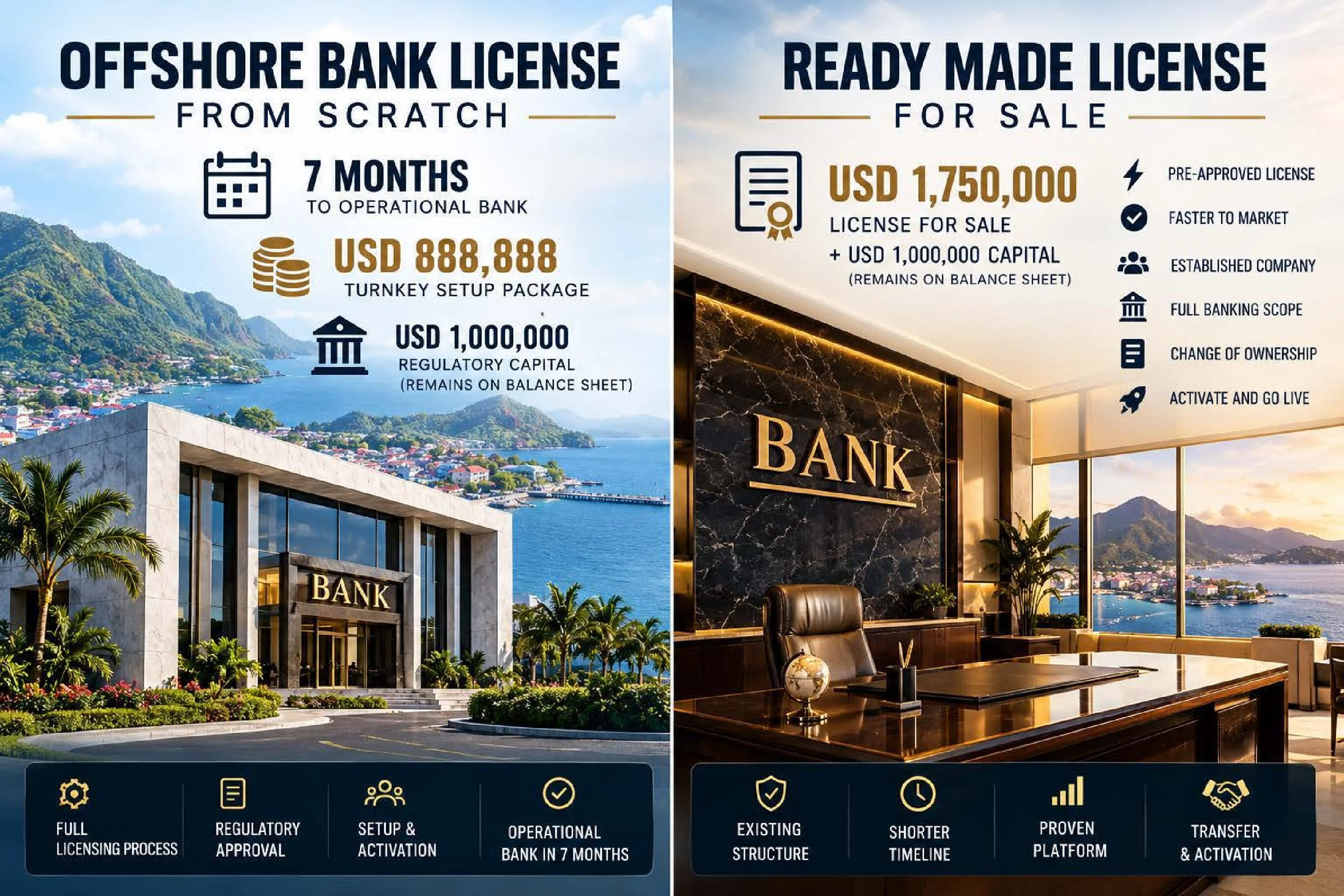
If that is not you, there are cheaper doors. For an international bank with a smaller capital requirement, Dominica is a serious alternative, and we currently have an offshore bank in Dominica for sale, ready to launch. For payments and accounts in Europe, an EMI may be all you need: see our EMI licence guide. And before you buy any offshore licence, read Comoros fake regulators, Gambia fake offshore licences.
How we help
We help you decide whether Puerto Rico is the right place, then carry the project through: the business plan, the IFE application and tax decree, the compliance set-up, and the search for banking partners. If Puerto Rico is not the right fit, we will tell you before you spend a dollar, and show you the route that is. Write to us at insight@fintechlex.com.
If you are planning to buy or set up a bank, see our banking licence acquisition and formation service.
Sources: Act 273-2012 (International Financial Center Regulatory Act), as amended by Act 44-2024; Act 45-2024; OCIF Puerto Rico; US Treasury, National Money Laundering Risk Assessments 2022 and 2024; FinCEN, enforcement action against Bancrédito International (2023); McConnell Valdés, client alert on the 2024 IBE/IFE reform.
This article is for general information only and does not constitute legal or tax advice.