Your Stablecoin Is Global. Its Reserves Are Not: The USDT Case and the USDT reserves.A stablecoin is sold as money without borders. You can send it from Bangkok to Zurich on a Sunday night and it arrives in seconds. Nobody asks about your bank’s opening hours.
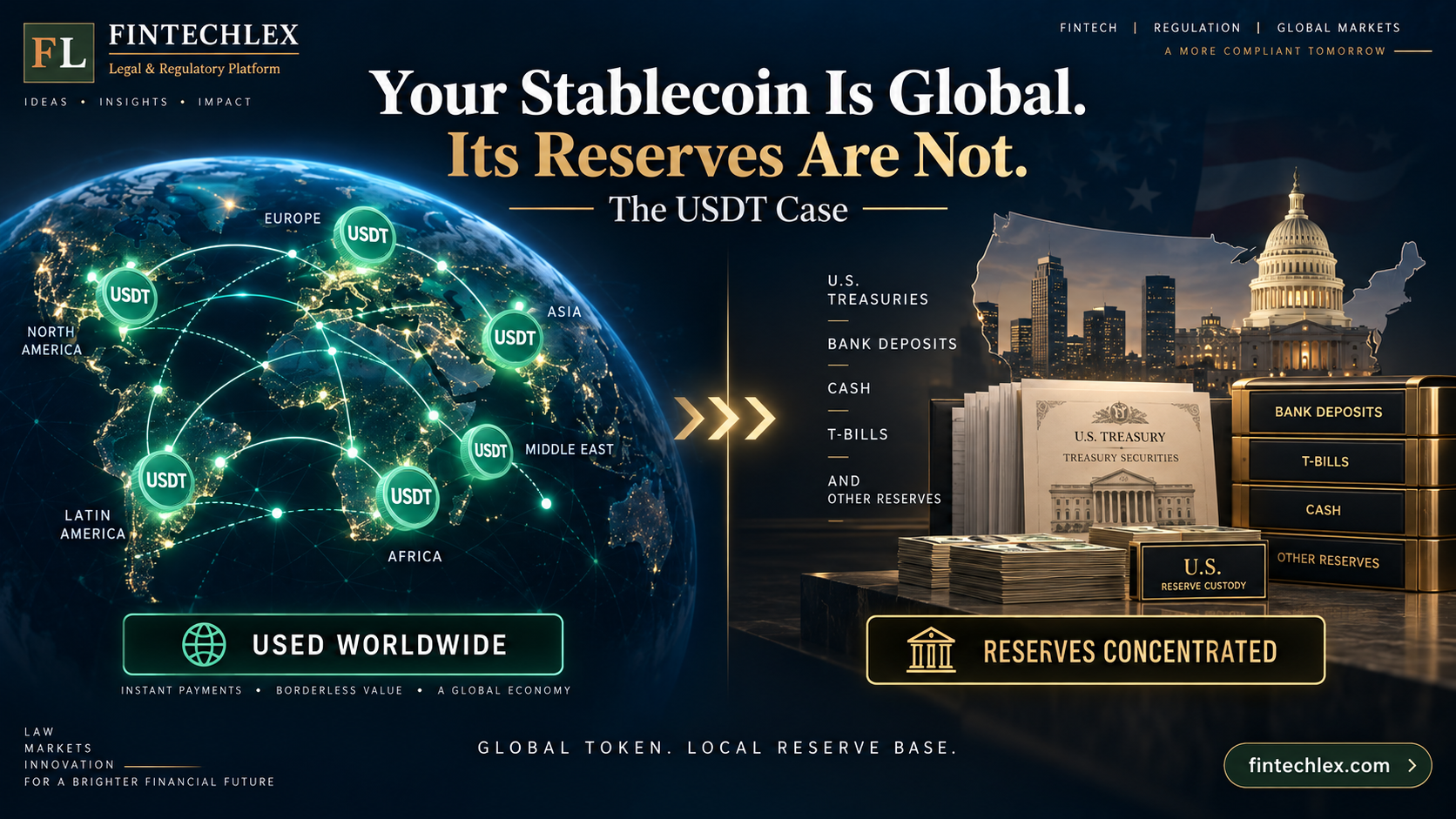
But a stablecoin is only a promise, and the money behind the promise does not travel. The USDT reserves, like those of any stablecoin, sit somewhere: with a bank or a broker, in one country, under that country’s law. The token is global. The backing is local. Nobody tells you that when you buy it.
Let us be clear from the start: we are not saying Tether does not have its reserves. The published figures say it does. The question is a different one: where does the money sit, whose law reaches it, and what can you, the holder, actually do with your token? USDT, the biggest stablecoin of them all, is the best case study there is.
One coin, five jurisdictions
- The issuer is Tether International, S.A. de C.V., in El Salvador. It moved there from the British Virgin Islands in January 2025.
- The contract you accept when you deal with Tether is governed by the law of the British Virgin Islands (terms of 26 February 2026).
- Disputes go to confidential, individual arbitration – no class action – with London as the default seat.
- The money is mostly US Treasury bills, about $115 billion of them, a large share held through Cantor Fitzgerald in New York, which also owns about 5% of Tether.
- The figures are checked once a quarter by BDO’s Italian firm.
- The holder is anywhere: Lagos, Istanbul, Buenos Aires, Bangkok.
So if something goes wrong, you are a holder in Bangkok, with a contract under British Virgin Islands law, against a company in San Salvador, arguing in London about money sitting in New York. Good luck with that.
What actually backs one USDT
Here is what Tether reported at 30 June 2026, as attested by BDO:
| Reserve asset | USD billions |
|---|---|
| US Treasury bills | 114.96 |
| Reverse repurchase agreements | 25.62 |
| Physical gold (146 tonnes) | 18.84 |
| Secured loans | 13.45 |
| Bitcoin | 5.80 |
| Other investments and listed shares | 9.08 |
| Total assets | 187.75 |
| Total liabilities | 183.64 |
| Excess reserves (the cushion) | 4.11 |
Two things jump out.
First, the cushion is thin. $4.11 billion on $183.6 billion of liabilities is about 2.2%. Three months earlier, at 31 March, it was $8.23 billion. It was cut in half in one quarter – the same quarter in which Tether announced $1.5 billion of net operating profit.
Both figures can be true. Operating profit leaves out the revaluation of gold, bitcoin and the rest. Tether’s own equity table shows a financial result of minus $3.17 billion for the first half of 2026, partly offset by $0.94 billion of fresh capital. The lesson is an old one: read the balance sheet, not the press release.
How thin is 2.2%? For illustration only: if gold fell 10%, bitcoin 30% and listed shares 20%, the loss would be about $4.4 billion – more than the whole cushion. This ignores income and any hedging, and it is not a forecast. It simply shows how little room there is.
Second, about a quarter of the reserves is not cash or Treasuries. Gold, bitcoin, secured loans, shares and other investments add up to some $47 billion. And Tether’s own terms state that the reserves “may include loan receivables and other assets from Affiliates”. That does not mean they do. It means nothing stops them.
Where the money sits decides whose law applies
A coin used mostly outside the United States is backed mostly by assets inside it. US Treasury bills held through a New York broker are within reach of US courts, the US Treasury and US sanctions. Whatever happens in San Salvador, the real pressure point is New York.
And the controls do not stop at the reserves. Tether can freeze the tokens themselves, even in a wallet you control yourself. In 2026 alone, it says it froze more than $344 million in April and more than $130 million in July, in wallets linked to Iran’s central bank – and more than $4.9 billion in total across all cases. This time the targets were sanctioned parties. But the same switch works on any wallet: holding the private key is not the same as holding the money.
Washington is watching. On 28 September 2026, Democratic staff of the Senate Permanent Subcommittee on Investigations published a report, “Tethered to Terrorism”, criticising Tether’s sanctions controls and its links with Cantor Fitzgerald. It is an investigation, not a court ruling. But it tells you where the next pressure will come from.
Can you actually get your dollar back?
“One USDT, one dollar” sounds simple. Here is what direct redemption with Tether actually requires, according to its own fee page:
- a verified customer account, with a $150 verification fee;
- a minimum of $100,000 per redemption;
- a fee of $1,000 or 0.1%, whichever is greater.
The terms also let Tether delay or suspend redemptions at its discretion. So if you hold $5,000 of USDT, you will never see Tether. Your exit is an exchange, a broker or a market maker – and you take whatever price they give you on the day.
And promises can be withdrawn. Since 1 September 2025, Tether no longer redeems USDT issued on five older blockchains: Omni, Bitcoin Cash SLP, Kusama, EOS and Algorand. The tokens still exist. The promise behind them is gone.
Europe closes the door. Switzerland does not – yet
USDT has no authorisation under the EU’s crypto regulation, MiCA. On 8 October 2026, the European Securities and Markets Authority (ESMA) told European crypto providers to stop all services in non-MiCA stablecoins for EU clients – trading, custody, transfers, advice, the lot – and to clear remaining positions within three months, that is by 8 January 2027. Coinbase went faster: its customers in the European Economic Area must withdraw their USDT by 30 October 2026, or it is converted into USDC.
Switzerland is not in the EU and not bound by MiCA, so Swiss providers can still offer USDT. But a Swiss firm cannot go out and market USDT services to EU clients: MiCA only tolerates genuine reverse solicitation, where the client comes to you on his own. We cover this in Stablecoins Across the Swiss–EU Border: USDT and USDC Coming In, Swiss Coins Going Out.
What Switzerland plans instead
Compare this with the model Switzerland is preparing. Under the draft reform put out for consultation by the Federal Council in October 2025, only a Swiss payment instrument institution, licensed and supervised by FINMA, could issue a Swiss stablecoin tied to a single currency. The client funds it receives would be segregated if the institution fails. Holders would have a legal right to redemption. And the issuer would have to publish a white paper.
One issuer, one supervisor, one law. It is still a draft and the details may change, but it is the opposite of the five-jurisdiction structure above. We explain the new licences in Switzerland’s Two New Licences.
To be fair to Tether
Things have improved. In August 2026, KPMG U.S. issued a clean opinion on Tether International’s 2025 accounts – the first full audit in the company’s history. Tether also launched a separate coin for the American market, USA₮, issued through Anchorage Digital Bank under the US GENIUS Act. Which tells you, by the way, that USDT itself is staying offshore.
But S&P Global still rates USDT’s ability to hold its peg at 5 out of 5, “weak”, its lowest score, since November 2025 – citing riskier reserves and gaps in what Tether discloses about its custodians. That is not a credit rating and not a forecast of failure. It is a professional saying the backing is less solid than the slogan.
If you are planning a stablecoin
USDT is a giant, and giants can afford to live with these questions. A new issuer cannot. If you are planning your own coin, here is what we tell our clients:
- Choose where the reserves sit as carefully as where the company sits. The holder’s protection is only as good as the law where the money is.
- Match the reserves to your market. The new regimes increasingly dictate where and with whom reserves must be held. A coin sold in Europe with reserves in Bangkok will have a problem.
- Name your custodians and keep a real cushion. Opacity costs you ratings, listings and, in the end, clients.
- Put the coin in its own company. If the platform is hacked or the coin runs into trouble, the rest of your group should not go down with it.
A stablecoin is a promise. Before you buy one – or issue one – find out where the promise lives.
Planning a stablecoin, or the licence behind it? Write to insight@fintechlex.com.
Read the full series on stablecoins and the new licences:
- Why a Swiss Franc Stablecoin Is a Hard Business: The Zero-Rate Problem
- Switzerland vs the EU: Which Swiss Licence Matches Which European Licence?
- EMI, MiCA and Stablecoin Licences in Europe: Three Regimes, and What PSD3 Changes
- Stablecoins: When Even a Bank Needs a Separately Licensed Subsidiary
- Stablecoins Across the Swiss–EU Border: USDT and USDC Coming In, Swiss Coins Going Out (companion post)
Sources: Tether International, BDO assurance reports at 31 March and 30 June 2026; Tether terms of service (26 February 2026) and fee schedule; Tether announcement of the KPMG audit (13 August 2026); ESMA opinion of 8 October 2026; Coinbase notice to EEA customers; S&P Global Ratings stablecoin assessment (26 November 2025); US Senate Permanent Subcommittee on Investigations, minority staff report (28 September 2026); Tether statements on wallet freezes (2026); Tether notice on legacy blockchains (2025); Swiss Federal Department of Finance, fact sheet on stablecoins (October 2025). General information, not legal advice.