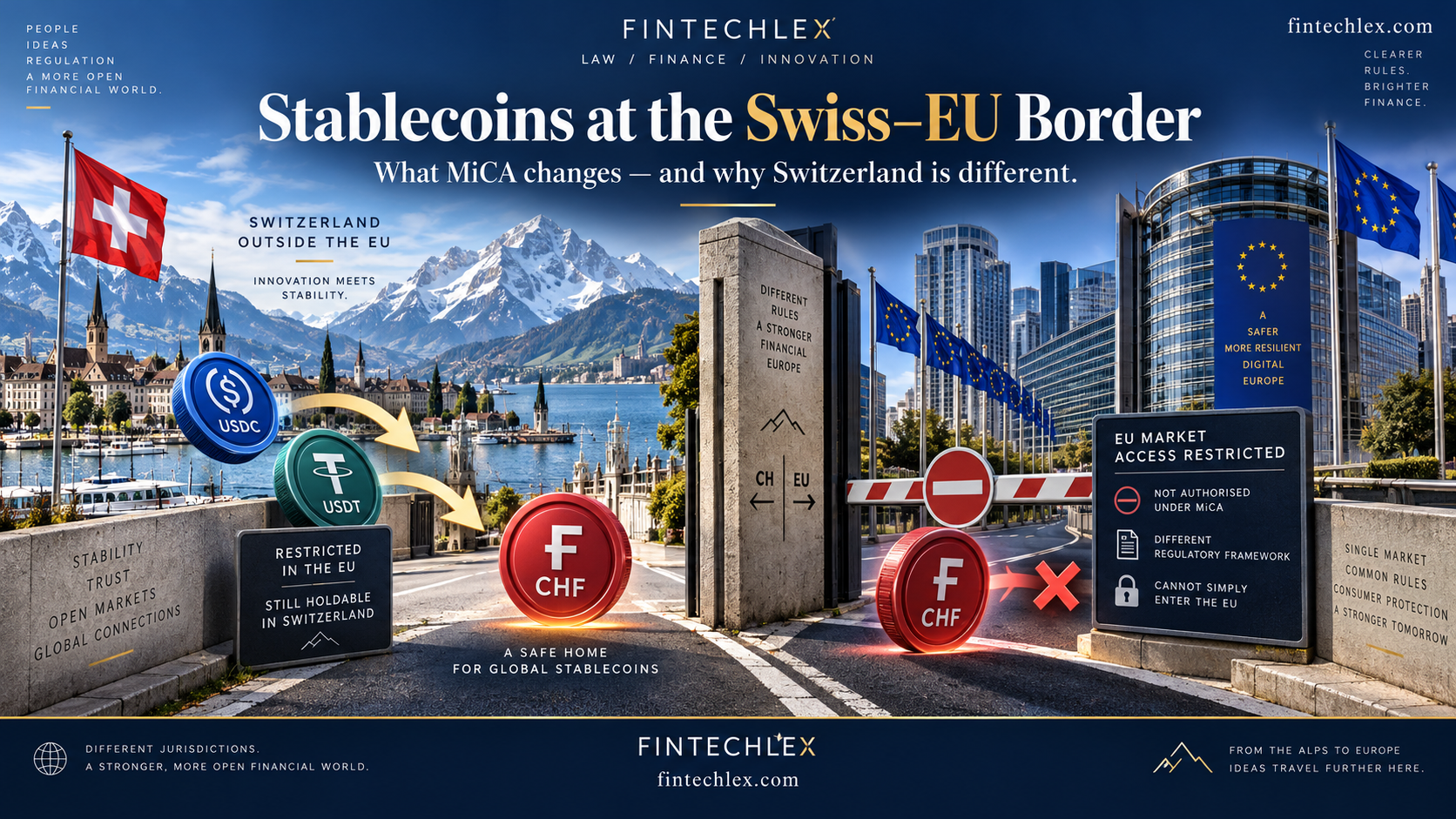
Switzerland sits in the middle of Europe, but not in the European Union. For most businesses that is a detail. For stablecoins, it is the whole story.
Since MiCA, the EU’s crypto regulation, the Union has decided which stablecoins may be offered and traded inside its borders. Switzerland has not followed – at least not yet. The result is a border that works in both directions: some coins are being pushed out of the EU and can still be held in Switzerland, while a Swiss coin cannot simply walk into the EU. Here is how it works, and what it means for your business.
1. The EU side: one licence, or the door
Under MiCA, a stablecoin tied to one official currency is an e-money token. Nobody may offer it to the public or have it admitted to trading in the EU unless the issuer is authorised there, as a bank or as an electronic money institution (Article 48 MiCA). No authorisation, no market.
That is the line that splits the two big dollar coins:
- USDC: Circle holds an electronic money institution licence in France, so USDC is MiCA-compliant and can circulate on EU platforms.
- USDT: Tether has not sought MiCA authorisation. EU platforms have been delisting it since 2025.
On 8 October 2026, the European Securities and Markets Authority (ESMA) went a step further. Authorised crypto providers must stop all services in non-MiCA stablecoins for EU clients – trading, exchange, custody, transfers, advice, portfolio management – and clear remaining positions within three months, that is by 8 January 2027. Only wind-down services remain: withdrawal, conversion, liquidation. Coinbase did not wait: customers in the European Economic Area must withdraw their USDT by 30 October 2026, or it is converted into USDC.
One point people miss: MiCA regulates issuers and service providers, not holders. An EU resident who keeps USDT in his own wallet is not breaking the law. He just has nobody regulated left to deal with.
2. USDT and USDC coming into Switzerland
Switzerland is not bound by MiCA, and Swiss law does not ban USDT. Today, a Swiss company that holds, exchanges or transfers stablecoins for clients is a financial intermediary under the Anti-Money Laundering Act. In practice, that means affiliation with a self-regulatory organisation (SRO) – or a FINMA licence for bank-type activities. So a Swiss provider can still offer USDT, and many do.
This is set to change. The reform the Federal Council put out for consultation in October 2025 (not yet before Parliament) creates two new licences: a payment instrument institution licence for issuers of Swiss stablecoins, and a crypto institution licence for crypto service providers. Under the draft, a foreign stablecoin such as USDT or USDC is treated as a crypto-asset. A Swiss firm that holds or trades it for clients would then need the crypto institution licence – an SRO affiliation would no longer be enough. We explain the split in Switzerland’s Two New Licences.
So for now Switzerland is open, under the SRO regime. Under the reform it stays open, but at the price of a FINMA licence.
3. The trap: serving EU clients from Switzerland
This is where Swiss firms get it wrong. Being outside MiCA does not mean you may serve EU clients as you please. A non-EU firm may only provide crypto services to a client in the EU if the client came to it on his own exclusive initiative – reverse solicitation, Article 61 MiCA. And the exception is narrow:
- no marketing, advertising or targeted campaigns towards EU clients, directly or through third parties;
- it covers the service the client asked for, not a general open door to sell him more;
- EU supervisors read it strictly, and ESMA has said so publicly.
In plain words: a Swiss platform that offers USDT to its own clients is fine. A Swiss platform that runs Google ads in Germany offering USDT to Germans is asking for trouble – now more than ever, since EU providers themselves have to drop the coin.
4. Swiss coins going out
Now the other direction. Suppose you issue a Swiss franc stablecoin from Switzerland. Demand is there: the franc is a safe-haven currency, and a properly licensed franc coin should sell very well. But you cannot offer it to the public in the EU, or list it on an EU platform, unless the issuer is an authorised EU bank or electronic money institution. A Swiss status – today an SRO affiliation with a Swiss bank guarantee, tomorrow a payment instrument institution licence – does not count in the EU. There is no passport between Switzerland and the EU for this.
The market has already drawn the conclusion. In February 2026, AllUnity, a joint venture of DWS, Flow Traders and Galaxy, announced CHFAU, a franc-denominated e-money token issued under MiCA – from Germany. A franc coin, built in the EU, to be sold in the EU.
So if you want to reach both markets, you have three options:
| Option | What it means | Trade-off |
|---|---|---|
| Swiss issuer only | Swiss status, Swiss clients, EU clients only on reverse solicitation | Cheapest; the EU market stays closed for the rest |
| EU issuer only | Electronic money institution in an EU country, MiCA rules for e-money tokens | Opens 27 countries; Switzerland treats it as a foreign coin |
| Both | Swiss issuer plus an EU subsidiary issuing its own token | Full access; two licences, two reserves, two supervisors |
For the EU route, you do not have to start from zero. Applying for an electronic money institution licence takes many months; buying one that is already authorised and operating can be much faster. We currently have one on offer: EMI Licence for Sale: A Live EU E-Money Institution. On the Swiss side, the same logic applies to Swiss SRO companies for sale.
Whichever you choose, put the issuing activity in its own company. If the platform is hacked or the coin runs into trouble, the rest of your group should not sink with it.
What this means for you
- If you run a Swiss crypto business: USDT is still yours to offer, but keep your hands off EU marketing, and budget for the crypto institution licence the reform will bring.
- If you are an EU business holding USDT: your providers will force a conversion or a withdrawal by 8 January 2027 at the latest. Plan it rather than suffer it.
- If you plan a stablecoin: decide first where you want to sell it. That decides where the issuer must sit – and where the reserves should sit. For why the second question matters as much as the first, read Your Stablecoin Is Global. Its Reserves Are Not: The USDT Case.
Frequently asked questions
Is USDT legal in Switzerland?
Yes. Swiss law does not ban it. A Swiss company that exchanges, transfers or holds USDT for clients must comply with the Anti-Money Laundering Act, today usually through affiliation with an SRO. Under the draft reform, holding or trading it for clients would require the new FINMA crypto institution licence.
Can EU residents still hold USDT?
Yes. MiCA regulates issuers and service providers, not holders. But authorised EU crypto providers must stop serving clients in USDT by 8 January 2027, and some are leaving sooner: Coinbase on 30 October 2026.
Can a Swiss franc stablecoin be sold in the EU?
Not by a Swiss issuer on its own. To offer it to the public or list it on an EU platform, the issuer must be a bank or electronic money institution authorised in the EU. A Swiss issuer can serve EU clients only when they come to it on their own initiative.
Can a Swiss platform offer USDT to EU clients?
Only on genuine reverse solicitation: the client must approach the platform on his own exclusive initiative. Marketing to EU clients, directly or through third parties, takes the platform outside the exception.
Planning a stablecoin, or the licence behind it, on either side of the border? Write to insight@fintechlex.com.
Read the full series on stablecoins and the new licences:
- Why a Swiss Franc Stablecoin Is a Hard Business: The Zero-Rate Problem
- Switzerland vs the EU: Which Swiss Licence Matches Which European Licence?
- EMI, MiCA and Stablecoin Licences in Europe: Three Regimes, and What PSD3 Changes
- Stablecoins: When Even a Bank Needs a Separately Licensed Subsidiary
- Your Stablecoin Is Global. Its Reserves Are Not: The USDT Case (companion post)
Sources: Regulation (EU) 2023/1114 (MiCA), Articles 48 and 61; ESMA opinion of 8 October 2026 on services in non-MiCA-compliant stablecoins; Coinbase notice to EEA customers (October 2026); Federal Council consultation draft of 22 October 2025 amending the Financial Institutions Act; Anti-Money Laundering Act; FINMA Guidance 06/2024 on stablecoins; AllUnity announcement of 2 February 2026. General information, not legal advice.